Close Menu
  • Home
  • UNSUBSCRIBE
  • News
  • Lifestyle
  • Tech
  • Entertainment
  • Sports
  • Travel
Facebook X (Twitter) WhatsApp
Trending
  • Socotra Archipelago: The Yemeni islands covered with astonishing cucumber, bottle and dragon’s blood trees
  • The US government wants to mine more lithium, but there may not be enough water to do it, study finds
  • NASA’s Perseverance rover finds record-breaking trove of carbon molecules at Bright Angel rock formation on Mars
  • Some of the last surviving Neanderthals were remarkably diverse ‪—‬ suggesting inbreeding didn’t doom them
  • 'This is the next jump in technology': World's first sub-1nm chip keeps Moore's Law alive a little longer
  • Scientists find thousands of earthquakes in a perfectly straight line in Alaska, revealing a hidden ‘microplate’
  • ‘You can’t patch your way out of it’: Cheap AI worm can spread between devices without human guidance — but how did scientists create it?
  • Diagnostic dilemma: After taking a medicine for years, a man suddenly had weird changes in his taste that made food disgusting
Facebook X (Twitter) WhatsApp
Baynard Media
  • Home
  • UNSUBSCRIBE
  • News
  • Lifestyle
  • Tech
  • Entertainment
  • Sports
  • Travel
Baynard Media
Home»Lifestyle»Scientists watch a single electron move during a chemical reaction for first time ever
Lifestyle

Scientists watch a single electron move during a chemical reaction for first time ever

EditorBy EditorAugust 29, 2025No Comments4 Mins Read
Share Facebook Twitter Pinterest LinkedIn Tumblr Reddit Telegram Email
Share
Facebook Twitter LinkedIn Pinterest Email

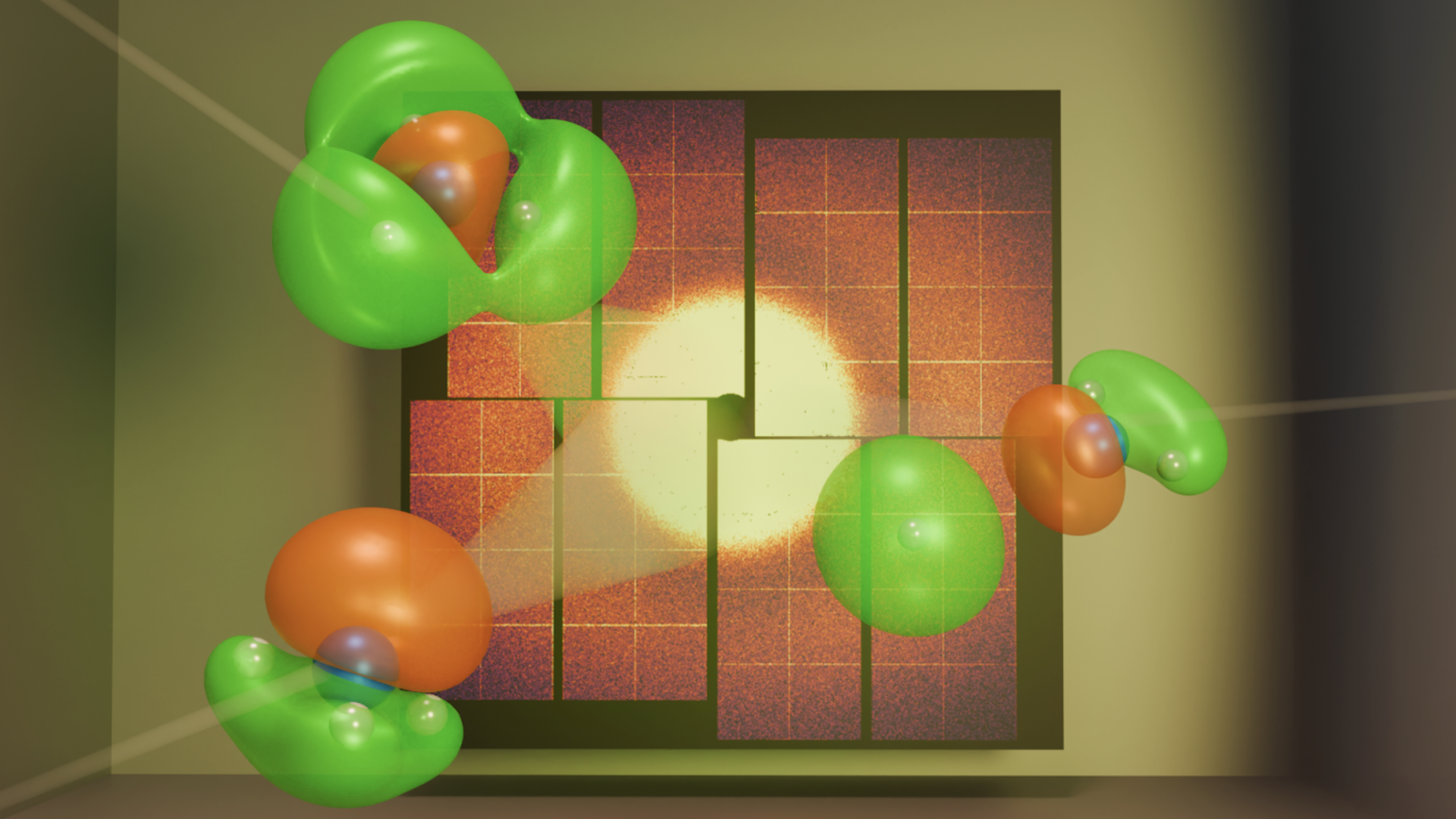
For the first time, scientists have used ultrafast X-ray flashes to take a direct image of a single electron as it moved during a chemical reaction.

In the new study, published Aug. 20 in the journal Physical Review Letters, the researchers accomplished this incredible feat by imaging how a valence electron — an electron in the outer shell of an atom — moved when an ammonia molecule broke apart.

For decades, scientists have used ultrafast X-ray scattering to image atoms and their chemical reactions. The scattering uses supershort bursts of X-rays to freeze tiny, fast-moving molecules in action. X-rays have the perfect wavelength range for capturing details at the atomic scale, which is why they’re ideal for imaging molecules.


You may like

However, X-rays interact strongly only with core electrons near the atom’s nucleus. Valence electrons — the outermost electrons in an atom and the ones actually responsible for the chemical reactions — were hidden.

“We wanted to take pictures of the actual electrons that are driving that motion,” Ian Gabalski, a physics doctoral student and lead author of the study, told Live Science.

If scientists can understand how valence electrons move during chemical reactions, it could help them design better drugs, cleaner chemical processes, and more efficient materials, Gabalski said.

To get started, the team needed to find the right molecule. It turned out to be ammonia.

Get the world’s most fascinating discoveries delivered straight to your inbox.

“Ammonia is kind of special,” Gabalski said. “Because it has mostly light atoms, there aren’t a lot of core electrons to drown out the signal from the outer ones. So we had a shot at actually seeing that valence electron.”

a 3D illustration of an atom's structure

An illustration of an atom with valence electrons moving in different orbitals. (Image credit: KTSDesign/SCIENCEPHOTOLIBRARY via Getty Images)

The experiment was conducted at the SLAC National Accelerator Laboratory’s Linac Coherent Light Source, a facility that produces intense, short X-ray pulses. First, the team gave the ammonia molecule a tiny jolt of ultraviolet light, which made one of the electrons “jump” to a higher energy level. Electrons in molecules usually stay in low-energy states, and if they are pushed to a higher one, it triggers a chemical reaction. Then, with the X-ray beam, the researchers recorded how the electron’s “cloud” shifted as the molecule began to break apart.

Related: The shape of light: Scientists reveal image of an individual photon for 1st time ever

In quantum physics, electrons aren’t seen as tiny balls orbiting the nucleus. Instead, they exist as probability clouds, “where higher density means you’re more likely to see the electron,” Gabalski explained. These clouds are also known as orbitals, and each one has a distinct shape depending on the energy and position of the electron.

To map this electron cloud, the team ran quantum mechanical simulations to calculate the molecule’s electronic structure. “So now this program that we use for these kinds of calculations goes and it figures out where the electrons are filling up those orbitals around the molecule,” Gabalski said.

The X-rays themselves act like waves, and when they pass through the electron’s probability cloud, they scatter in different directions. “But then those X-rays can go and interfere with each other,” Gabalski said. By measuring this interference pattern, the team reconstructed an image of the electron’s orbital and saw how the electron moved during the reaction.

They compared the results to two theoretical models: one that included valence electron motion, and one that didn’t. The data matched the first model, confirming that they had captured the electron’s rearrangement in action.

The researchers hope to adapt the system for use in more complex, 3D environments that better mimic real tissues. That would move it closer to applications in regenerative medicine, such as growing or repairing tissue on demand.

Source link

Share. Facebook Twitter Pinterest LinkedIn Tumblr Email
Previous ArticleTommy DeVito joins Patriots with frozen cutlets from mom after Giants cut
Next Article Conservative Wisconsin Supreme Court Justice Rebecca Bradley won’t run for re-election
Editor
  • Website

Related Posts

Lifestyle

Socotra Archipelago: The Yemeni islands covered with astonishing cucumber, bottle and dragon’s blood trees

June 26, 2026
Lifestyle

The US government wants to mine more lithium, but there may not be enough water to do it, study finds

June 26, 2026
Lifestyle

NASA’s Perseverance rover finds record-breaking trove of carbon molecules at Bright Angel rock formation on Mars

June 25, 2026
Add A Comment

Comments are closed.

Categories
  • Entertainment
  • Lifestyle
  • News
  • Sports
  • Tech
  • Travel
Recent Posts
  • Socotra Archipelago: The Yemeni islands covered with astonishing cucumber, bottle and dragon’s blood trees
  • The US government wants to mine more lithium, but there may not be enough water to do it, study finds
  • NASA’s Perseverance rover finds record-breaking trove of carbon molecules at Bright Angel rock formation on Mars
  • Some of the last surviving Neanderthals were remarkably diverse ‪—‬ suggesting inbreeding didn’t doom them
  • 'This is the next jump in technology': World's first sub-1nm chip keeps Moore's Law alive a little longer
calendar
June 2026
M T W T F S S
1234567
891011121314
15161718192021
22232425262728
2930  
« May    
Recent Posts
  • Socotra Archipelago: The Yemeni islands covered with astonishing cucumber, bottle and dragon’s blood trees
  • The US government wants to mine more lithium, but there may not be enough water to do it, study finds
  • NASA’s Perseverance rover finds record-breaking trove of carbon molecules at Bright Angel rock formation on Mars
About

Welcome to Baynard Media, your trusted source for a diverse range of news and insights. We are committed to delivering timely, reliable, and thought-provoking content that keeps you informed
and inspired

Categories
  • Entertainment
  • Lifestyle
  • News
  • Sports
  • Tech
  • Travel
Facebook X (Twitter) Pinterest WhatsApp
  • Contact Us
  • About Us
  • Privacy Policy
  • Disclaimer
  • UNSUBSCRIBE
© 2026 copyrights reserved

Type above and press Enter to search. Press Esc to cancel.