Close Menu
  • Home
  • UNSUBSCRIBE
  • News
  • Lifestyle
  • Tech
  • Entertainment
  • Sports
  • Travel
Facebook X (Twitter) WhatsApp
Trending
  • Don Juan Pond: Antarctica’s salty, syrupy lake that never freezes, even when it’s minus 58 F
  • Withings ScanWatch 2 review: Style meets next-level health monitoring
  • AI Chatbots are turbo-charging violence against women and girls: We urgently need to regulate them | Yvonne McDermott Rees
  • ‘The biggest El Niño event since the 1870s’: ‘Super’ El Niño is now the most likely scenario by the end of this year ‪—‬ and the humanitarian cost could be huge
  • Antarctica’s sudden sea ice loss is one of the most extreme and confusing events in the modern climate record. Scientists now know why it’s happening.
  • ‘I heard gasps’: Artemis II astronauts reveal inside story of their mind-bending solar eclipse
  • A pill can stop people from developing COVID after being exposed to the virus, trial finds
  • ‘There are 4 people in those pixels’: Earth-based telescope snapped Artemis II crew orbiting the moon
Facebook X (Twitter) WhatsApp
Baynard Media
  • Home
  • UNSUBSCRIBE
  • News
  • Lifestyle
  • Tech
  • Entertainment
  • Sports
  • Travel
Baynard Media
Home»Lifestyle»Scientists may have discovered the most powerful particle accelerator in the universe — and the Large Hadron Collider has its work cut out for it
Lifestyle

Scientists may have discovered the most powerful particle accelerator in the universe — and the Large Hadron Collider has its work cut out for it

EditorBy EditorMay 25, 2025No Comments3 Mins Read
Share Facebook Twitter Pinterest LinkedIn Tumblr Reddit Telegram Email
Share
Facebook Twitter LinkedIn Pinterest Email

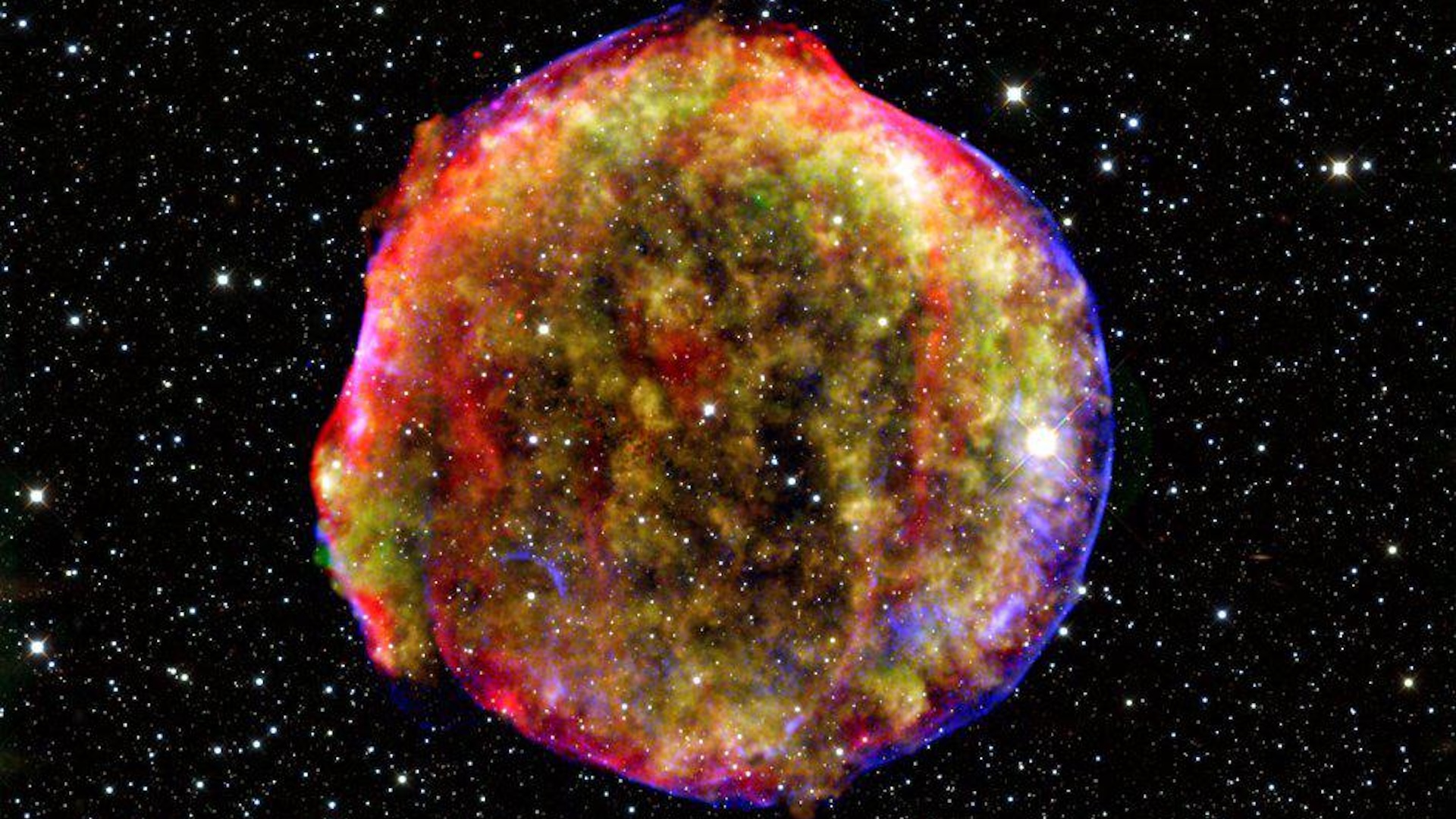
Supernovas can become some of the most powerful particle colliders in the universe — but only if they pass a whole lot of gas before they explode, new research finds.

For almost a century, astronomers have detected high-energy particles streaming in from the distant universe. Known as cosmic rays, they are made primarily of protons and, occasionally, nuclei of heavier elements. Most cosmic rays are deflected by Earth’s magnetic field or are absorbed in the upper atmosphere, but some make it all the way to the surface. Roughly once every second, a cosmic ray manages to strike your body.

The cosmic rays span a broad range of energies, with the most powerful ones topping one peta-electron volt (PeV). That’s one quadrillion electron volts, or up to a thousand times more powerful than the collision energies of the Large Hadron Collider, the world’s most powerful atom smasher.


You may like

Astronomers have long suspected that the explosive deaths of massive stars may be responsible for these extremely powerful cosmic rays. After all, these supernovas have all the right ingredients: There is a detonation with more than enough energy, a flood of elementary particles, and magnetic fields that can drive those particles into a frenzy before releasing them into the cosmos.

But observations of nearby supernova remnants such as Tycho and Cassiopeia A have not met expectations; the cosmic rays coming from those places are far weaker than expected.

In a paper accepted for publication in the journal Astronomy & Astrophysics, researchers have rescued the supernova hypothesis and found that, in special cases, supernova remnants are indeed capable of becoming “PeVatrons” — that is, explosions capable of generating PeV cosmic rays.

Related: World’s largest atom smasher turned lead into gold — and then destroyed it in an instant

Get the world’s most fascinating discoveries delivered straight to your inbox.

The team found that, before going supernova, a star must lose a significant amount of mass — at least two suns’ worth of material. This is fairly common, as powerful winds can drive off the outer layers of a star’s atmosphere prior to the main explosion. But crucially, that material can’t disperse too widely. It has to stay dense, compact and close to the star.

Then, when the supernova finally happens, the shock wave from the exploding star slams into this shell of material. And then all hell breaks loose.

As the shock travels through the surrounding shell, magnetic fields ramp up to incredibly powerful energies. These magnetic fields take any random subatomic particles — the debris in the shell — and accelerate them, bouncing them back and forth within the shock wave. With every bounce, the particle gains more energy. Finally, it gets enough energy to leave the chaos altogether and stream into the universe.

But within a few months, the system loses steam as the shock wave slows down. It still produces abundant cosmic rays, but not above the PeV threshold.

This scenario explains why we haven’t directly observed any active PeVatrons. Even though a supernova goes off in the Milky Way every few years, none have been close enough in modern times for us to observe the short window when they can accelerate cosmic rays to these extreme energies. So we’ll just have to be patient.

Source link

Share. Facebook Twitter Pinterest LinkedIn Tumblr Email
Previous ArticleHow long can human sperm survive?
Next Article US Representatives worry Trump’s NASA budget plan will make it harder to track dangerous asteroids
Editor
  • Website

Related Posts

Lifestyle

Don Juan Pond: Antarctica’s salty, syrupy lake that never freezes, even when it’s minus 58 F

May 16, 2026
Lifestyle

Withings ScanWatch 2 review: Style meets next-level health monitoring

May 15, 2026
Lifestyle

AI Chatbots are turbo-charging violence against women and girls: We urgently need to regulate them | Yvonne McDermott Rees

May 15, 2026
Add A Comment

Comments are closed.

Categories
  • Entertainment
  • Lifestyle
  • News
  • Sports
  • Tech
  • Travel
Recent Posts
  • Don Juan Pond: Antarctica’s salty, syrupy lake that never freezes, even when it’s minus 58 F
  • Withings ScanWatch 2 review: Style meets next-level health monitoring
  • AI Chatbots are turbo-charging violence against women and girls: We urgently need to regulate them | Yvonne McDermott Rees
  • ‘The biggest El Niño event since the 1870s’: ‘Super’ El Niño is now the most likely scenario by the end of this year ‪—‬ and the humanitarian cost could be huge
  • Antarctica’s sudden sea ice loss is one of the most extreme and confusing events in the modern climate record. Scientists now know why it’s happening.
calendar
May 2026
M T W T F S S
 123
45678910
11121314151617
18192021222324
25262728293031
« Apr    
Recent Posts
  • Don Juan Pond: Antarctica’s salty, syrupy lake that never freezes, even when it’s minus 58 F
  • Withings ScanWatch 2 review: Style meets next-level health monitoring
  • AI Chatbots are turbo-charging violence against women and girls: We urgently need to regulate them | Yvonne McDermott Rees
About

Welcome to Baynard Media, your trusted source for a diverse range of news and insights. We are committed to delivering timely, reliable, and thought-provoking content that keeps you informed
and inspired

Categories
  • Entertainment
  • Lifestyle
  • News
  • Sports
  • Tech
  • Travel
Facebook X (Twitter) Pinterest WhatsApp
  • Contact Us
  • About Us
  • Privacy Policy
  • Disclaimer
  • UNSUBSCRIBE
© 2026 copyrights reserved

Type above and press Enter to search. Press Esc to cancel.