Close Menu
  • Home
  • UNSUBSCRIBE
  • News
  • Lifestyle
  • Tech
  • Entertainment
  • Sports
  • Travel
Facebook X (Twitter) WhatsApp
Trending
  • New robotic heart mimics common, mysterious condition to help researchers study it
  • Canon EOS R6 III review: A wildlife wonder
  • Medieval babies and adults buried together in Sweden were not related, archaeologists discover — raising big questions about early Christian burial practices
  • NASA is creating a fifth state of matter on the ISS, thanks to an upgrade to a mini-fridge-sized quantum lab
  • New sodium metal battery design charges in just 4 minutes and retains its capacity for years
  • Quantum computing wielded to create extremely rare material critical to nuclear fusion
  • Scientists build tiny ‘diving suit’ for cockroaches, turning them into search-and-rescue cyborgs
  • Physicists develop the first working model of quantum mechanics using only ‘real’ numbers
Facebook X (Twitter) WhatsApp
Baynard Media
  • Home
  • UNSUBSCRIBE
  • News
  • Lifestyle
  • Tech
  • Entertainment
  • Sports
  • Travel
Baynard Media
Home»Lifestyle»Scientists have finally made an elusive meteorite diamond, predicted to be 50% harder than Earth diamonds
Lifestyle

Scientists have finally made an elusive meteorite diamond, predicted to be 50% harder than Earth diamonds

EditorBy EditorAugust 16, 2025No Comments4 Mins Read
Share Facebook Twitter Pinterest LinkedIn Tumblr Reddit Telegram Email
Share
Facebook Twitter LinkedIn Pinterest Email

Scientists have created the first sizable meteorite diamond — also known as lonsdaleite or hexagonal diamond — a material predicted to be even harder than the diamonds normally found on Earth.

The high-pressure, high-temperature technique created tiny disks of this ultrahard diamond which could ultimately replace conventional diamonds in applications such as drilling tools and electronics, the scientists reported July 30 in the journal Nature.

Diamonds hold the record for the world’s hardest naturally occurring substance. Each carbon atom in the infinitely repeating molecular structure forms four equal-length bonds to other carbon atoms, each separated by a 109.5 degree angle, to create an endless array of perfect tetrahedra. Viewed from the side, this structure appears to contain three repeating layers of carbon atoms (labeled A, B, and C), and this gives diamond what crystallographers call a face-centered cubic crystal structure.


You may like

In the 1960s, however, a subtly different structure of diamond was proposed, with small impure crystals of this structure subsequently discovered in the Canyon Diablo meteorite, which crashed in the Arizona desert around 50,000 years ago.

Unlike in cubic diamond, this form contains two different bond lengths — one slightly longer than in normal diamond and one slightly shorter. The carbon atoms are still organized into endless planes of tetrahedra. But this time, when viewed from the side, the structure contains only two repeating layers (labeled A and B). This slight shift in the carbon layers gives meteorite diamond a hexagonal structure, which scientists theorize should boost the solid’s hardness by 58%.
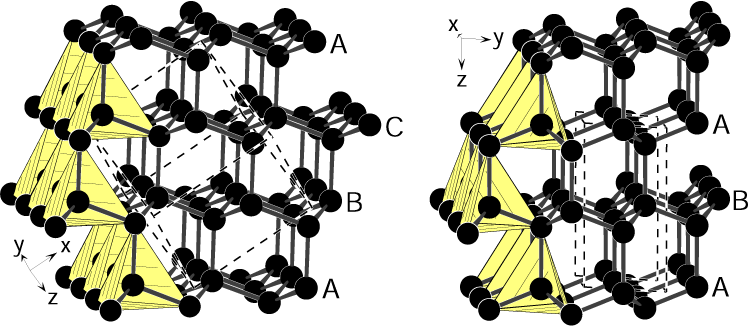
An illustration of the structural differences between cubic diamond and hexagonal lonsdaleite

A diagram showing the structural differences between cubic diamond (left) and meteorite diamond (right). (Image credit: Ralf Riedel)

But preparing samples of this hexagonal structure large enough to analyze has been challenging. What’s more, the presence of other contaminating forms of carbon in the original meteorite sample — including graphite, cubic diamond and amorphous carbon — led many to doubt whether hexagonal diamond exists at all.

Related: Why do diamonds come in different colors?

Get the world’s most fascinating discoveries delivered straight to your inbox.

Inspired by the Canyon Diablo meteoric fragment, Wenge Yang and colleagues at the Center for High Pressure Science and Technology Advanced Research in Beijing, sought to reproduce the intense conditions of an impact with Earth in the lab, developing a high-pressure, high-temperature synthesis using a diamond anvil cell, a piece of equipment that squashes a sample between two flattened surfaces made of diamond. Starting from another form of carbon, purified graphite, they slowly and carefully compressed the material, fixing the shifted atoms in place with targeted heat from a laser.

a meteorite

The research was inspired by a fragment of Canyon Diablo meteorite that contained lonsdaleite, which likely formed due to the high pressures and temperatures experienced during Earth impact. (Image credit: By Geoffrey Notkin, Aerolite Meteorites of TucsonOriginal uploader was Geoking42 at en.wikipedia – Transferred from en.wikipedia(Original text : Self-made. Image created by Geoffrey Notkin, Aerolite Meteorites [1]), CC BY-SA 2.5, Link)

“At pressures around 20 GPa (200,000 atmospheres), the flat carbon layers of graphite are forced to slide and bond with adjacent layers, forming a buckled carbon honeycomb characteristic of hexagonal diamond,” Yang told Live Science in an email. “Laser heating above 1400 °C [2,552 Fahrenheit] facilitates this transition.” Once these distorted tetrahedra of hexagonal diamond had formed, the team slowly released the pressure, ensuring the new crystal didn’t spontaneously turn back into graphite.

The team then used powerful techniques to view the crystal structure and confirm their achievement. Although the crystal disk remained somewhat impure, containing random fragments of cubic diamond, electron microscope images clearly showed its AB carbon layers, and X-ray crystallography revealed the hexagonal structure.

“It’s a good first demonstration,” said Soumen Mandal, a physicist who specializes in the applications of diamond at the University of Cardiff in the U.K., who was not involved in the study. “Now we need pure crystals and more material to start exploring its physical and mechanical properties, thermal properties, electric properties, all of these.”

Hardness testing generally requires larger samples than the ones Yang’s team produced, according to the study. However, they did confirm the new material was at least as tough as regular diamondsl and Yang hopes subsequent experiments with larger and purer crystals will soon provide a concrete answer.

The team would ultimately like to see hexagonal diamond begin to replace conventional diamond in industrial technologies such as precision machinery, high-performance electronics, quantum technologies and thermal management systems, although such applications may still be 10 years away.

“Looking forward, our goal is to produce larger, high-quality hexagonal diamond samples suitable for real-world applications,” he said. “These efforts will help tailor hexagonal diamond’s properties for specific applications and pave the way for its industrial adoption.”

Source link

Share. Facebook Twitter Pinterest LinkedIn Tumblr Email
Previous ArticleNavy veterans mark 80th wedding anniversary on V-J Day
Next Article West Virginia governor deploys hundreds of National Guard troops to Washington
Editor
  • Website

Related Posts

Lifestyle

New robotic heart mimics common, mysterious condition to help researchers study it

July 11, 2026
Lifestyle

Canon EOS R6 III review: A wildlife wonder

July 10, 2026
Lifestyle

Medieval babies and adults buried together in Sweden were not related, archaeologists discover — raising big questions about early Christian burial practices

July 10, 2026
Add A Comment

Comments are closed.

Categories
  • Entertainment
  • Lifestyle
  • News
  • Sports
  • Tech
  • Travel
Recent Posts
  • New robotic heart mimics common, mysterious condition to help researchers study it
  • Canon EOS R6 III review: A wildlife wonder
  • Medieval babies and adults buried together in Sweden were not related, archaeologists discover — raising big questions about early Christian burial practices
  • NASA is creating a fifth state of matter on the ISS, thanks to an upgrade to a mini-fridge-sized quantum lab
  • New sodium metal battery design charges in just 4 minutes and retains its capacity for years
calendar
July 2026
M T W T F S S
 12345
6789101112
13141516171819
20212223242526
2728293031  
« Jun    
Recent Posts
  • New robotic heart mimics common, mysterious condition to help researchers study it
  • Canon EOS R6 III review: A wildlife wonder
  • Medieval babies and adults buried together in Sweden were not related, archaeologists discover — raising big questions about early Christian burial practices
About

Welcome to Baynard Media, your trusted source for a diverse range of news and insights. We are committed to delivering timely, reliable, and thought-provoking content that keeps you informed
and inspired

Categories
  • Entertainment
  • Lifestyle
  • News
  • Sports
  • Tech
  • Travel
Facebook X (Twitter) Pinterest WhatsApp
  • Contact Us
  • About Us
  • Privacy Policy
  • Disclaimer
  • UNSUBSCRIBE
© 2026 copyrights reserved

Type above and press Enter to search. Press Esc to cancel.