
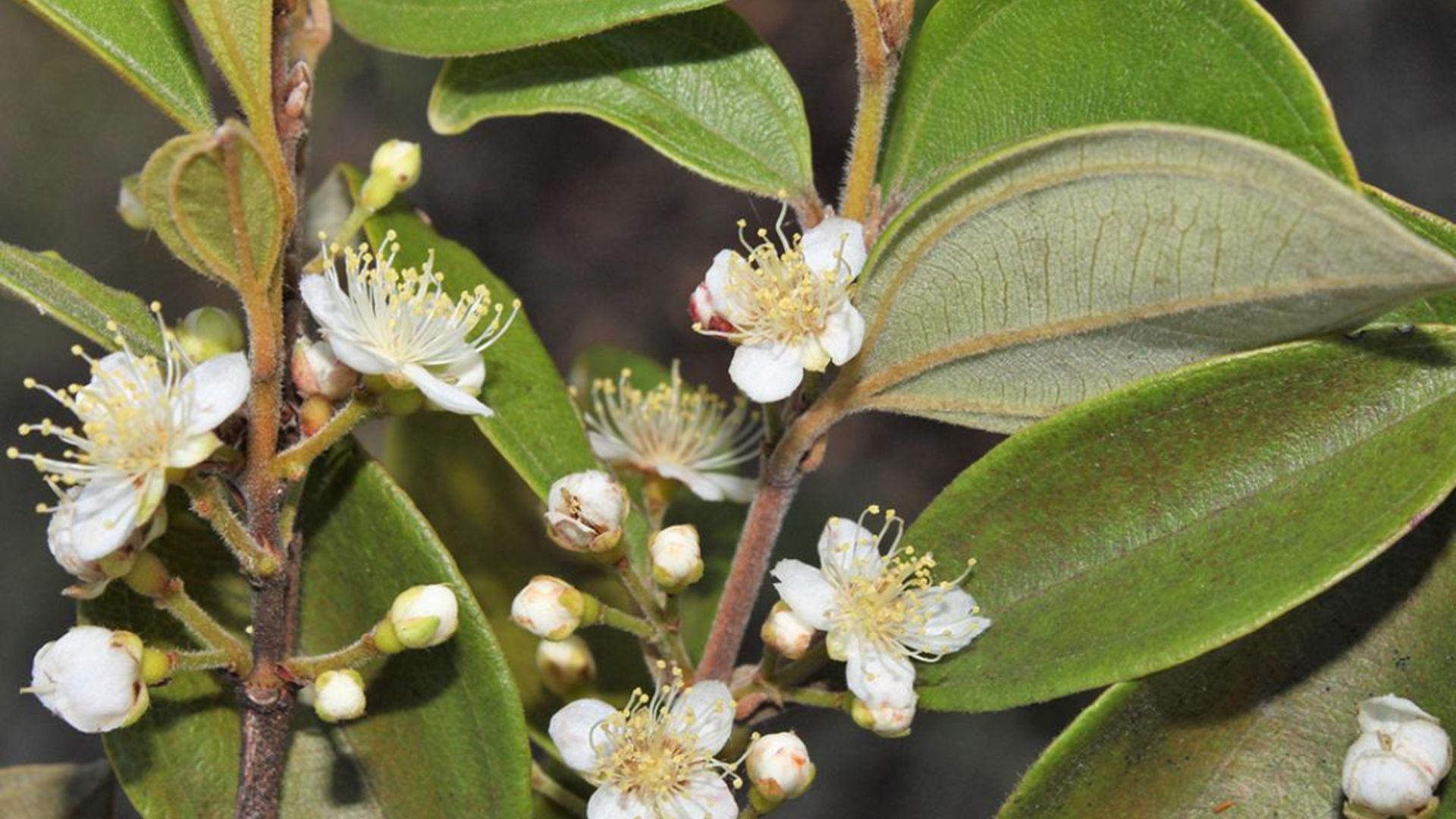
Scientists in Australia are in a desperate race to rescue a newly identified “zombie tree” before it vanishes from Queensland’s rainforests.
They discovered that the tree, Rhodamnia zombi, can no longer produce flowers, fruit or seeds — leaving it alive but unable to propagate itself in the wild. The zombie tree, which was just discovered in 2020 and was described as a new species last year, is suffering from a fast-spreading fungal disease called myrtle rust.
Article continues below
In a study published Dec. 11, 2025, in the journal Austral Ecology, researchers warned that R. zombi and 16 other rainforest tree species are under attack by this fungal pathogen and could be extinct within a generation without proper intervention.
Fungal fatalities
Myrtle rust, which is caused by the fungus Austropuccinia psidii, was first detected in Hawaii in 2005 and in Australia in 2010. Since then, its spores have spread widely as they are carried by wind, birds, people, machinery and insects.
“There’s very little you can do about stopping the spread,” Fensham told Live Science. “The Achilles’ heel with myrtle rust is that it needs a certain kind of environment. It needs to be a humid world, not too cold either … Where I live in Brisbane, in the middle, is the perfect environment for it.”
Myrtle rust is native to South America, where the native plants that co-evolved with the fungus developed resistance to it. The disease is called myrtle rust because the fungus attacks plants in the myrtle family, Myrtaceae, which includes eucalyptus, tea trees and other Australian rainforest species. Myrtle rust produces powdery yellow, orange or brown spore pustules — which look like rust — on infected plant tissue, slowly killing the plant by draining it of nutrients.

Because Australian species have evolved little or no resistance against the pathogen, they are what Fensham calls “naive hosts.” “Humans were a naive host for the coronavirus,” he said, “and this is similar.”
To determine how widespread the myrtle rust was, the researchers revisited vulnerable rainforest populations in the wild. By surveying sites across eastern Australia, the team tracked which species were still producing flowers and fruit, which ones had stopped reproducing, and which populations had already died out.
Those species included the zombie tree. When the team revisited known wild populations of R. zombi, they found that about 10% of the populations had already died out and the remaining infected trees were no longer producing flowers or fruit.
“Myrtaceae is a monstrous family in Australia, [and] it’s a small subset we’ve come to realize is in real trouble as a result of this disease,” Fensham said. “So I guess it could be worse if the intolerance was more widespread in that huge group of plants. But it’s bad enough as it is.”
How to rescue a zombie
Because infected wild trees are no longer reliably making seeds, scientists are cloning the surviving plants using cuttings that can then be raised in nurseries and later moved to safer areas where the climate is less favorable to myrtle rust.
Another option is to use fungicide to keep trees in infected areas alive long enough for the plants to produce seeds. Scientists may then be able to identify seedlings that show more tolerance to myrtle rust. In the best-case scenario, those hardier plants could be returned to the forest someday.
“That sounds like a real long shot,” Fensham said. “But actually, all the steps … have been done by enthusiastic people in the last few years. There’s a real will and capability of rescuing these trees.”
Fensham said researchers are looking into a tree-saving treatment that works similarly to a vaccine. “There’s some … attempts to develop an RNA vaccine,” he said. “Different variants [are] evolving, as we speak, that might have different tolerances.”
However, he said the more realistic plan is to focus on cultivating cuttings from the surviving plants in a safe environment. “The species needs time and space without being constantly walloped by myrtle rust to hopefully express some resistance,” he said in the statement.
Fensham, R. J., Butler, D., Espe, B., Paxton, I. J., Radford‐Smith, J., & Shaw, S. (2025). Myrtle Rust continues to blight subtropical rainforest trees: Strategies for resurrecting the living Dead. Austral Ecology, 50(12). https://doi.org/10.1111/aec.70155
