Close Menu
  • Home
  • UNSUBSCRIBE
  • News
  • Lifestyle
  • Tech
  • Entertainment
  • Sports
  • Travel
Facebook X (Twitter) WhatsApp
Trending
  • New robotic heart mimics common, mysterious condition to help researchers study it
  • Canon EOS R6 III review: A wildlife wonder
  • Medieval babies and adults buried together in Sweden were not related, archaeologists discover — raising big questions about early Christian burial practices
  • NASA is creating a fifth state of matter on the ISS, thanks to an upgrade to a mini-fridge-sized quantum lab
  • New sodium metal battery design charges in just 4 minutes and retains its capacity for years
  • Quantum computing wielded to create extremely rare material critical to nuclear fusion
  • Scientists build tiny ‘diving suit’ for cockroaches, turning them into search-and-rescue cyborgs
  • Physicists develop the first working model of quantum mechanics using only ‘real’ numbers
Facebook X (Twitter) WhatsApp
Baynard Media
  • Home
  • UNSUBSCRIBE
  • News
  • Lifestyle
  • Tech
  • Entertainment
  • Sports
  • Travel
Baynard Media
Home»Lifestyle»Science history: Gravitational waves detected, proving Einstein right — Sept. 14, 2015
Lifestyle

Science history: Gravitational waves detected, proving Einstein right — Sept. 14, 2015

EditorBy EditorSeptember 14, 2025No Comments4 Mins Read
Share Facebook Twitter Pinterest LinkedIn Tumblr Reddit Telegram Email
Share
Facebook Twitter LinkedIn Pinterest Email

Quick facts

Discovery: First gravitational waves detected

Discovery date: Sept. 14, 2015 at 5:51 a.m. EDT (09:51 UTC)

Where: Livingston, Louisiana and Hanford, Washington

Who: Scientists with the LIGO Scientific Collaboration

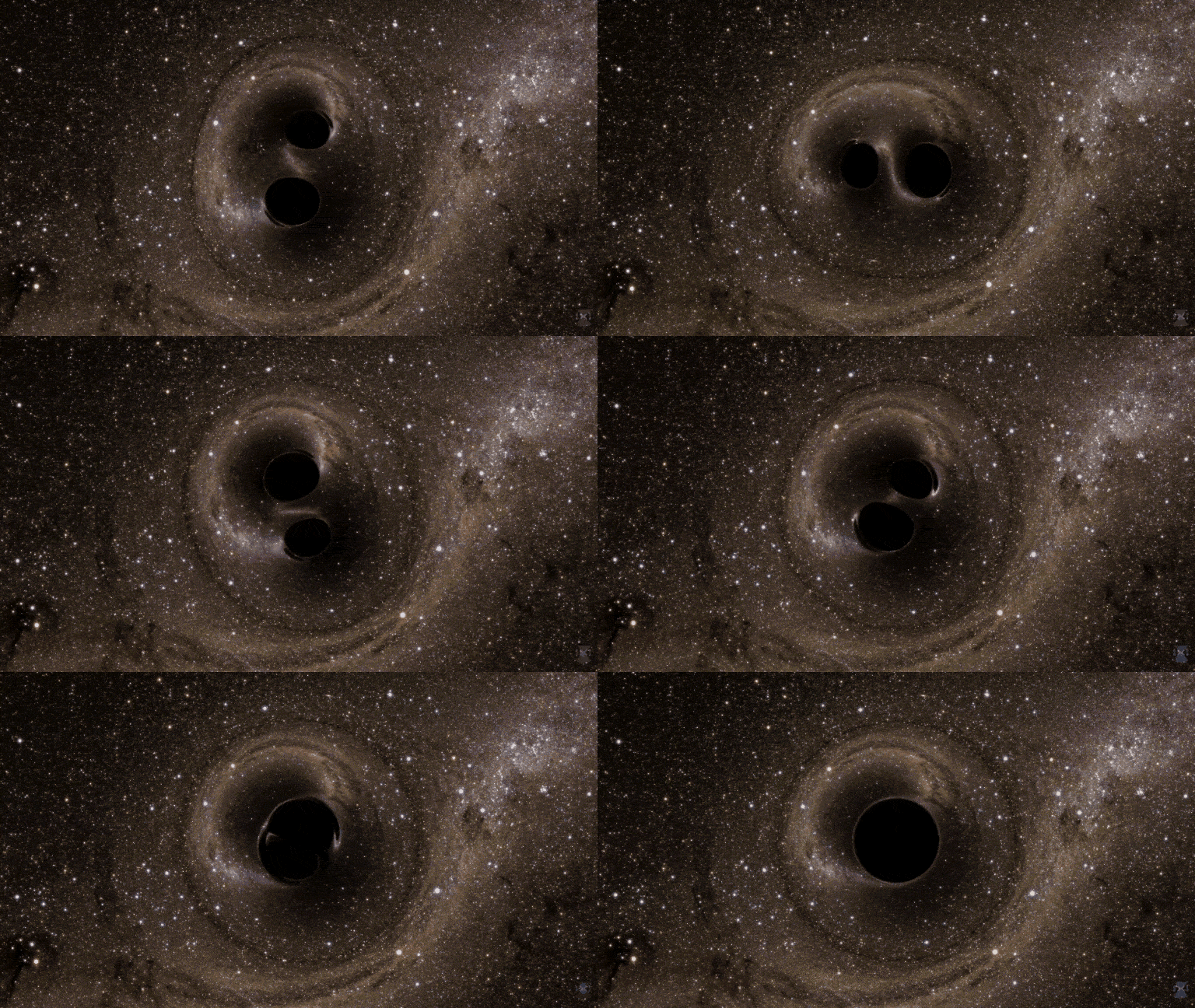
Ten years ago today, on Sept. 14, physicists detected gravitational waves rippling through the cosmos for the first time.

The roots of this discovery date back a century. Albert Einstein’s general relativity predicted that massive objects would warp space-time. When such massive objects accelerate — such as when two black holes collide — they would send ripples through the cosmos, called gravitational waves, he posited.

Einstein never thought we could detect them, because the distortion of space-time caused by these waves would be far tinier than a single atom.


You may like

However, in the 1970s, MIT physicist Rainer Weiss, who died in August, proposed it might be possible to detect these tiny ripples from colliding massive black holes.

Key to his scheme was the interferometer, which would split a beam of laser light. From there, the light would travel down two separate paths before bouncing off hanging mirrors and recombining at their source, where a light detector would measure their arrival. Ordinarily, if the paths were the same lengths, these two beams would return at the same time.

But if a gravitational wave was passing by, Weiss reasoned, these beams would be ever-so-slightly out of phase. That’s because gravitational waves temporarily smoosh and stretch space-time, thereby creating fluctuations in the length of the passageways through which the laser beams travel.

Weiss, along with Caltech physicist Kip Thorne, proposed the idea of trying to measure these elusive waves. The detector pathways, they argued, needed to be very long to detect such tiny signals. And the project would need two widely spaced detectors to eliminate the possibility that signals came from local disturbances, and to help localize the source of cosmic collisions.

Get the world’s most fascinating discoveries delivered straight to your inbox.

A figure from a scientific paper showing the signals of a black hole merger

The iconic “chirp” waveform that revealed the moment gravitational waves were first detected at Hanford (left) and Livingston (right). The top three pairs of images show strain, or how much space-time was stretched and compressed, as the waves passed through. The top row shows data collected by each detector, while the middle row shows the reconstructed waveform produced when the detector data is put into theoretical models of the black holes involved. The third row shows what’s left when the reconstructed and detector data are compared. The bottom row shows the strain over time, with the frequency increasing over time. (Image credit: Abbott et al., Physical Review Letters 2016; CC BY 3.0)

By 1990, the Laser Interferometer Gravitational-Wave Observatory (LIGO) project had been approved, and two identical L-shaped detectors, with arms 2.5 miles (4 kilometers) long, were built in Hanford, Washington and Livingston, Louisiana, respectively.

For years, the detectors found nothing. So LIGO was upgraded to become more sensitive to ever-tinier signals. Much of that entailed protecting the equipment from vibrations caused by nearby traffic, planes or distant earthquakes, which could obscure the signals from the distant universe.

In September 2015, the scientists turned on the upgraded instruments.


You may like

Overnight on Sept. 14, researchers at both LIGO sites detected something interesting.

“I got to the computer and I looked at the screen. And lo and behold, there is this incredible picture of the waveform, and it looked like exactly the thing that had been imagined by Einstein,” Weiss said in a documentary about the discovery.

It was a strong “chirp,” or a fluctuation in the length of the detector arms, and it was a thousand times smaller than the diameter of a nucleus.

On Feb. 11, 2016, scientists announced that the event they’d detected came from the smashup of two massive black holes that collided about 1.3 billion years ago. Europe’s gravitational wave experiment, called Virgo, detected the same event.

The discovery ushered in a whole new way to study the universe’s most extreme events. Since that first detection, LIGO’s detectors, along with its European counterpart experiment Virgo and the Japanese Kamioka Gravitational Wave Detector (KAGRA), have detected around 300 collisions, including triple black hole mergers and the collision of black holes and neutron stars. In June 2023, a team of scientists announced that a faint “gravitational wave background” permeates the universe thanks to pairs of black holes veering toward collision all across space and time. And in September 2025, scientists from the LIGO Collaboration validated Stephen Hawking’s decades-old theory about black holes, linking quantum mechanics and general relativity.

Weiss and Thorne, along with their colleague Barry Barish, were awarded the 2017 Nobel Prize for their work.

Source link

Share. Facebook Twitter Pinterest LinkedIn Tumblr Email
Previous ArticleRG3 recalls his wildest fan moment while criticizing ‘Phillies Karen’
Next Article Pete Buttigieg says Trump not showing ‘leadership we need’ in wake of Kirk shooting: Full interview
Editor
  • Website

Related Posts

Lifestyle

New robotic heart mimics common, mysterious condition to help researchers study it

July 11, 2026
Lifestyle

Canon EOS R6 III review: A wildlife wonder

July 10, 2026
Lifestyle

Medieval babies and adults buried together in Sweden were not related, archaeologists discover — raising big questions about early Christian burial practices

July 10, 2026
Add A Comment

Comments are closed.

Categories
  • Entertainment
  • Lifestyle
  • News
  • Sports
  • Tech
  • Travel
Recent Posts
  • New robotic heart mimics common, mysterious condition to help researchers study it
  • Canon EOS R6 III review: A wildlife wonder
  • Medieval babies and adults buried together in Sweden were not related, archaeologists discover — raising big questions about early Christian burial practices
  • NASA is creating a fifth state of matter on the ISS, thanks to an upgrade to a mini-fridge-sized quantum lab
  • New sodium metal battery design charges in just 4 minutes and retains its capacity for years
calendar
July 2026
M T W T F S S
 12345
6789101112
13141516171819
20212223242526
2728293031  
« Jun    
Recent Posts
  • New robotic heart mimics common, mysterious condition to help researchers study it
  • Canon EOS R6 III review: A wildlife wonder
  • Medieval babies and adults buried together in Sweden were not related, archaeologists discover — raising big questions about early Christian burial practices
About

Welcome to Baynard Media, your trusted source for a diverse range of news and insights. We are committed to delivering timely, reliable, and thought-provoking content that keeps you informed
and inspired

Categories
  • Entertainment
  • Lifestyle
  • News
  • Sports
  • Tech
  • Travel
Facebook X (Twitter) Pinterest WhatsApp
  • Contact Us
  • About Us
  • Privacy Policy
  • Disclaimer
  • UNSUBSCRIBE
© 2026 copyrights reserved

Type above and press Enter to search. Press Esc to cancel.