Close Menu
  • Home
  • UNSUBSCRIBE
  • News
  • Lifestyle
  • Tech
  • Entertainment
  • Sports
  • Travel
Facebook X (Twitter) WhatsApp
Trending
  • Google wants to release 64 million bacteria-riddled mosquitoes across California and Florida. Here’s why scientists are enthusiastic.
  • ‘In an unrecoverable state’: NASA confirms MAVEN spacecraft is officially dead after loss of signal behind Mars
  • 2 rivers merged to form the Euphrates 3.6 million years ago, eventually leading to the Fertile Crescent
  • NASA confirms fireball meteor exploded over northeastern US with force of 230 tons of TNT
  • Astronauts could use lightning-like plasma jets to kill germs on the moon and Mars, demo hints
  • First whole-genome sequence of a Greenland shark holds clues to their extreme longevity
  • Heading a soccer ball just once is enough to raise levels of proteins associated with brain damage
  • OpenAI’s internal AI model just solved an 80-year-old math problem ‪—‬ and mathematicians verified it
Facebook X (Twitter) WhatsApp
Baynard Media
  • Home
  • UNSUBSCRIBE
  • News
  • Lifestyle
  • Tech
  • Entertainment
  • Sports
  • Travel
Baynard Media
Home»Lifestyle»Science history: Archaeologists discover King Tut’s tomb, and rumors of the ‘mummy’s curse’ begin swirling — Nov. 4, 1922
Lifestyle

Science history: Archaeologists discover King Tut’s tomb, and rumors of the ‘mummy’s curse’ begin swirling — Nov. 4, 1922

EditorBy EditorNovember 4, 2025No Comments4 Mins Read
Share Facebook Twitter Pinterest LinkedIn Tumblr Reddit Telegram Email
Share
Facebook Twitter LinkedIn Pinterest Email

QUICK FACTS

Milestone: Staircase to King Tut’s tomb uncovered

When: Nov. 4, 1922

Where: Valley of the Kings, Egypt

Who: An archaeological team led by Howard Carter

On a sunny morning, Egyptian workers were clearing the sands at the Valley of the Kings, when they uncovered the hint of stone steps about 13 feet (4 meters) below the tomb of Ramesses VI.

This sunken staircase would lead to the unlooted tomb of King Tutankhamun, a pharaoh who died as a teenager more than 3,200 years earlier.

The excavation team, helmed by British archaeologist Howard Carter but composed almost exclusively of Egyptians, had been clearing away sand near huts in the Valley of the Kings. Some stories hold that a water boy, Hussein Abd el-Rassul, may have been the first to spot the staircase.


You may like

When they found the steps, the group knew they had uncovered something important. The team worked feverishly until they reached the 12th step, where they discovered a small doorway covered with plaster, Carter wrote in his diary. On the door, they could partly make out the seal of the Royal Necropolis, which depicted the god Anubis as a king standing over the vanquished bodies of nine foes.

“Here before us was sufficient evidence to show that it really was an entrance to a tomb, and by the seals, to all outward appearances that it was intact,” Carter wrote in his diary on Nov. 5.

As they explored further, the team found that the entryway had been filled with rubble — likely by priests intending to block the tomb, which was further evidence the tomb had not been looted.

Image 1 of 2

Howard Carter and an Egyptian archaeologist stand over the sarcophagus of Tutankhamun
(Image credit: Apic via Getty Images)

Howard Carter and an Egyptian archaeologist examine the sarcophagus of Tutankhamun in 1922.

an artist retouches an Egyptian statue
(Image credit: General Photographic Agency via Getty Images)

An artist in London restores a mannequin found in King Tut’s tomb in 1924. Archaeologists believe the mannequin was a way for the teenage king to try on different clothing in the afterlife.


For the next few weeks, the team excavated the steps and the doorway until they uncovered a seal bearing the cartouche — an oval filled with hieroglyphs depicting a ruler’s name — of King Tutankhamun on Nov. 24. But the team still wasn’t sure who was buried inside, because the rubble filling the entryway had a confusing mélange of pottery shards and broken boxes that bore signs of other ancient Egyptian monarchs, including Akhenaten, Tut’s father.

Get the world’s most fascinating discoveries delivered straight to your inbox.

On Nov. 25, they opened the first door to the tomb. The next day, they found a second door and cut a tiny hole inside to see what lay beyond it. No Egyptian officials were permitted to view the tomb, but Carter had brought along Lord Carnarvon, who had financed the tomb excavation; Lady Evelyn Herbert, Carnarvon’s daughter; and Arthur Callender, an engineer with the dig. All waited anxiously to see what lay inside.

“It was sometime before one could see, the hot air escaping caused the candle to flicker, but as soon as one’s eyes became accustomed to the glimmer of light the interior of the chamber gradually loomed before one, with its strange and wonderful medley of extraordinary and beautiful objects heaped upon one another,” Carter wrote in his diary.

a row of Egyptian statues

A statue of Ptah, the chief god of Memphis, from the tomb of King Tutankhamun. (Image credit: Scott Olson via Getty Images)

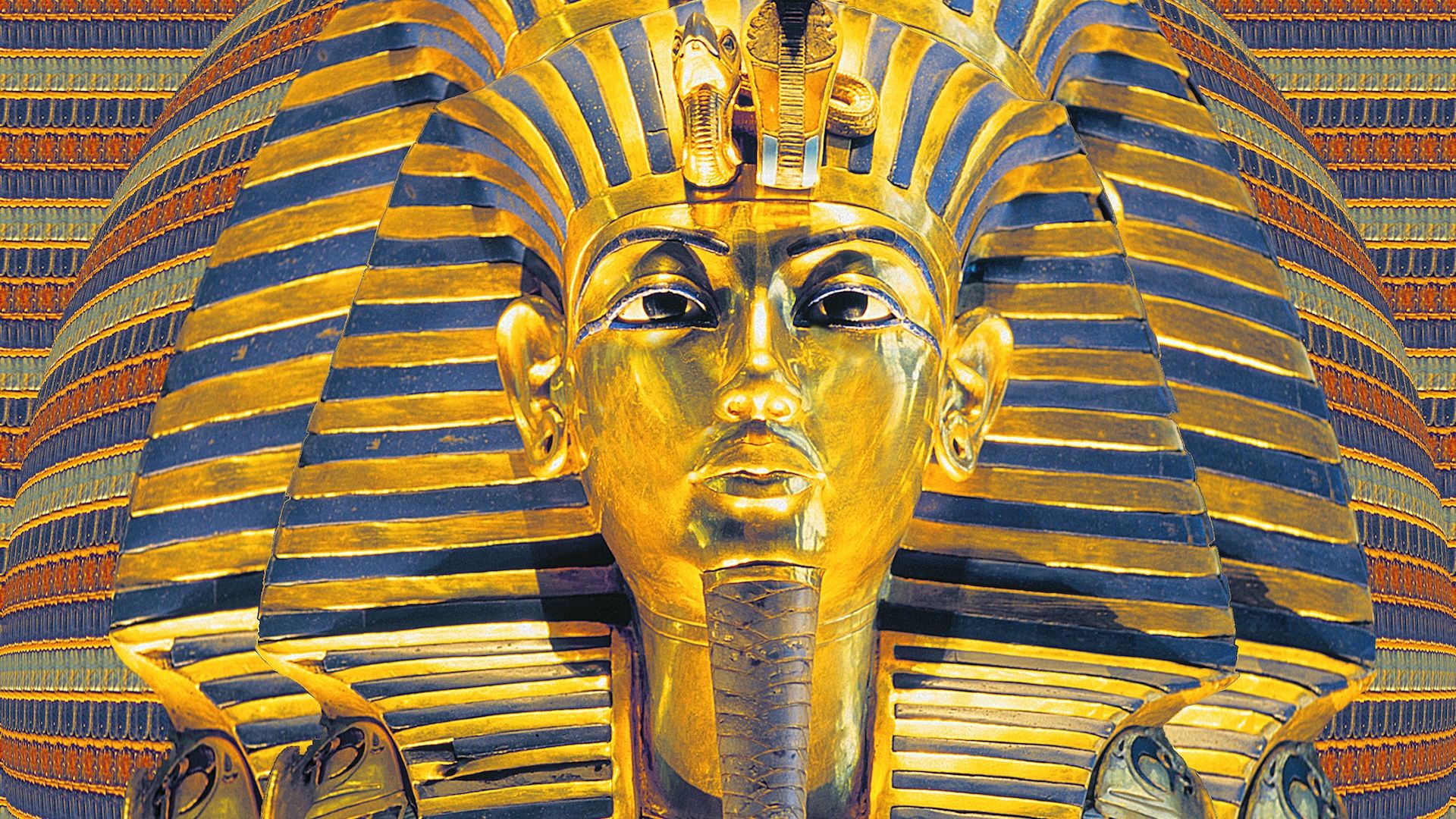
King Tut’s tomb was the first unlooted pharaoh’s tomb discovered in the modern era, and it was teeming with rich treasure. One of the most famous artifacts discovered was his ornate death mask, a 22-pound (10 kilograms) solid-gold face covering inlaid with semiprecious stones. But Tutankhamun was also buried with board games, several beds, and even a mannequin to try on outfits in the afterlife.

Tutankhamun was laid to rest in three nesting coffins — two made of gilded wood and the third (and smallest) of solid gold — and his body was soaked in oil that turned it black before he was mummified.

About a month after the tomb was opened, Lord Carnarvon died after a mosquito bite became infected following a shaving accident. And, in 1923, Pearson’s Magazine published a fictional story called “The Tomb of the Bird,” in which Carter’s canary was found dead in the mouth of a cobra soon after the tomb was opened. The rumor mill and media reports spun these and a handful of other flimsy coincidences into evidence of a mummy’s curse, the notion that whoever opened a pharaoh’s tomb would face an early or unnatural death. However, a 2002 study found that the 25 Westerners exposed to the tomb (and thus the “mummy’s curse”) lived about as long as would be expected for the time.

Source link

Share. Facebook Twitter Pinterest LinkedIn Tumblr Email
Previous ArticleOver a month into government shutdown, no end in sight – but predictions rampant
Next Article Florida deputy rescues 7-year-old boy held hostage
Editor
  • Website

Related Posts

Lifestyle

Google wants to release 64 million bacteria-riddled mosquitoes across California and Florida. Here’s why scientists are enthusiastic.

June 3, 2026
Lifestyle

‘In an unrecoverable state’: NASA confirms MAVEN spacecraft is officially dead after loss of signal behind Mars

June 3, 2026
Lifestyle

2 rivers merged to form the Euphrates 3.6 million years ago, eventually leading to the Fertile Crescent

June 2, 2026
Add A Comment

Comments are closed.

Categories
  • Entertainment
  • Lifestyle
  • News
  • Sports
  • Tech
  • Travel
Recent Posts
  • Google wants to release 64 million bacteria-riddled mosquitoes across California and Florida. Here’s why scientists are enthusiastic.
  • ‘In an unrecoverable state’: NASA confirms MAVEN spacecraft is officially dead after loss of signal behind Mars
  • 2 rivers merged to form the Euphrates 3.6 million years ago, eventually leading to the Fertile Crescent
  • NASA confirms fireball meteor exploded over northeastern US with force of 230 tons of TNT
  • Astronauts could use lightning-like plasma jets to kill germs on the moon and Mars, demo hints
calendar
June 2026
M T W T F S S
1234567
891011121314
15161718192021
22232425262728
2930  
« May    
Recent Posts
  • Google wants to release 64 million bacteria-riddled mosquitoes across California and Florida. Here’s why scientists are enthusiastic.
  • ‘In an unrecoverable state’: NASA confirms MAVEN spacecraft is officially dead after loss of signal behind Mars
  • 2 rivers merged to form the Euphrates 3.6 million years ago, eventually leading to the Fertile Crescent
About

Welcome to Baynard Media, your trusted source for a diverse range of news and insights. We are committed to delivering timely, reliable, and thought-provoking content that keeps you informed
and inspired

Categories
  • Entertainment
  • Lifestyle
  • News
  • Sports
  • Tech
  • Travel
Facebook X (Twitter) Pinterest WhatsApp
  • Contact Us
  • About Us
  • Privacy Policy
  • Disclaimer
  • UNSUBSCRIBE
© 2026 copyrights reserved

Type above and press Enter to search. Press Esc to cancel.