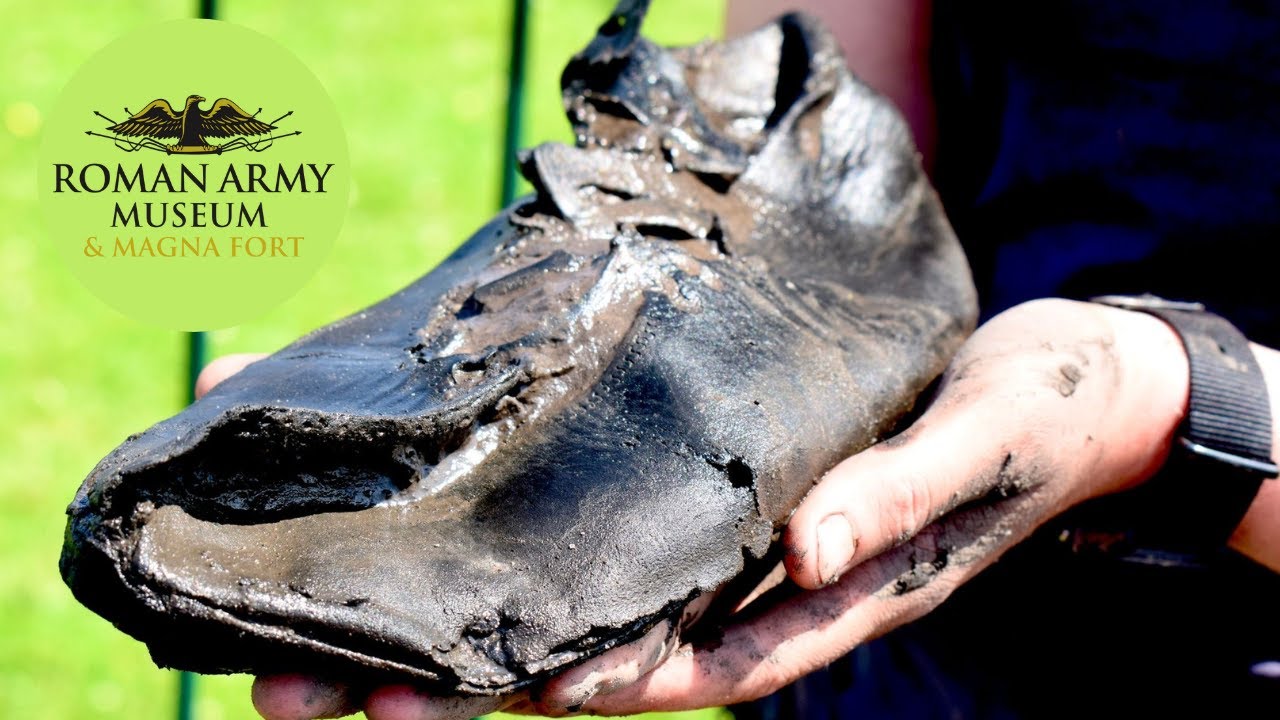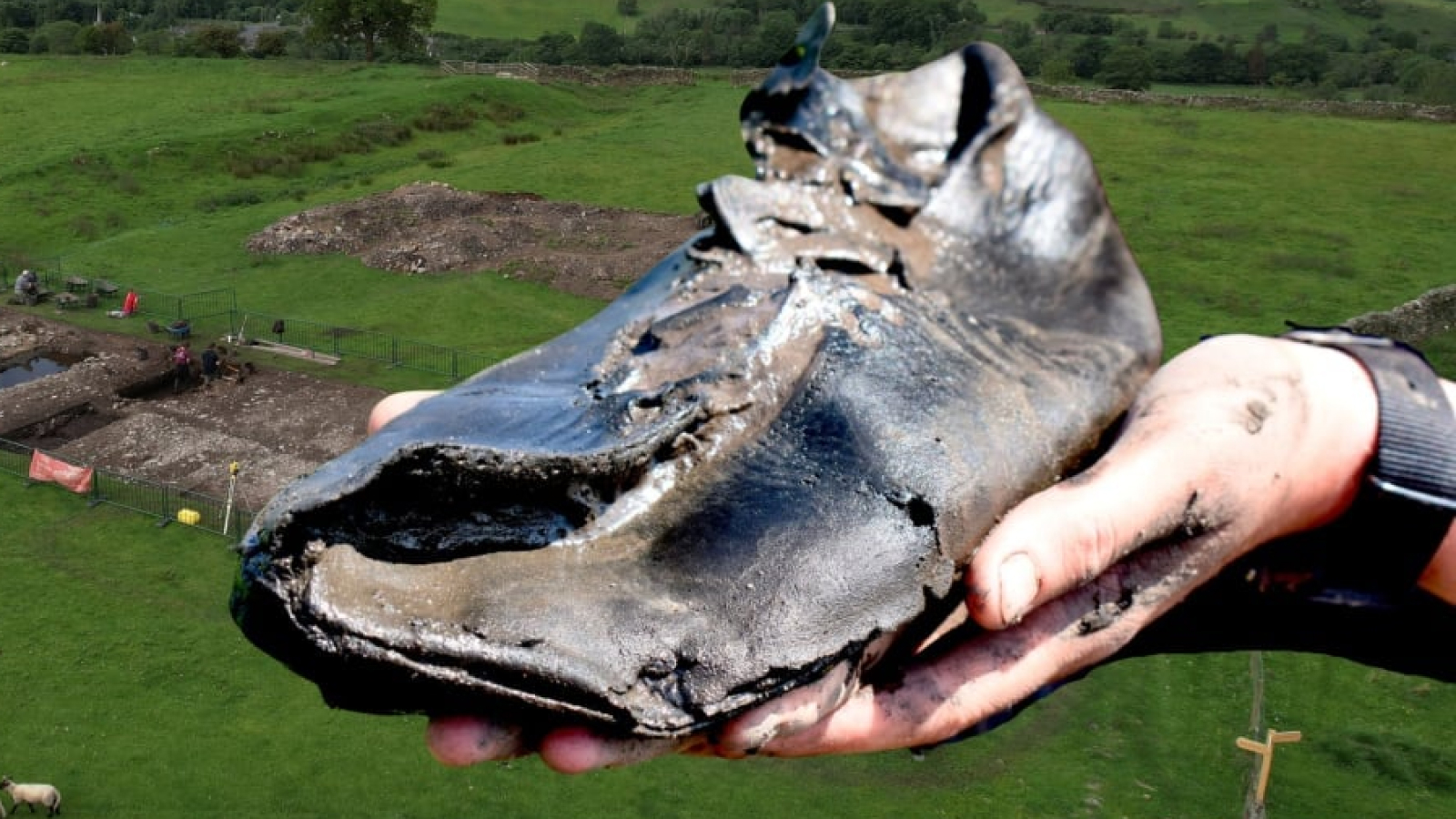
Excavations at the Roman fort of Magna near Hadrian’s Wall in Northumberland in north east England have uncovered some very large leather footwear. Their discovery, according to some news coverage, has “baffled” archaeologists.
The survival of the shoes is not by itself miraculous or unusual. Excellent preservation conditions caused by waterlogged environments with low-oxygen means that leather, and other organic materials, survive in the wet soil of this part of northern England.
Many years of excavations by the Vindolanda Trust at Vindolanda just south of Hadrian’s Wall, and now at Magna, have recovered an enormous collection of Roman shoes. These finds have provided us with an excellent record of the footwear of soldiers and the civilians who lived around them.
The shoes from Magna stand out because many of them are big. Big shoes have also been found at Vindolanda. However, of those whose size can be determined, only 0.4% are big. The average shoe size at Vindolanda is 9.5 to 10.2 inches in length, which is between a modern UK shoe size 7 to 8.
Big shoes make up a much larger share of the shoes at Magna. The biggest shoe is a whopping 12.8 inches long, roughly equivalent to a modern UK size 12 to 14.
This shoe collection raises an immediate and obvious question: why did people at Magna have such large shoes?
Related: Thousands of leather shoes, bags and sword scabbards discovered during dig in medieval harbor in Norway
The possible answers to this question raise more questions and bring to the fore a central component of archaeological research: a good debate.
Emma Frame, senior archaeologist for the Magna excavations, suggests: “We have to assume it’s something to do with the people living here, having bigger feet, being potentially taller but we don’t know.”
This idea of bigger feet, bigger people makes a good deal of sense, though it would suggest that some of the military community at Magna were very tall indeed. And, as the Roman cemeteries of Hadrian’s Wall have been little excavated or studied, we have little information about how tall people were in this part of the Roman world.

Other ideas might be worth entertaining too, however. For example, could these be some kind of snowshoes or winter boots meant to allow extra layers of padding or multiple pairs of socks to be worn?
A letter, preserved by similar conditions to the shoes at Vindolanda, refers to a gift of socks and underpants that was sent to someone stationed there, presumably to keep them warm during the cold winter nights. We also know from other evidence that Syrian archers made up one of the units stationed at Magna. These men would not have been used to the frosty climate of northern England.
Could these large shoes be an attempt to cope with the bitter shock of a British winter? Or instead, could these shoes have a medical purpose, perhaps to allow people with swollen feet or people utilising medical dressings to wear shoes?
It’s important to note, I am not claiming to have the answers. I’m simply putting out some hypotheses which could explain the extra-large shoes based on other evidence we have and potential logical explanations for such large footwear.
These kinds of hypotheses lie right at the heart of the archaeological method. Fresh archaeological discoveries are made everyday, and they often make headlines with phrases about “baffled archaeologists.” While this language can spark public interest, it also risks giving a misleading impression of the discipline. In reality, the work archaeologists like me and thousands of my colleagues around the world do is grounded in careful, evidence-based analysis.
The challenge lies not in our lack of expertise, but in the nature of the evidence itself. Much of the distant past has been lost to time, and what we do recover represents only a small fragment of the original picture.
We’re not so much “baffled” as we are rigorously testing multiple hypotheses to arrive at the most plausible interpretations. Interpreting these fragments is a complex process, like piecing together a thousand-piece jigsaw puzzle with many of the most crucial pieces (like the edges) missing.
Sometimes we have exactly the right pieces to understand the big picture, but other times we have gaps, and we have to put forward a series of different suggestions until more evidence comes to light.
This edited article is republished from The Conversation under a Creative Commons license. Read the original article.