
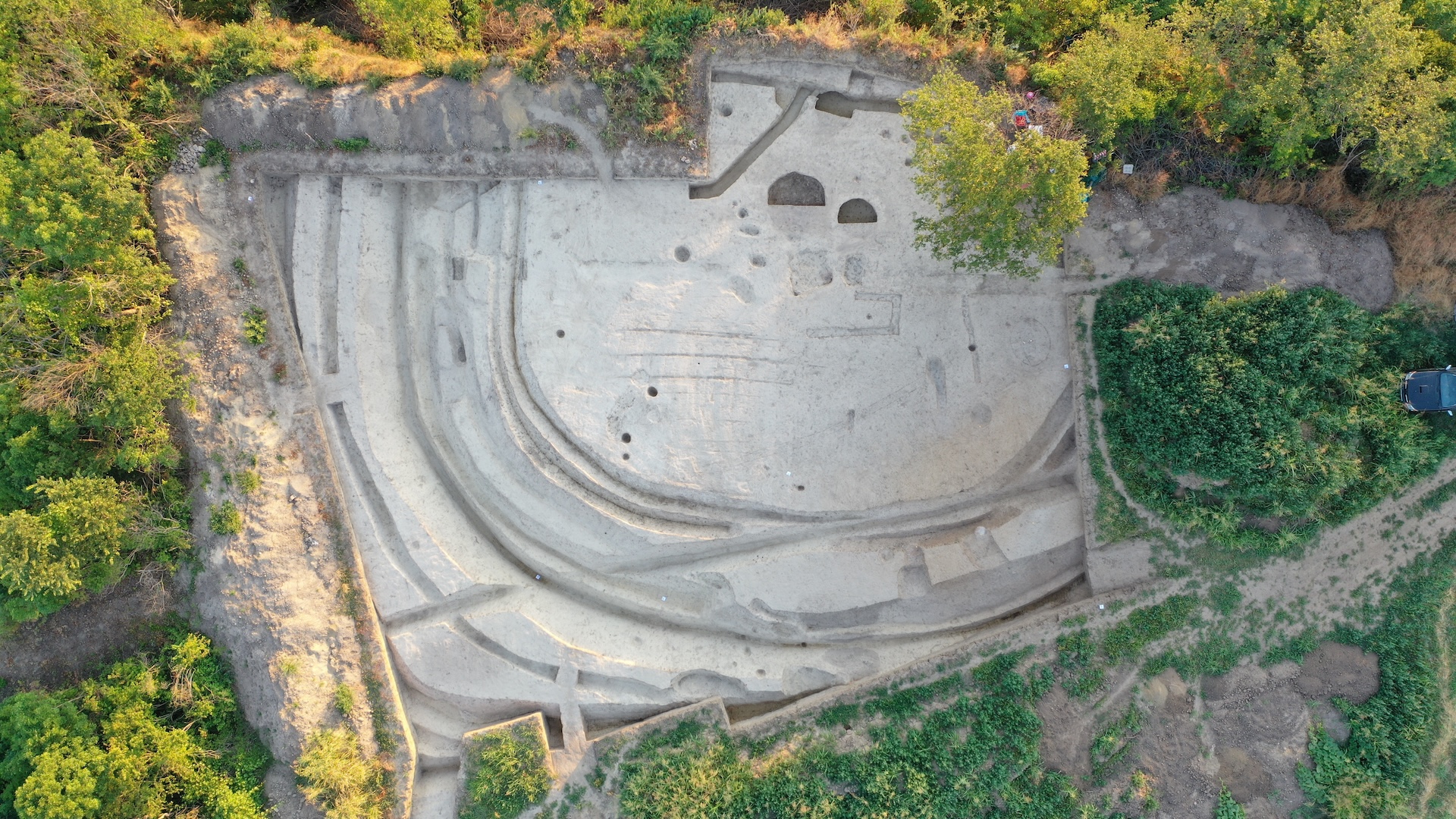
Archaeologists in Croatia have unearthed the remains of a 1,800-year-old watchtower that was erected to help the Romans defend the “limes” — the border along the Danube River that marked the frontier of the Roman Empire.
Roman artifacts revealed at the site, including military equipment, brooches and ceramic vessels, indicate that the watchtower was constructed in the late second century A.D. and used in the third century A.D., the team reported.
“This is also the period of pressure on the Limes and the time of the Marcomannic War, when it was necessary to additionally protect the border on the Danube,” Marko Dizdar, from the Institute of Archaeology in Zagreb and the research leader of the excavation, told Live Science in an email.
During the Marcomannic Wars (circa A.D. 166 to 180), Roman soldiers under the rule of emperor Marcus Aurelius fought several peoples — including the Germanic Marcomanni who lived north of the Danube, and the Sarmatians, a nomadic people from what is now southern Russia who later spread to Central and Eastern Europe.
The Marcomannic Wars prompted the Romans to build camps, or garrisons, in Sotin and Ilok, in what is now eastern Croatia. The newly excavated watchtower, in the village of Mohovo, was likely part of an effort to defend the Danubian Limes.
“The watchtower was built in a strategic location, at one of the crossings over the Danube River,” Dizdar said. “From this position, there was excellent visual control of a large area, and it was also naturally protected on three sides by deep natural ravines.”
Related: 1,700-year-old Roman watchtower ruins discovered in Switzerland
The watchtower likely had visual communication with nearby watchtowers about 1.2 to 1.9 miles (2 to 3 kilometers) away, Dizdar added. “Most likely, several soldiers were stationed there, who in case of danger notified the neighboring watchtowers and garrisons in Ilok and Sotin, which are located about 12 kilometers [7.5 miles] from it.”

Watchtowers in Croatia
Archaeologists initially discovered the watchtower site, along with about 10 other sites, during field surveys in eastern Croatia in 2003, 2013 and 2020 to 2023. These were dated from the second to the end of the fourth century A.D., and their location along the elevated banks of the Danube River suggested they were fortifications — though this wasn’t known for certain initially.
In 2020, geomagnetic surveys — a noninvasive technique that maps magnetic anomalies to “see” structures underground — revealed that the sites likely held the remains of watchtowers and smaller fortifications. Finally, in 2024, trial excavations at Mohovo confirmed this, and in April 2025, a larger excavation at Mohovo took place.
“This is the first systematically researched watchtower on the Limes in Croatia,” Dizdar said. “Until now, they were unknown, although it was assumed that they existed.”
The Mohovo watchtower was about 130 by 100 feet (40 by 30 meters) and well defended. “It was protected by a system of deep ditches and a wooden fence-palisade, and in the center there was a wooden building,” Dizdar explained. “Crossing such ditches from the attacker’s side was very demanding and gave Roman soldiers enough time for a more successful defense.”
The watchtower went through at least three different phases of construction, suggesting that it needed repairs and upgrades. In the fourth century A.D., it was likely replaced by a smaller fort with a tower., and excavations next year will investigate this transition, Dizdar said.
At that time in Roman history, the Romans generally maintained trade with the Sarmatians. But “with the arrival of Germanic tribes to the Danube, the situation changed and it was necessary to provide stronger border protection” Dizdar said. “Because of this, from the 4th century, larger forts were built and the number of soldiers increased.”
The excavation is part of a push to protect and include Roman sites on the limes in the UNESCO list of World Heritage Sites. Dizdar said that the team also found structures from the Copper, Early Bronze, Iron and even Middle ages, “which shows that this is a site that was inhabited for several millennia.”
Roman emperor quiz: Test your knowledge on the rulers of the ancient empire
