Close Menu
  • Home
  • UNSUBSCRIBE
  • News
  • Lifestyle
  • Tech
  • Entertainment
  • Sports
  • Travel
Facebook X (Twitter) WhatsApp
Trending
  • Chinese medical practitioners used extremely toxic plant as a topical anesthetic 600 years ago, study finds
  • Bead net funerary shroud: A 2,500-year-old beaded veil from Egypt depicting the deceased’s transformation into Osiris
  • Rare genetic disease makes scientists reconsider what the ‘seat of fear’ in the brain really is
  • It’s illegal to repair most of our devices. There’s a surprising reason for that.
  • Jupiter’s Ganymede, the largest moon in the solar system, may be heating up
  • Bizarre patterns on Venus have scientists puzzled
  • Scientists trained an AI model using an IBM quantum computer — and it answered questions correctly that the base model couldn’t
  • How did animals survive the asteroid that killed the dinosaurs?
Facebook X (Twitter) WhatsApp
Baynard Media
  • Home
  • UNSUBSCRIBE
  • News
  • Lifestyle
  • Tech
  • Entertainment
  • Sports
  • Travel
Baynard Media
Home»Lifestyle»Ram-shaped teapot from ancient Canaanite cult discovered near ancient city of Armageddon
Lifestyle

Ram-shaped teapot from ancient Canaanite cult discovered near ancient city of Armageddon

EditorBy EditorNovember 9, 2025No Comments4 Mins Read
Share Facebook Twitter Pinterest LinkedIn Tumblr Reddit Telegram Email
Share
Facebook Twitter LinkedIn Pinterest Email

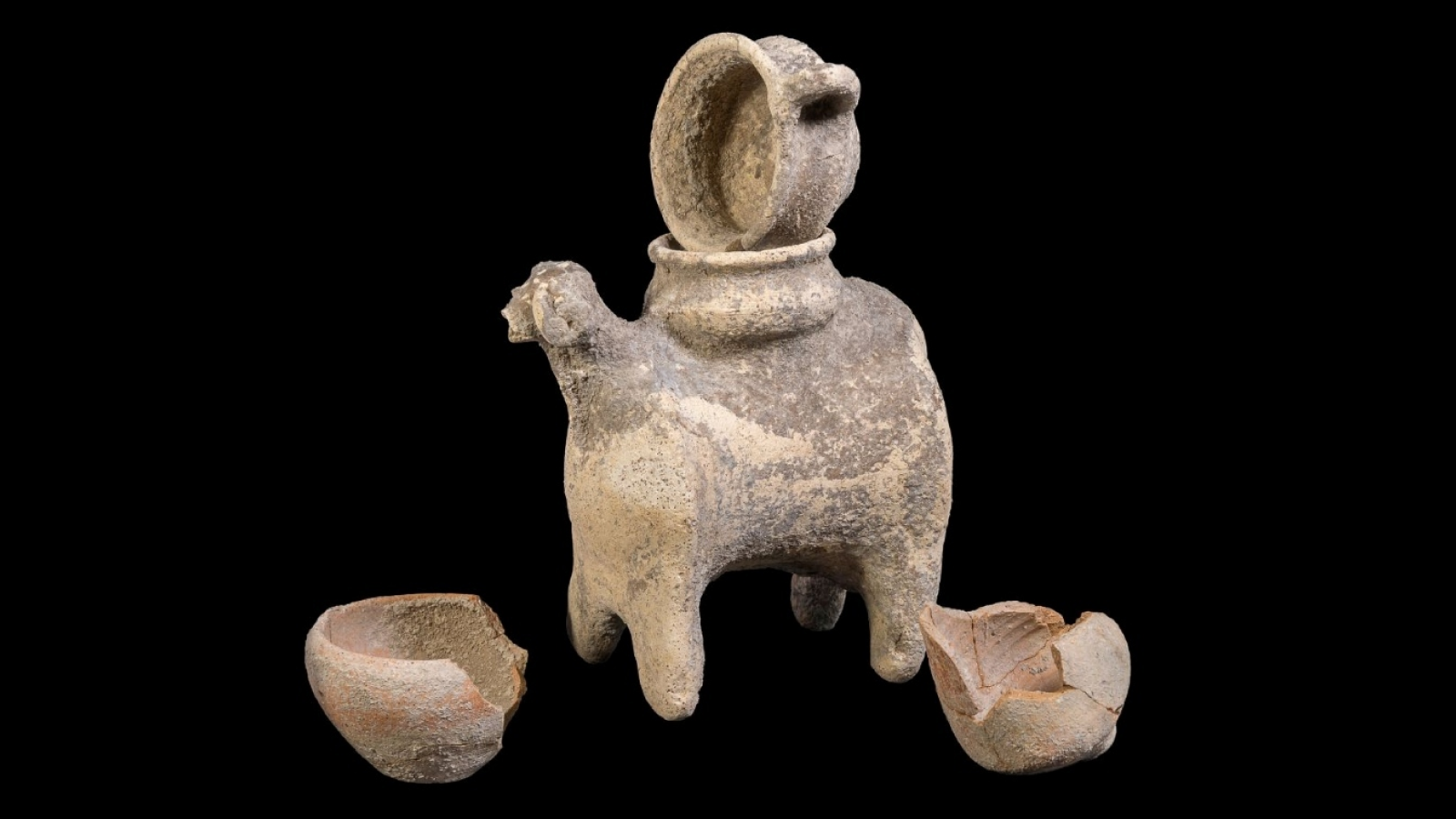
While excavating near the ancient city of Armageddon in Israel, archaeologists unearthed a 3,300-year-old Canaanite “tea set,” a dollhouse-sized temple, and one of the oldest known winepresses in the world.

The tea set includes a teapot shaped like a ram and a few small bowls that were buried together during the Late Bronze Age. The ram’s head, which was molded into the spout, would have been tilted forward so liquid spilled out of its mouth.

“The vessel seems intended for pouring a valuable liquid such as milk, oil, wine or another beverage, which could either be drunk directly from the spout, or poured into a smaller vessel for consumption, or as a votive gift,” an object given for sacred or religious purposes, researchers said in a statement from the Israel Antiquities Authority (IAA).


You may like

Animals such as sheep, donkeys and goats were highly prized in Canaan, with evidence showing that during part of Egypt’s Old Kingdom (around 2649 to 2150 B.C.), some of these animals were raised in Egypt and then imported into Canaan, some of them for sacrificial purposes.

The Canaanites likely buried the teapot and bowls as ritual offerings, according to the statement. Archaeologists unearthed the tea set near Megiddo, also known as Armageddon, ahead of road construction in the Jezreel Valley.

Other Canaanite cult offerings recovered in several small pits during the excavation included storage jars, and imported jugs from Cyprus. These artifacts were likely buried by local people, such as farmers who couldn’t enter the city or the nearby Canaanite temple at Tel Megiddo (“Tel” means hill). Instead, they may have chosen to bury these offerings, and possibly agricultural produce, at a rock outcrop that may have served as an outdoor altar, the statement reported.

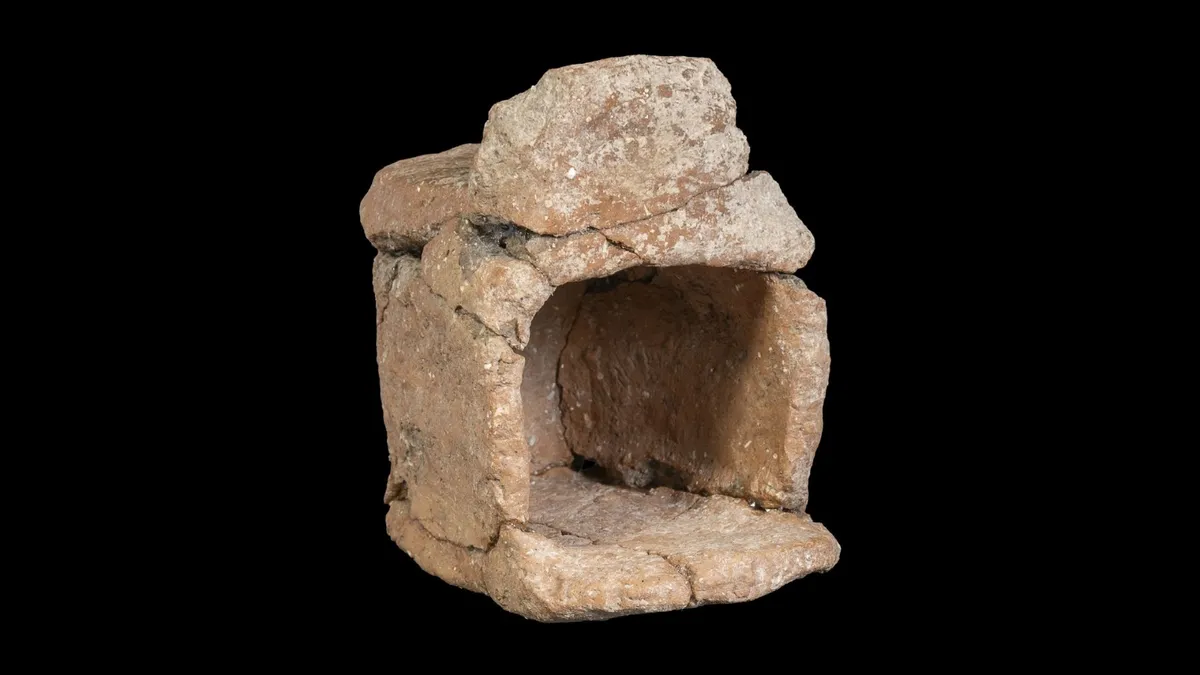
The buried mini-temple, made of ceramic, is also 3,300 years old. “This is what the real temples in the Canaanite Late Bronze Age may have looked like,” Amir Golani, one of the IAA excavation directors at the site, said in a translated video.
Get the world’s most fascinating discoveries delivered straight to your inbox.

A 3,300-year-old model temple made of clay against a black background

A 3,300-year-old model temple was found not too far from Megiddo, also known as Armageddon.  (Image credit: Katerina Katzan/IAA)

Excavations at Armageddon

People have lived at Megiddo since roughly 7000 B.C. Many battles were fought there over the years, and the Book of Revelation, which calls the site Armageddon, predicted that the final battle at the end of time would happen there.

The excavation reveals artifacts from two different periods at Megiddo: one from the Early Bronze Age (or the Early Canaanite period), around 5,000 years ago, and the others, including the tea set, from the Late Bronze Age (or the Late Canaanite period), around 3,300 years ago.

“Megiddo has been excavated for over a century,” the researchers wrote. But while it’s long been known as a site of “ancient urbanism and Canaanite worship,” the new excavations have now revealed a new area between the ancient city and activities that took place around and outside of the city, they wrote.

Aerial image of the site.

One of the oldest known winemaking presses in the world was found during the excavation.  (Image credit: Yakov Shmidov/IAA)

The team was surprised to discover a 5,000-year-old small, dug-out wine production press, one of the oldest of its kind known in the world. The press had been carved into the rock, with a sloping surface where the grapes were tread on, which then led to a collection vat.

“This winepress is unique, one of very few known from such an ancient period when urbanization first took place in our region,” Golani and Barak Tzin, an IAA excavation director at the site, noted in a joint statement. “Until now, indirect evidence indicated that wine could have been produced 5,000 years ago, but we did not have conclusive proof of this — a ‘smoking gun’ that would clearly show when this happened in our area.”

The team also unearthed many residential buildings around the winepress, which indicates that the winepress was likely important to the community.

Source link

Share. Facebook Twitter Pinterest LinkedIn Tumblr Email
Previous ArticleBipartisan AI job impact legislation introduced by Hawley and Warner
Next Article ‘Wicked’ director Jon M. Chu discusses ‘poisonous’ use of AI
Editor
  • Website

Related Posts

Lifestyle

Chinese medical practitioners used extremely toxic plant as a topical anesthetic 600 years ago, study finds

May 26, 2026
Lifestyle

Bead net funerary shroud: A 2,500-year-old beaded veil from Egypt depicting the deceased’s transformation into Osiris

May 25, 2026
Lifestyle

Rare genetic disease makes scientists reconsider what the ‘seat of fear’ in the brain really is

May 25, 2026
Add A Comment

Comments are closed.

Categories
  • Entertainment
  • Lifestyle
  • News
  • Sports
  • Tech
  • Travel
Recent Posts
  • Chinese medical practitioners used extremely toxic plant as a topical anesthetic 600 years ago, study finds
  • Bead net funerary shroud: A 2,500-year-old beaded veil from Egypt depicting the deceased’s transformation into Osiris
  • Rare genetic disease makes scientists reconsider what the ‘seat of fear’ in the brain really is
  • It’s illegal to repair most of our devices. There’s a surprising reason for that.
  • Jupiter’s Ganymede, the largest moon in the solar system, may be heating up
calendar
May 2026
M T W T F S S
 123
45678910
11121314151617
18192021222324
25262728293031
« Apr    
Recent Posts
  • Chinese medical practitioners used extremely toxic plant as a topical anesthetic 600 years ago, study finds
  • Bead net funerary shroud: A 2,500-year-old beaded veil from Egypt depicting the deceased’s transformation into Osiris
  • Rare genetic disease makes scientists reconsider what the ‘seat of fear’ in the brain really is
About

Welcome to Baynard Media, your trusted source for a diverse range of news and insights. We are committed to delivering timely, reliable, and thought-provoking content that keeps you informed
and inspired

Categories
  • Entertainment
  • Lifestyle
  • News
  • Sports
  • Tech
  • Travel
Facebook X (Twitter) Pinterest WhatsApp
  • Contact Us
  • About Us
  • Privacy Policy
  • Disclaimer
  • UNSUBSCRIBE
© 2026 copyrights reserved

Type above and press Enter to search. Press Esc to cancel.