

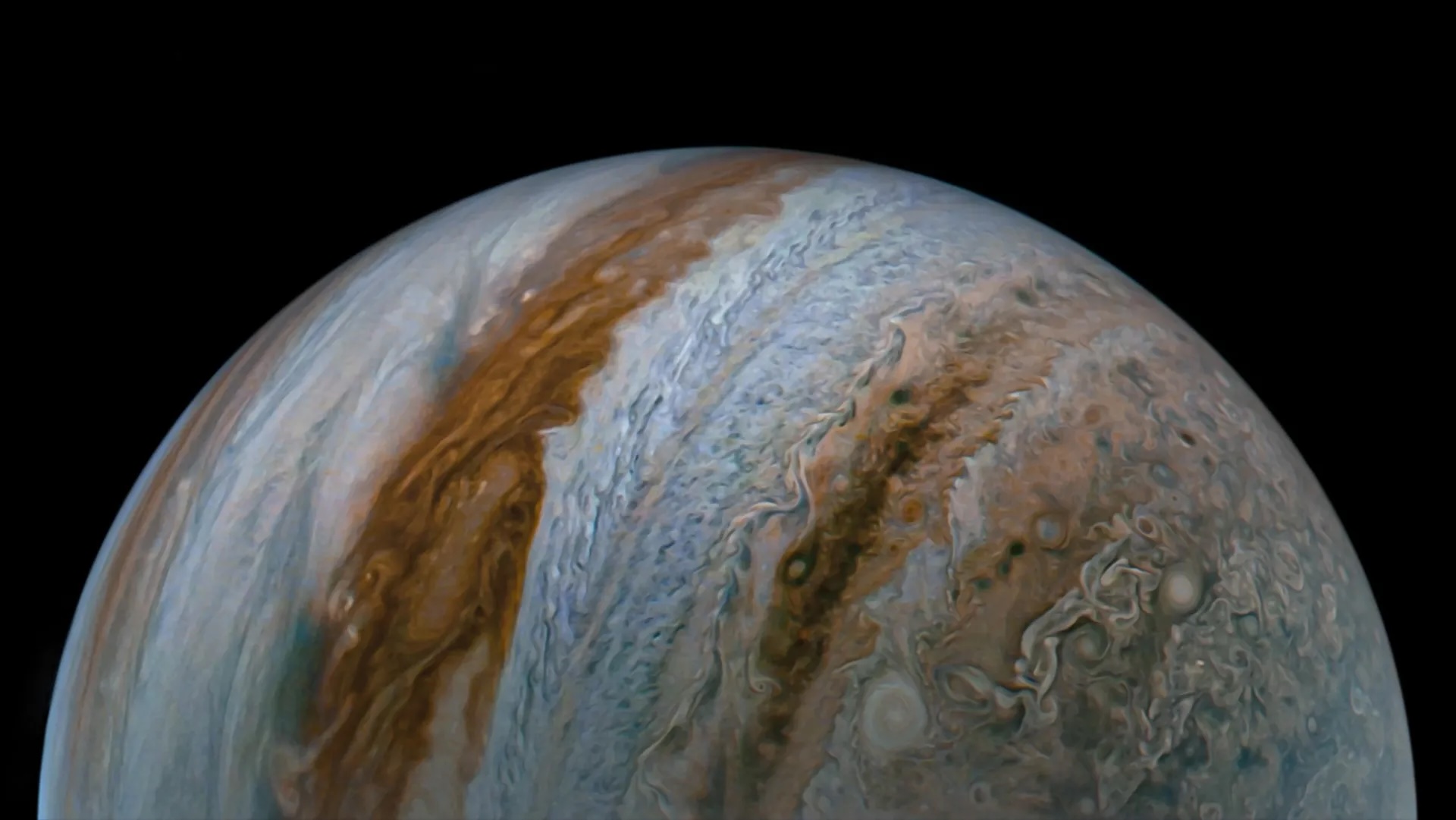
A massive solar windstorm in 2017 compressed Jupiter’s magnetosphere “like a giant squash ball,” a new study reports.
The discovery stemmed from an unusual temperature pattern scientists observed in Jupiter‘s atmosphere using the Keck Observatory in Hawai’i. Normally, Jupiter’s powerful polar auroras inject significant heat into the gas giant’s upper atmosphere near the poles.
These spectacular lights resemble those seen on Earth, where they’re generated when energetic particles interact with our planet’s magnetic field, but Jupiter’s auroras are believed to proceed through a different mechanism and are far more intense and energetic.
When scientists from Reading University in England detected unexpectedly high temperatures stretching across half of Jupiter’s circumference — reaching over 930 degrees Fahrenheit (500 degrees Celsius), significantly higher than the typical atmospheric background temperature of 660 degrees F (350 degrees C) — they were baffled.
Related: The chaotic heart of the Milky Way like you’ve never seen it before
“Typically, temperatures decrease gradually toward the equator, reflecting how auroral energy is redistributed across the planet,” the team wrote in their paper, which was published April 3 in the journal Geophysical Research Letters.
As “there are no known heating mechanisms capable of producing a feature with these temperatures outside of the auroral region,” the team proposed that the superheated region was likely “launched” toward the equator from the poles.
To figure out how this might have occurred, the researchers combined ground-based observations from the Keck telescope with data from NASA’s Juno spacecraft, which has been exploring Jupiter and its moons since 2016. They traced the cause of this sudden heat displacement to a dense burst of solar wind that compressed Jupiter’s enormous magnetosphere — a magnetic bubble surrounding the planet, shaped by its own magnetic field. (Earth has one, too! In fact, life would not be possible without it.)
“We have never captured Jupiter’s response to solar wind before — and the way it changed the planet’s atmosphere was very unexpected,” study lead author James O’Donoghue of the University of Reading said in a statement. “This is the first time we’ve ever seen a thing like this on any outer world.”
The compression of the magnetosphere by the solar wind appears to have intensified auroral heating at Jupiter’s poles, causing the upper atmosphere to expand and spill hot gas typically confined to the poles down toward the equator, team members said.
“The solar wind squished Jupiter’s magnetic shield like a giant squash ball,” O’Donoghue said. “This created a super-hot region that spans half the planet. Jupiter’s diameter is 11 times larger than Earth’s, meaning this heated region is enormous.”
And such solar wind events are believed to hit Jupiter two to three times per month!
Scientists had previously thought that Jupiter’s fast rotation would shield it from such effects, keeping auroral heating confined to the polar regions due to barriers created by the planet’s strong winds. However, the new findings challenge that assumption, revealing that even the solar system’s largest planet is at the sun’s mercy.
“We’ve studied Jupiter, Saturn and Uranus in increasing detail over the past decade. These giant planets are not as resistant to the sun’s influence as we thought — they’re vulnerable, like Earth,” O’Donoghue said in the statement.
“Jupiter acts like a laboratory, allowing us to study how the sun affects planets in general,” he added. “By watching what happens there, we can better predict and understand the effects of solar storms which might disrupt GPS, communications and power grids on Earth.”
Originally posted on Space.com.
