Close Menu
  • Home
  • UNSUBSCRIBE
  • News
  • Lifestyle
  • Tech
  • Entertainment
  • Sports
  • Travel
Facebook X (Twitter) WhatsApp
Trending
  • ‘One of the oldest gravestones of a free Black person in America’ discovered in Boston
  • 6,000-year-old broken ribs discovered in Syria may be one of the oldest known cases of child abuse in the world
  • A physicist built a ‘mini-universe’ out of ultracold atoms and watched time being born inside it.
  • Are CAPTCHAs obsolete in the age of AI?
  • Colorful ‘painting-like’ ripples cover an ancient seafloor structure the Bahamas — Earth from space
  • First experiment to thicken Arctic ice with seawater shows promise — but there’s a big catch
  • Heart issues tied to ‘microdamage’ in the brain might raise risk of memory loss, study hints
  • Neanderthals and modern humans may have shared culture 59,000 years ago in Turkey, study finds
Facebook X (Twitter) WhatsApp
Baynard Media
  • Home
  • UNSUBSCRIBE
  • News
  • Lifestyle
  • Tech
  • Entertainment
  • Sports
  • Travel
Baynard Media
Home»Lifestyle»‘Potentially hazardous’ asteroid Ryugu once had ‘flowing water’ inside it, surprising study claims
Lifestyle

‘Potentially hazardous’ asteroid Ryugu once had ‘flowing water’ inside it, surprising study claims

EditorBy EditorSeptember 16, 2025No Comments4 Mins Read
Share Facebook Twitter Pinterest LinkedIn Tumblr Reddit Telegram Email
Share
Facebook Twitter LinkedIn Pinterest Email

Scientists in Japan now believe that liquid water once flowed through the heart of the near-Earth asteroid Ryugu, after researchers detected something unusual in the samples of the space rock that were returned to our planet five years ago.

The surprising findings also have potential implications for how Earth acquired its own water, the researchers say.

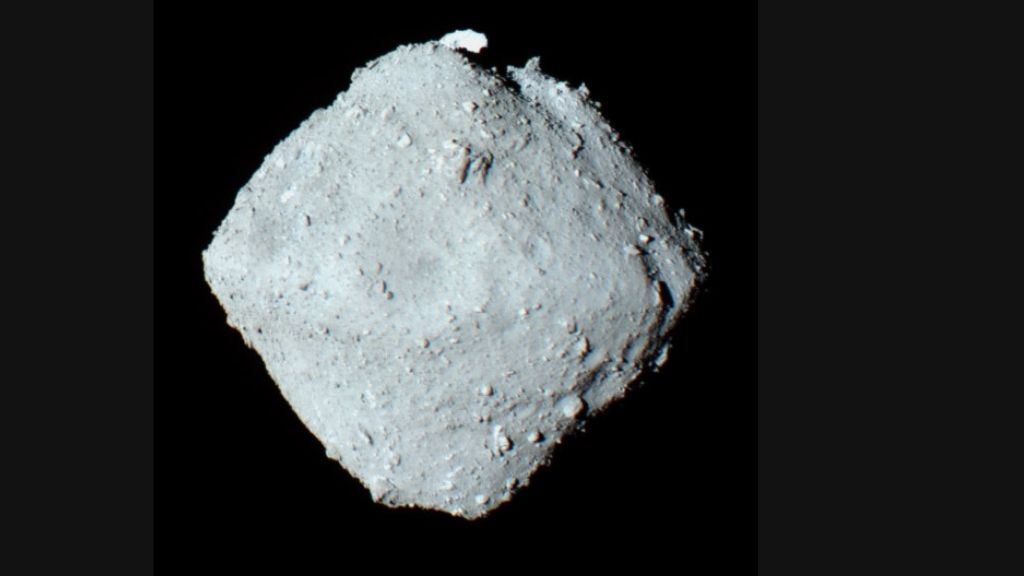
162173 Ryugu is a roughly 3,000-foot-wide (900 meter) asteroid that orbits the sun every 474 days on a trajectory that frequently overlaps with Earth’s. It is unlikely to ever hit our planet, but it is still large enough and comes close enough to us to be considered “potentially hazardous” by NASA.


You may like

Ryugu was visited by Japan’s Hayabusa2 mission between 2018 and 2019, which deployed a probe that landed on the spinning top-shape space rock and collected samples that were later returned to Earth in December 2020.

In a new study, published Sept. 10 in the journal Nature, researchers unearthed chemical irregularities within these samples, which they say can currently be explained only by the historic presence of flowing water within the asteroid.

“We found that Ryugu preserved a pristine record of water activity,” study lead author Tsuyoshi Iizuka, a geochemist at the University of Tokyo in Japan, said in a statement. There is also “evidence that fluids moved through its rocks,” he added. “It was a genuine surprise!”

Related: Key building block for life discovered on distant asteroid Ryugu — and it could explain how life on Earth began

Get the world’s most fascinating discoveries delivered straight to your inbox.

The new findings emerged after the team analyzed the radioactive isotopes — rare versions of elements with an altered atomic mass — of lutetium (Lu) and hafnium (Hf) within the samples.

Lu-176 naturally decays into Hf-176 via beta decay, in which an element spits out charged subatomic particles, such as electrons or positrons, transforming them into something else. By working out the ratio of Lu-176 to Hf-176 and comparing it to the half life of Lu-176 — the time taken for half a sample of the isotope to naturally decay — the team aimed to work out how old the samples were.

But when they carried out their analysis, the researchers found that there was far too much Hf-176 in the samples. The researchers argue that the only thing that could properly explain this result was that ancient liquid water had washed away a majority of Lu-176 within the samples, which could have started happening shortly after Ryugu was born.


You may like

These bits of rock and dust were gathered from the C-type asteroid Ryugu by the spacecraft Hayabusa2.

These bits of rock and dust were gathered from the near-Earth asteroid Ryugu by the spacecraft Hayabusa2 on 2019. (Image credit: Yada, et al.; Nature Astronomy)

A watery past

“The most likely trigger [for the water] was an impact on a larger asteroid parent of Ryugu, which fractured the rock and melted buried ice, allowing liquid water to percolate through the body,” Izuka said.

Recent analysis from the James Webb Space Telescope (JWST) had suggested that Ryugu’s parent asteroid may have also spawned the asteroid Bennu, which was visited by NASA’s OSIRIS-REx mission that later returned samples of the asteroid to Earth in September 2023. However, similar signs of flowing water have not been seen within Bennu’s samples so far, creating uncertainty about the asteroids’ respective origins.

Given that Ryugu likely had flowing water, the researchers also believe that its parent asteroid may have contained ice for at least a billion years after the solar system was formed, which is far longer than most asteroids were thought to be able to hold onto their water.

“This changes how we think about the long-term fate of water in asteroids,” Izuka said. “The water hung around for a long time and was not exhausted so quickly as thought.”

It is widely accepted that a majority of Earth’s water likely came from impacts with asteroids, comets or other planetesimals in the early days of the solar system. The new findings hint that asteroids could have played a much larger role in this process than previously thought, potentially delivering up to three times more water to our planet than expected, the researchers claim.

The study team is now planning to analyze veins of phosphate within the samples, which could pin down a more accurate age for the water that flowed through Ryugu, and look more closely at the isotopes from asteroid Bennu to see if it too has signs of flowing water, according to Live Science’s sister site Space.com.

Source link

Share. Facebook Twitter Pinterest LinkedIn Tumblr Email
Previous ArticleCalifornia state Sen. Scott Wiener calls Charlie Kirk ‘a vile bigot’
Next Article Spain to quit 2026 Eurovision Song Contest if Israel participates
Editor
  • Website

Related Posts

Lifestyle

‘One of the oldest gravestones of a free Black person in America’ discovered in Boston

July 7, 2026
Lifestyle

6,000-year-old broken ribs discovered in Syria may be one of the oldest known cases of child abuse in the world

July 7, 2026
Lifestyle

A physicist built a ‘mini-universe’ out of ultracold atoms and watched time being born inside it.

July 7, 2026
Add A Comment

Comments are closed.

Categories
  • Entertainment
  • Lifestyle
  • News
  • Sports
  • Tech
  • Travel
Recent Posts
  • ‘One of the oldest gravestones of a free Black person in America’ discovered in Boston
  • 6,000-year-old broken ribs discovered in Syria may be one of the oldest known cases of child abuse in the world
  • A physicist built a ‘mini-universe’ out of ultracold atoms and watched time being born inside it.
  • Are CAPTCHAs obsolete in the age of AI?
  • Colorful ‘painting-like’ ripples cover an ancient seafloor structure the Bahamas — Earth from space
calendar
July 2026
M T W T F S S
 12345
6789101112
13141516171819
20212223242526
2728293031  
« Jun    
Recent Posts
  • ‘One of the oldest gravestones of a free Black person in America’ discovered in Boston
  • 6,000-year-old broken ribs discovered in Syria may be one of the oldest known cases of child abuse in the world
  • A physicist built a ‘mini-universe’ out of ultracold atoms and watched time being born inside it.
About

Welcome to Baynard Media, your trusted source for a diverse range of news and insights. We are committed to delivering timely, reliable, and thought-provoking content that keeps you informed
and inspired

Categories
  • Entertainment
  • Lifestyle
  • News
  • Sports
  • Tech
  • Travel
Facebook X (Twitter) Pinterest WhatsApp
  • Contact Us
  • About Us
  • Privacy Policy
  • Disclaimer
  • UNSUBSCRIBE
© 2026 copyrights reserved

Type above and press Enter to search. Press Esc to cancel.