Close Menu
  • Home
  • UNSUBSCRIBE
  • News
  • Lifestyle
  • Tech
  • Entertainment
  • Sports
  • Travel
Facebook X (Twitter) WhatsApp
Trending
  • ‘We can identify these really early, before the clinical diagnosis’: Epigenetic markers may help explain why Native Hawaiians are aging faster
  • Catapult the cow: 6 medieval castles that were never conquered
  • China launches ‘human artificial embryos’ to space for the first time
  • NASA’s Psyche spacecraft beams back blue images of Mars on its way to a metal asteroid
  • Science news this week: Laotian ‘death jar’, climate change threatens rice crops, and an asthma drug treats tough cancer
  • DNA sequencing is rewriting our understanding of historic outbreaks, but it can’t tell the whole story
  • AI-generated images are making it impossible to distinguish truth from fiction. We need laws and AI watermarks to protect our shared reality.
  • Levoit Sprout Evaporative Humidifier review: A child-safe solution to dry air
Facebook X (Twitter) WhatsApp
Baynard Media
  • Home
  • UNSUBSCRIBE
  • News
  • Lifestyle
  • Tech
  • Entertainment
  • Sports
  • Travel
Baynard Media
Home»Lifestyle»Physicists just witnessed pinpricks of darkness moving faster than the speed of light ‪—‬ without breaking the laws of relativity
Lifestyle

Physicists just witnessed pinpricks of darkness moving faster than the speed of light ‪—‬ without breaking the laws of relativity

EditorBy EditorApril 14, 2026No Comments4 Mins Read
Share Facebook Twitter Pinterest LinkedIn Tumblr Reddit Telegram Email
Share
Facebook Twitter LinkedIn Pinterest Email

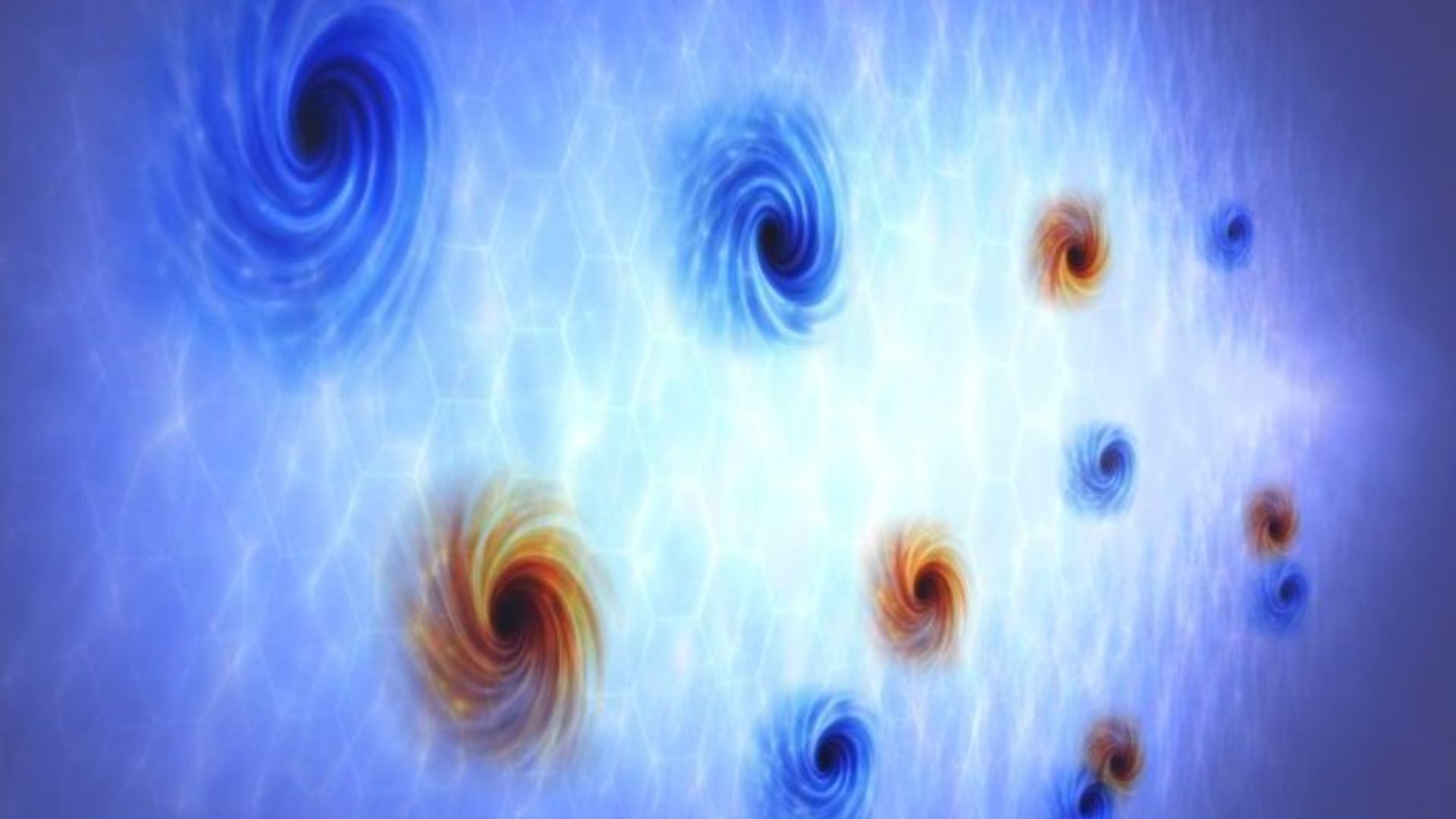
For the first time, researchers have detected empty voids moving faster than the speed of light — and they blazed past that cosmic speed limit without breaking the laws of relativity.

A recent study shows the voids’ acceleration. Researchers used recent advances in ultrafast electron microscopy to measure voids in phonon-polariton waves zooming around inside a thin flake of boron nitride. Phonon-polaritons are quasiparticles formed from photons (quantized light) coupled with tiny vibrations, and they act like light and sound waves combined.

Waves are often visualized as a single squiggle, but in many applications, imagining them as a lake could give a better idea of what’s going on. Lakes are full of waves and ripples that interfere with each other. If the waves interact when they’re at their maximum height, they combine to create an even higher wave. But if they make contact when they’re at their lowest points, they create deeper troughs than they would on their own.


You may like

Sometimes, waves cancel each other out, creating points where the waves’ magnitude drops to zero. In a lake, this would make a temporary whirlpool (a vortex) that moves around that empty point, also called a singularity. These singularities are found throughout nature and mathematics and, since the 1970s, have been theorized to move faster than light speed in some instances, according to a recent statement from the Technion-Israel Institute of Technology.

Blazing past the limit

Einstein’s theory of special relativity states that the speed of light in a vacuum ‪—‬ 299,792,458 meters per second, or about 186,000 miles per second ‪—‬ is the fastest speed information, matter and energy can travel through space. So how do singularities move faster than light speed? Because singularities are empty points of nothingness, they contain no information, no matter and no energy. They are tiny voids, so they don’t have to obey the cosmic speed limit.

These voids don’t just exceed the speed of light ‪—‬ they blaze past it. When two singularities encounter each other, they can sometimes exponentially speed up toward each other until their velocities approach infinity just before they cancel each other out. However, the faster they go, the harder it is to observe them. The recent study, published March 25 in the journal Nature, shows researchers doing just that.

“Our discovery reveals universal laws of nature shared by all types of waves, from sound waves and fluid flows to complex systems such as superconductors,” Ido Kaminer, an electrical and computer engineering professor at the Technion-Israel Institute of Technology and a member of the research team, said in the statement.

Get the world’s most fascinating discoveries delivered straight to your inbox.

The study’s results apply to more than just tiny whirlpools; the null points act enough like particles that scientists can study them to better understand particle interactions. To do this, researchers need to know where the comparison breaks down. The new study shows the voids’ need for speed is a point where the singularities stop acting like particles, since particles obey the cosmic speed limit that voids ignore.

In addition, the team’s new techniques for observing very small, very fast things could light up some previously unexplored pockets across multiple scientific disciplines.

“We believe these innovative microscopy techniques will enable the study of hidden processes in physics, chemistry, and biology, revealing for the first time how nature behaves in its fastest and most elusive moments,” Kaminer added.

Bucher, T., Gorlach, A., Niedermayr, A., Yan, Q., Nahari, H., Wang, K., Ruimy, R., Adiv, Y., Yannai, M., Abudi, T. L., Janzen, E., Spaegele, C., Roques-Carmes, C., Edgar, J. H., Koppens, F. H. L., Vanacore, G. M., Sheinfux, H. H., Tsesses, S., & Kaminer, I. (2026). Superluminal correlations in ensembles of optical phase singularities. Nature, 651(8107), 920–926. https://doi.org/10.1038/s41586-026-10209-z

Source link

Share. Facebook Twitter Pinterest LinkedIn Tumblr Email
Previous ArticleJD Vance says the ball is ‘in Iran’s court’ on potential agreement and more top headlines
Next Article Irvine Wrestles With Budget Shortfall Amid Questions on Future Stability
Editor
  • Website

Related Posts

Lifestyle

‘We can identify these really early, before the clinical diagnosis’: Epigenetic markers may help explain why Native Hawaiians are aging faster

May 24, 2026
Lifestyle

Catapult the cow: 6 medieval castles that were never conquered

May 24, 2026
Lifestyle

China launches ‘human artificial embryos’ to space for the first time

May 24, 2026
Add A Comment

Comments are closed.

Categories
  • Entertainment
  • Lifestyle
  • News
  • Sports
  • Tech
  • Travel
Recent Posts
  • ‘We can identify these really early, before the clinical diagnosis’: Epigenetic markers may help explain why Native Hawaiians are aging faster
  • Catapult the cow: 6 medieval castles that were never conquered
  • China launches ‘human artificial embryos’ to space for the first time
  • NASA’s Psyche spacecraft beams back blue images of Mars on its way to a metal asteroid
  • Science news this week: Laotian ‘death jar’, climate change threatens rice crops, and an asthma drug treats tough cancer
calendar
May 2026
M T W T F S S
 123
45678910
11121314151617
18192021222324
25262728293031
« Apr    
Recent Posts
  • ‘We can identify these really early, before the clinical diagnosis’: Epigenetic markers may help explain why Native Hawaiians are aging faster
  • Catapult the cow: 6 medieval castles that were never conquered
  • China launches ‘human artificial embryos’ to space for the first time
About

Welcome to Baynard Media, your trusted source for a diverse range of news and insights. We are committed to delivering timely, reliable, and thought-provoking content that keeps you informed
and inspired

Categories
  • Entertainment
  • Lifestyle
  • News
  • Sports
  • Tech
  • Travel
Facebook X (Twitter) Pinterest WhatsApp
  • Contact Us
  • About Us
  • Privacy Policy
  • Disclaimer
  • UNSUBSCRIBE
© 2026 copyrights reserved

Type above and press Enter to search. Press Esc to cancel.