Close Menu
  • Home
  • UNSUBSCRIBE
  • News
  • Lifestyle
  • Tech
  • Entertainment
  • Sports
  • Travel
Facebook X (Twitter) WhatsApp
Trending
  • Strange mammal ancestor laid huge, leathery eggs —‬ and it was key to surviving the world’s worst mass extinction
  • Ancient process that created rare earth elements discovered — and it could help us locate desperately needed deposits
  • This humanoid robot does all your housework for you ‪—‬ and its makers say it’s ready for your home
  • ‘Nations need to prepare now’: Key Atlantic ocean current is much closer to collapse than scientists thought
  • Neanderthal toddlers grew faster than modern humans, probably because of the harsh environment they evolved in
  • NASA shuts off another Voyager 1 instrument as humanity’s most distant spacecraft prepares for risky ‘Big Bang’ maneuver to save power
  • Florida is facing its most intense drought in 15 years. Here’s how it got so bad and how long it will last.
  • New blood test aims to spot liver scarring when it’s still reversible and before it paves the way to cancer
Facebook X (Twitter) WhatsApp
Baynard Media
  • Home
  • UNSUBSCRIBE
  • News
  • Lifestyle
  • Tech
  • Entertainment
  • Sports
  • Travel
Baynard Media
Home»Lifestyle»Physicists create ‘black hole bomb’ for first time on Earth, validating decades-old theory
Lifestyle

Physicists create ‘black hole bomb’ for first time on Earth, validating decades-old theory

EditorBy EditorMay 3, 2025No Comments3 Mins Read
Share Facebook Twitter Pinterest LinkedIn Tumblr Reddit Telegram Email
Share
Facebook Twitter LinkedIn Pinterest Email

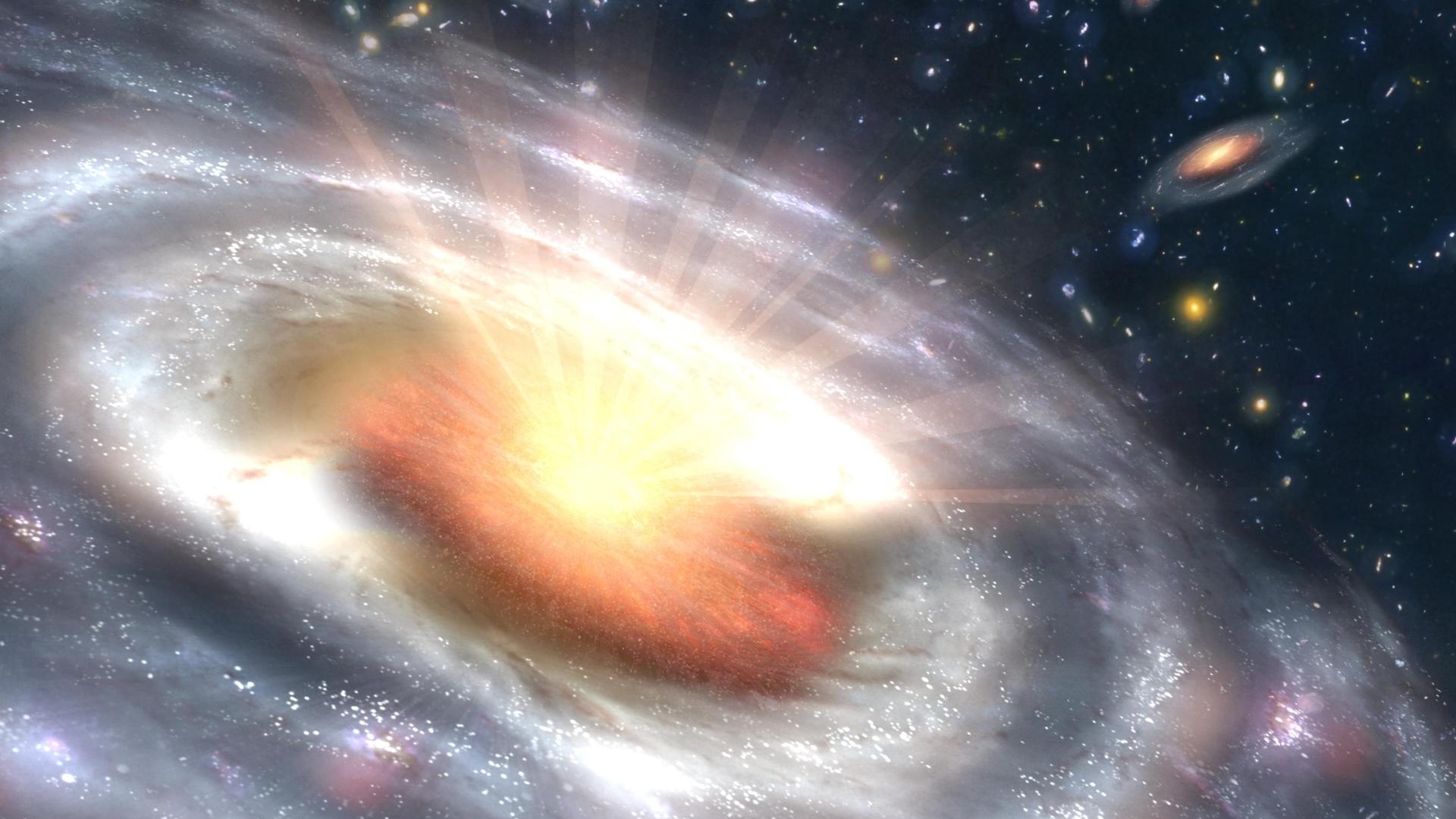
Researchers have created a “black hole bomb” in the lab for the first time.

In 1972, physicists William Press and Saul Teukolsky described a theoretical phenomenon called a black hole bomb, in which mirrors enclose, reflect and exponentially amplify waves emanating from a rotating black hole.

Now, in a new study, physicists from the University of Southampton, the University of Glasgow, and the Institute for Photonics and Nanotechnologies at Italy’s National Research Council experimentally verified the theoretical black hole bomb. This breakthrough will help astrophysicists better understand how black holes spin. The paper was published to the preprint server Arxiv on March 31 and has not yet been peer-reviewed.

The ideas underpinning this and the original 1972 paper trace back to foundational work laid by two other physicists. In 1969, British mathematical physicist and Nobel laureate Sir Roger Penrose proposed a way to extract energy from a rotating black hole, which became known as black hole superradiance. Then, in 1971, Belarussian physicist Yakov Zel’dovich sought to better understand the phenomenon. In the process, he realized that under the right conditions, a rotating object can amplify electromagnetic waves. This phenomenon is known as the Zel’dovich effect.

‘Components exploded’

In their new research, the scientists harnessed the Zel’dovich effect to create their experiment. They took an aluminum cylinder rotated by an electric motor and surrounded it with three layers of metal coils. The coils created and reflected a magnetic field back to the cylinder, acting as a mirror.

As the team directed a weak magnetic field at the cylinder, they observed that the field the cylinder reflected was even stronger, demonstrating superradiance.

Related: Black holes may obey the laws of physics after all, new theory suggests

Get the world’s most fascinating discoveries delivered straight to your inbox.

Next, they removed the coils’ initial weak magnetic field. The circuit, however, generated its own waves, which the spinning cylinder amplified, causing the coils to amass energy. Between the cylinder’s rotational speed and amplified magnetic field, the Zel’dovich effect was in full swing. Zel’dovich had also predicted that a rotating absorber — like the cylinder — would change from absorption to amplification if its surface moves faster than the incoming wave, which the experiment verified.

“Our work brings this prediction fully into the lab, demonstrating not only amplification but also the transition to instability and spontaneous wave generation,” study co-author Maria Chiara Braidotti, a physics research associate at the University of Glasgow, told Live Science in an email.

“We sometimes pushed the system so hard that circuit components exploded,” study co-author Marion Cromb, a researcher at the University of Southampton, told Live Science in an email. “That was both thrilling and a real experimental challenge!”

While the team didn’t create a real black hole, this analog demonstrates the crucial idea that rotational superradiance and exponential amplification are universal and don’t only apply to black holes. This model will also help physicists understand black hole rotation as well as concepts at the intersection of astrophysics, thermodynamics and quantum theory, Braidotti said. Their research is being reviewed for publication in a peer-reviewed journal.


Black hole quiz: How supermassive is your knowledge of the universe?

Source link

Share. Facebook Twitter Pinterest LinkedIn Tumblr Email
Previous ArticleAmateur astronomer captures detailed photos of Croc’s Eye and Whirlpool galaxies from backyard observatory
Next Article Do pandas eat anything besides bamboo?
Editor
  • Website

Related Posts

Lifestyle

Strange mammal ancestor laid huge, leathery eggs —‬ and it was key to surviving the world’s worst mass extinction

April 22, 2026
Lifestyle

Ancient process that created rare earth elements discovered — and it could help us locate desperately needed deposits

April 22, 2026
Lifestyle

This humanoid robot does all your housework for you ‪—‬ and its makers say it’s ready for your home

April 22, 2026
Add A Comment

Comments are closed.

Categories
  • Entertainment
  • Lifestyle
  • News
  • Sports
  • Tech
  • Travel
Recent Posts
  • Strange mammal ancestor laid huge, leathery eggs —‬ and it was key to surviving the world’s worst mass extinction
  • Ancient process that created rare earth elements discovered — and it could help us locate desperately needed deposits
  • This humanoid robot does all your housework for you ‪—‬ and its makers say it’s ready for your home
  • ‘Nations need to prepare now’: Key Atlantic ocean current is much closer to collapse than scientists thought
  • Neanderthal toddlers grew faster than modern humans, probably because of the harsh environment they evolved in
calendar
April 2026
M T W T F S S
 12345
6789101112
13141516171819
20212223242526
27282930  
« Mar    
Recent Posts
  • Strange mammal ancestor laid huge, leathery eggs —‬ and it was key to surviving the world’s worst mass extinction
  • Ancient process that created rare earth elements discovered — and it could help us locate desperately needed deposits
  • This humanoid robot does all your housework for you ‪—‬ and its makers say it’s ready for your home
About

Welcome to Baynard Media, your trusted source for a diverse range of news and insights. We are committed to delivering timely, reliable, and thought-provoking content that keeps you informed
and inspired

Categories
  • Entertainment
  • Lifestyle
  • News
  • Sports
  • Tech
  • Travel
Facebook X (Twitter) Pinterest WhatsApp
  • Contact Us
  • About Us
  • Privacy Policy
  • Disclaimer
  • UNSUBSCRIBE
© 2026 copyrights reserved

Type above and press Enter to search. Press Esc to cancel.