

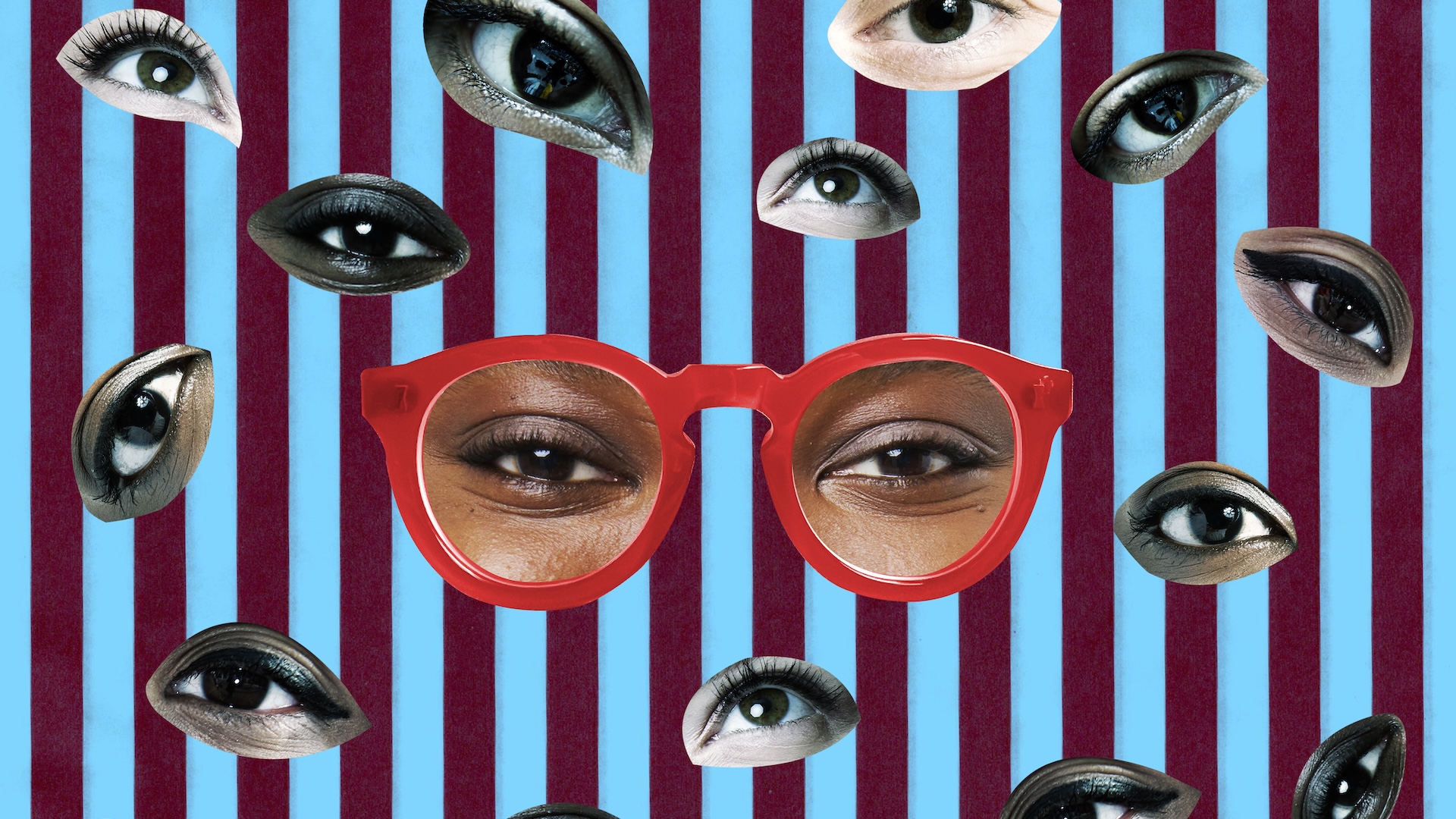
People can read intention in each other’s gazes, recent research finds, lending evidence to this well-known assumption about human communication.
The study reveals how humans use their eyes to communicate nonverbally. In the future, this line of research could lead to a better understanding of how people with conditions that affect social skills, such as autism, process these subtle, nonverbal cues.
You don’t have to be a psychologist to know that the eyes convey a lot of information; there’s a reason for the phrase “the eyes are the window to the soul.” But researchers have long been digging into exactly how the brain picks up tiny eye movements and translates them into an understanding of another person’s thoughts, feelings or mental state. How can we discern when a look is imbued with meaning and when it’s just a casual, meaningless glance?
“We try to find the reason for why our brain engages with social information differently,” said Jelena Ristic, a professor of psychology at McGill University in Canada and the senior author of the study, which was published online in September in the journal Communications Psychology.
Related: Scientists hijacked the human eye to get it to see a brand-new color. It’s called ‘olo.’
In the research, Ristic and her colleagues were interested in understanding whether people respond to intentional eye movements differently than they do to unintentional eye movements. First, they recorded people sitting in front of a screen and moving their eyes in response to prompts on that screen. For instance, the individuals were sometimes prompted to move their eyes left or right — their choice — and other times, they were expressly directed to look one way or the other.
“The only difference between those conditions is that, in one case, people are making intentional eye movements, and in another case, they’re making instructed or non-intentional eye movements,” Ristic told Live Science.
Next, the researchers recruited about 80 participants to watch these recordings, which were clipped just before the people in the video actually moved their eyes. In each clip, the participants were asked to predict which way each person would glance: left or right.
“They were faster to make these decisions when the looks were intentional,” Ristic said. This difference in prediction speed was a matter of a few milliseconds, but it revealed that people process intentional and unintentional gazes differently.
In two follow-up experiments, each with another set of about 70 participants, the researchers tested whether this difference in processing speed changed how people followed the gaze of the person on the screen. Perhaps they’d be faster to track the intentional gazes, for instance. But unexpectedly, the intention did not make a difference, Ristic said.
That suggests that separate processes in the brain might be detecting the intentionality of a person’s glance and then formulating a response. Or perhaps, that information about intentionality is gathered later in the social interaction, after the viewer has adequately observed the other person’s gaze.
The researchers analyzed their video recordings to figure out what participants might be seeing that would help them more quickly predict eye motion before a person intentionally shifted their gaze. To the naked eye, Ristic said, it didn’t look like the recorded individuals were moving at all. But in a close analysis, the researchers found that there was more motion around the eye area before someone chose to move their gaze versus when they were told which way to look. These tiny movements might have been a “tell.”
“We speculate based on this that these very subtle motion signals are communicated very quickly to indicate intentionally to others and that our system [as the observer] is very sensitive to that,” Ristic said.
The next step in the research, she said, will be to use more precise eye-tracking techniques to understand these subtle signals. The researchers will also film new videos in which they ask participants to move their eyes with a particular intention — to help someone or to deceive them, for example — to see if viewers can pick up on the specific intent behind someone’s gaze.
Finally, the team plans to conduct follow-up studies with participants who have a condition that affects social skills, such as autism spectrum disorder or attention-deficit/hyperactivity disorder (ADHD). In these neurodevelopmental disorders, people may struggle to notice and interpret social cues. The researchers are interested in investigating the specific point in processing where these individuals differ from neurotypical people.
“This is one of the holy grail questions in the autism world,” Ristic said. “Where is the system working differently, and in which aspects?”
