Close Menu
  • Home
  • UNSUBSCRIBE
  • News
  • Lifestyle
  • Tech
  • Entertainment
  • Sports
  • Travel
Facebook X (Twitter) WhatsApp
Trending
  • How can we prevent AI models from cannibalizing themselves when human-generated data runs out? Scientists say they’ve found the answer.
  • ‘The system is likely to reach a breaking point’: Major Italian volcano is speeding toward a transition, and a major eruption could be on the way
  • China installs world’s largest floating wind turbine in deep water test — it generates enough energy to power 4,200 homes annually
  • Diagnostic dilemma: A biopsy of a woman’s cancerous tumor caused it to vanish
  • Physicists confirm ‘negative time’ is real in mind-bending quantum experiment
  • Complex animals evolved up to 10 million years earlier than previously thought, fossil discovery shows
  • Scurvy-plagued whalers’ remains discovered at ‘Corpse Point’ on Arctic island
  • Some cancer patients don’t respond to immunotherapy. An existing asthma drug could change that.
Facebook X (Twitter) WhatsApp
Baynard Media
  • Home
  • UNSUBSCRIBE
  • News
  • Lifestyle
  • Tech
  • Entertainment
  • Sports
  • Travel
Baynard Media
Home»Lifestyle»Parts of Arizona are being sucked dry, with areas of land sinking 6 inches per year, satellite data reveals
Lifestyle

Parts of Arizona are being sucked dry, with areas of land sinking 6 inches per year, satellite data reveals

EditorBy EditorNovember 13, 2025No Comments3 Mins Read
Share Facebook Twitter Pinterest LinkedIn Tumblr Reddit Telegram Email
Share
Facebook Twitter LinkedIn Pinterest Email

Satellite data reveals that some areas in Arizona’s Willcox Basin are sinking more than 6 inches (15 centimeters) per year — the fastest rate of subsidence in the state.

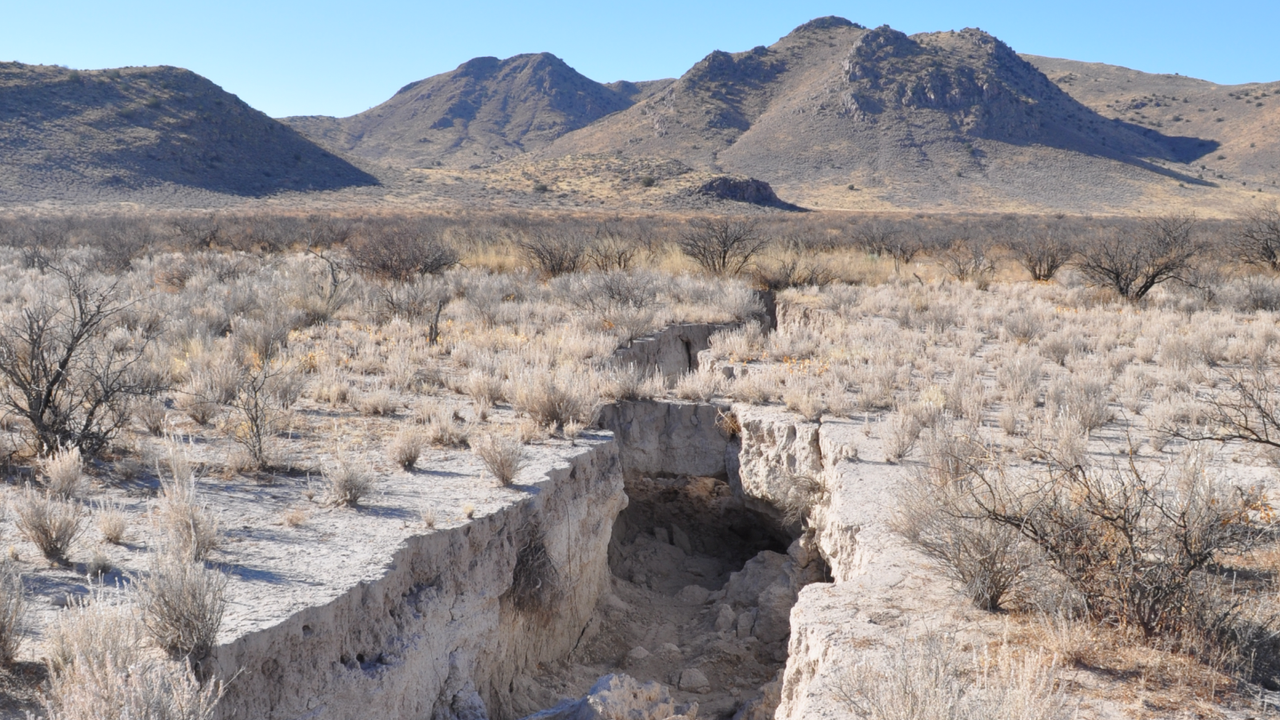
This sinking is the result of intensive groundwater extraction to support agriculture in the region, which lowers the water table in the basin, taking the land surface down with it. Past research has shown that since the mid-20th century, parts of the basin have sunk by up to 12 feet (3.6 meters).

The extraction and subsidence have caused wells to run dry and cracks to open up in the ground. The findings were presented Oct. 20 at The Geological Society of America Connects 2025 in San Antonio.


You may like

Groundwater in the basin fills the spaces between dust and dirt particles below the surface. When this groundwater is removed, the spaces it once filled collapse because the sediment can’t support its own weight. Once the spaces that used to hold water collapse, the change is permanent, and the basin loses its ability to replenish its groundwater.

“Over time, those pore spaces that were once being held open by water pressure start to collapse,” Brian Conway, a geophysicist at the Arizona Department of Water Resources who was not involved in the research, said in a statement. “That causes the overlying surface to sink because of the compaction that’s happening in the subsurface.”

In the new research, Danielle Smilovsky, a researcher at the Conrad Blucher Institute at Texas A&M University-Corpus Christi, used a satellite-based technique known as interferometric synthetic aperture radar (InSAR) to measure changes to Willcox Basin’s surface height between 2017 and 2021. InSAR measures the distance between a satellite orbiting Earth and a point on the planet’s surface. After averaging several measurements that have been taken in sequence, scientists can detect small changes in surface elevation over time.

The research revealed that some parts of Arizona sank nearly 3 feet (1 m) during the study period.

Get the world’s most fascinating discoveries delivered straight to your inbox.

Even heavy rains in 2022 and early 2023 weren’t enough to stop the sinking. Though higher-than-usual precipitation and snowmelt temporarily boosted groundwater levels in the basin, the land kept sinking. In some areas, it even sped up. This suggests that letting the groundwater naturally recharge is unlikely to keep up with extraction.

Regulating groundwater pumping could slow the sinking in the future. In 2024, policymakers declared Willcox Basin an active management area (AMA), which could limit extraction and preserve the basin’s ability to store groundwater. The details of the management plan have not been finalized, but similar plans have helped manage water elsewhere in the state.

“Especially in the Phoenix and Tucson areas, groundwater levels are recovering, and we’ve seen subsidence rates decrease quite a bit,” Conway said in the statement. “In the Tucson area, we’re not even seeing subsidence anymore with the groundwater management.”

Smilovsky took a more cautious long-term view. “I don’t think subsidence will ever stop,” she said in the statement. “But an AMA might slow it down a bit.”

Source link

Share. Facebook Twitter Pinterest LinkedIn Tumblr Email
Previous ArticleGeorgia judge rules city’s gun ordinance unconstitutional, unenforceable
Next Article Judge hears challenge to Trump’s appointment of Lindsey Halligan, the prosecutor in James Comey and Letitia James cases
Editor
  • Website

Related Posts

Lifestyle

How can we prevent AI models from cannibalizing themselves when human-generated data runs out? Scientists say they’ve found the answer.

May 21, 2026
Lifestyle

‘The system is likely to reach a breaking point’: Major Italian volcano is speeding toward a transition, and a major eruption could be on the way

May 21, 2026
Lifestyle

China installs world’s largest floating wind turbine in deep water test — it generates enough energy to power 4,200 homes annually

May 21, 2026
Add A Comment

Comments are closed.

Categories
  • Entertainment
  • Lifestyle
  • News
  • Sports
  • Tech
  • Travel
Recent Posts
  • How can we prevent AI models from cannibalizing themselves when human-generated data runs out? Scientists say they’ve found the answer.
  • ‘The system is likely to reach a breaking point’: Major Italian volcano is speeding toward a transition, and a major eruption could be on the way
  • China installs world’s largest floating wind turbine in deep water test — it generates enough energy to power 4,200 homes annually
  • Diagnostic dilemma: A biopsy of a woman’s cancerous tumor caused it to vanish
  • Physicists confirm ‘negative time’ is real in mind-bending quantum experiment
calendar
May 2026
M T W T F S S
 123
45678910
11121314151617
18192021222324
25262728293031
« Apr    
Recent Posts
  • How can we prevent AI models from cannibalizing themselves when human-generated data runs out? Scientists say they’ve found the answer.
  • ‘The system is likely to reach a breaking point’: Major Italian volcano is speeding toward a transition, and a major eruption could be on the way
  • China installs world’s largest floating wind turbine in deep water test — it generates enough energy to power 4,200 homes annually
About

Welcome to Baynard Media, your trusted source for a diverse range of news and insights. We are committed to delivering timely, reliable, and thought-provoking content that keeps you informed
and inspired

Categories
  • Entertainment
  • Lifestyle
  • News
  • Sports
  • Tech
  • Travel
Facebook X (Twitter) Pinterest WhatsApp
  • Contact Us
  • About Us
  • Privacy Policy
  • Disclaimer
  • UNSUBSCRIBE
© 2026 copyrights reserved

Type above and press Enter to search. Press Esc to cancel.