Close Menu
  • Home
  • UNSUBSCRIBE
  • News
  • Lifestyle
  • Tech
  • Entertainment
  • Sports
  • Travel
Facebook X (Twitter) WhatsApp
Trending
  • Google wants to release 64 million bacteria-riddled mosquitoes across California and Florida. Here’s why scientists are enthusiastic.
  • ‘In an unrecoverable state’: NASA confirms MAVEN spacecraft is officially dead after loss of signal behind Mars
  • 2 rivers merged to form the Euphrates 3.6 million years ago, eventually leading to the Fertile Crescent
  • NASA confirms fireball meteor exploded over northeastern US with force of 230 tons of TNT
  • Astronauts could use lightning-like plasma jets to kill germs on the moon and Mars, demo hints
  • First whole-genome sequence of a Greenland shark holds clues to their extreme longevity
  • Heading a soccer ball just once is enough to raise levels of proteins associated with brain damage
  • OpenAI’s internal AI model just solved an 80-year-old math problem ‪—‬ and mathematicians verified it
Facebook X (Twitter) WhatsApp
Baynard Media
  • Home
  • UNSUBSCRIBE
  • News
  • Lifestyle
  • Tech
  • Entertainment
  • Sports
  • Travel
Baynard Media
Home»Lifestyle»Pale Blue Dot: The iconic Valentine’s Day photo of Earth turns 35 today — and you’re probably in it
Lifestyle

Pale Blue Dot: The iconic Valentine’s Day photo of Earth turns 35 today — and you’re probably in it

EditorBy EditorFebruary 14, 2025No Comments3 Mins Read
Share Facebook Twitter Pinterest LinkedIn Tumblr Reddit Telegram Email
Share
Facebook Twitter LinkedIn Pinterest Email

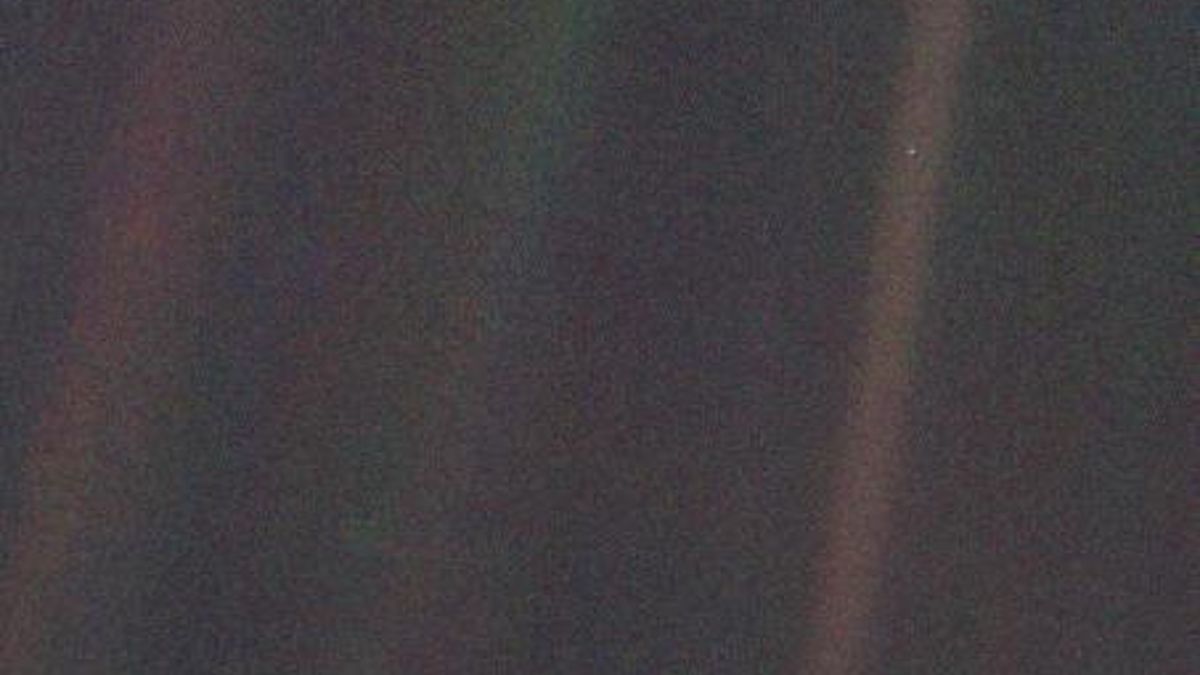
On Valentine’s Day 1990, NASA’s Voyager 1 spacecraft snapped what would become one of the most iconic images ever taken: a view of Earth from 3.7 billion miles (6 billion kilometers) away. In that moment, all of humanity was captured in a ghostly fragment of a pixel swimming through an unrelenting sea of darkness — a “Pale Blue Dot” lost in a void.

Carl Sagan — the astronomer, author, and science communicator best known for the award-winning TV series “Cosmos: A Personal Voyage” — is one of the reasons this picture exists.

As a member of the Voyager team, Sagan helped develop the Golden Records that ride aboard the twin Voyager probes, carrying emblematic examples of human culture and messages of peace to any hypothetical aliens that may one day encounter them. And following the launch of the Voyager 1 probe in 1977, Sagan also suggested that the spacecraft snap a picture of Earth on its journey to the outer solar system.

Capturing the image took a decade of planning, according to The Planetary Society, and overcame risks to the spacecraft’s sensitive cameras and layoffs of critical personnel. But after Voyager 1 finally snapped the photo from beyond the orbit of Neptune, it stored the image on its tape recorder and slowly beamed the information back to Earth’s radio telescopes, pixel by pixel, over the course of three months, according to a newspaper article Sagan wrote for the Prescott Courier (now called the Daily Courier) in 1990.

Related: Earth from space — Incredible images of our planet from above

Writing in his book Pale Blue Dot (1994), Sagan’s famous description of the image is just as relevant and powerful today as it was decades ago.

“Look again at that dot. That’s here. That’s home. That’s us,” Sagan wrote. “On it everyone you love, everyone you know, everyone you ever heard of, every human being who ever was, lived out their lives.”

Get the world’s most fascinating discoveries delivered straight to your inbox.

“Every hunter and forager, every hero and coward, every creator and destroyer of civilization, every king and peasant, every young couple in love, every mother and father, hopeful child, inventor and explorer, every teacher of morals, every corrupt politician, every ‘superstar,’ every ‘supreme leader,’ every saint and sinner in the history of our species lived there — on a mote of dust suspended in a sunbeam.”

A fuzzy image of space with one light blue pixel

An uncropped version of the “Pale Blue Dot” photo. Earth is the bright pixel shining within the right-most sunbeam. (Image credit: NASA/JPL-Caltech)

Thirty-five years later, much has changed for Earth, and for the Voyager probes. Voyager 1 is over 15.5 billion miles (25 billion km) from Earth — four times farther than it was when that photo was taken, and it’s still transmitting science data back to us from interstellar space (despite some occasional technical difficulties).

Unfortunately, interstellar space has proven to be a bit empty, so it looks like Voyager 1 will be spending Valentine’s Day alone yet again. Hopefully, some of us on Earth can spare a little love for the spacecraft that helped us see our fragile, beautiful planet from a new perspective.

Source link

Share. Facebook Twitter Pinterest LinkedIn Tumblr Email
Previous ArticleSir Gino injury: Nicky Henderson tells Unbridled his star is comfortable but fight against infection not over | Racing News
Next Article Kinhank Super Console X2 Pro for just $99.99
Editor
  • Website

Related Posts

Lifestyle

Google wants to release 64 million bacteria-riddled mosquitoes across California and Florida. Here’s why scientists are enthusiastic.

June 3, 2026
Lifestyle

‘In an unrecoverable state’: NASA confirms MAVEN spacecraft is officially dead after loss of signal behind Mars

June 3, 2026
Lifestyle

2 rivers merged to form the Euphrates 3.6 million years ago, eventually leading to the Fertile Crescent

June 2, 2026
Add A Comment

Comments are closed.

Categories
  • Entertainment
  • Lifestyle
  • News
  • Sports
  • Tech
  • Travel
Recent Posts
  • Google wants to release 64 million bacteria-riddled mosquitoes across California and Florida. Here’s why scientists are enthusiastic.
  • ‘In an unrecoverable state’: NASA confirms MAVEN spacecraft is officially dead after loss of signal behind Mars
  • 2 rivers merged to form the Euphrates 3.6 million years ago, eventually leading to the Fertile Crescent
  • NASA confirms fireball meteor exploded over northeastern US with force of 230 tons of TNT
  • Astronauts could use lightning-like plasma jets to kill germs on the moon and Mars, demo hints
calendar
June 2026
M T W T F S S
1234567
891011121314
15161718192021
22232425262728
2930  
« May    
Recent Posts
  • Google wants to release 64 million bacteria-riddled mosquitoes across California and Florida. Here’s why scientists are enthusiastic.
  • ‘In an unrecoverable state’: NASA confirms MAVEN spacecraft is officially dead after loss of signal behind Mars
  • 2 rivers merged to form the Euphrates 3.6 million years ago, eventually leading to the Fertile Crescent
About

Welcome to Baynard Media, your trusted source for a diverse range of news and insights. We are committed to delivering timely, reliable, and thought-provoking content that keeps you informed
and inspired

Categories
  • Entertainment
  • Lifestyle
  • News
  • Sports
  • Tech
  • Travel
Facebook X (Twitter) Pinterest WhatsApp
  • Contact Us
  • About Us
  • Privacy Policy
  • Disclaimer
  • UNSUBSCRIBE
© 2026 copyrights reserved

Type above and press Enter to search. Press Esc to cancel.