Close Menu
  • Home
  • UNSUBSCRIBE
  • News
  • Lifestyle
  • Tech
  • Entertainment
  • Sports
  • Travel
Facebook X (Twitter) WhatsApp
Trending
  • China’s real-life ‘transformer’ mech is a giant humanoid robot that can switch from bounding on 4 legs to walking on 2
  • How can we prevent AI models from cannibalizing themselves when human-generated data runs out? Scientists say they’ve found the answer.
  • ‘The system is likely to reach a breaking point’: Major Italian volcano is speeding toward a transition, and a major eruption could be on the way
  • China installs world’s largest floating wind turbine in deep water test — it generates enough energy to power 4,200 homes annually
  • Diagnostic dilemma: A biopsy of a woman’s cancerous tumor caused it to vanish
  • Physicists confirm ‘negative time’ is real in mind-bending quantum experiment
  • Complex animals evolved up to 10 million years earlier than previously thought, fossil discovery shows
  • Scurvy-plagued whalers’ remains discovered at ‘Corpse Point’ on Arctic island
Facebook X (Twitter) WhatsApp
Baynard Media
  • Home
  • UNSUBSCRIBE
  • News
  • Lifestyle
  • Tech
  • Entertainment
  • Sports
  • Travel
Baynard Media
Home»Lifestyle»Our solar system’s asteroid belt is slowly disappearing
Lifestyle

Our solar system’s asteroid belt is slowly disappearing

EditorBy EditorOctober 2, 2025No Comments3 Mins Read
Share Facebook Twitter Pinterest LinkedIn Tumblr Reddit Telegram Email
Share
Facebook Twitter LinkedIn Pinterest Email

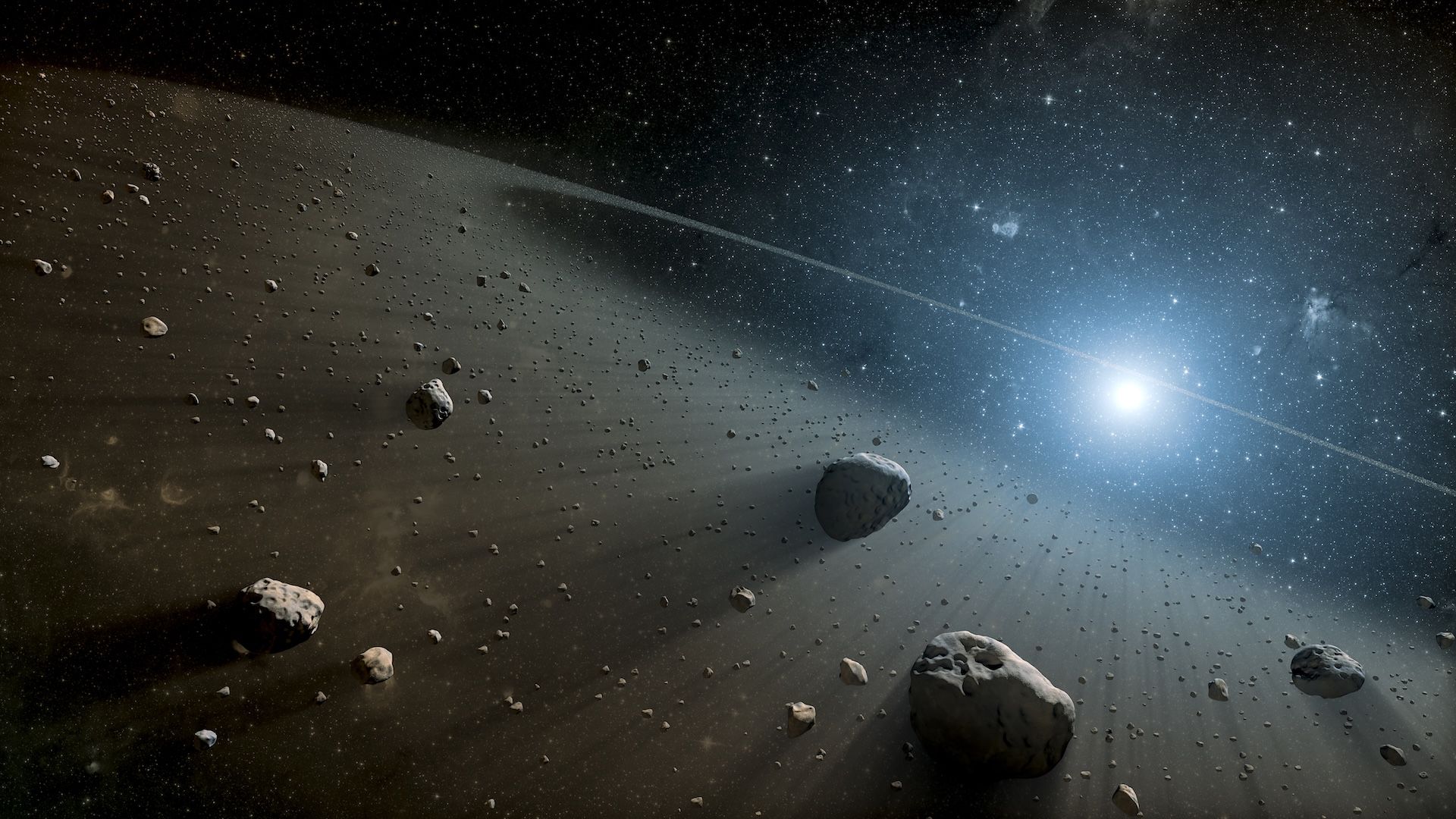
The asteroid belt is found orbiting between Mars and Jupiter and is a vast collection of rocks that is thought to be a planet that never formed. When our Solar System formed 4.6 billion years ago, the material in this region should have coalesced into a planet, however, Jupiter’s gravitational influence prevented this from happening, stirring up the region so that collisions became destructive rather than constructive. What remains today contains only about 3% of the Moon’s mass scattered across millions of kilometres.

Jupiter’s influence didn’t stop there. Gravitational resonances, areas in space where the orbital periods of asteroids create regular interactions with Jupiter, Saturn, and even Mars, destabilise asteroid orbits, flinging fragments either toward the inner Solar System, where Earth resides, or outward toward Jupiter’s orbit. Asteroid fragments that don’t escape are ground down by mutual collisions into meteoritic dust.

A team of astronomers led by Julio Fernández from the Universidad de la República in Uruguay has calculated precisely how fast this depletion of asteroid belt material is progressing. They found that the asteroid belt is currently losing approximately 0.0088% of the portion of the asteroid belt that’s still participating in the ongoing collisions. That might sound like a small number but it represents a significant flow of material when considered over the immense timescales of Solar System evolution.


You may like

What makes this result particularly interesting is how that lost mass splits up between different fates. About 20% escapes as asteroids and meteoroids that occasionally cross Earth’s orbit and sometimes make rather dramatic entrances into our atmosphere as meteors. The remaining 80% is ground down through mutual collisions into meteoritic dust that feeds the faint glow that is the zodiacal dust that is visible in the night sky after sunset or before sunrise. The more familiar asteroids like Ceres, Vesta, and Pallas were excluded from the study since they have survived sufficiently long to no longer be participating in the ongoing depletion of material.

An image of Ceres. It is a grayish, cream colored planet with some craters.

Approximate true-color image of Ceres. (Image credit: NASA/JPL-Caltech/UCLA/MPS/DLR/IDA)

Understanding the asteroid belt’s mass loss is important and has a direct implication for Earth’s evolution. The large bodies that escape the belt don’t simply vanish into space, some eventually find their way to the inner Solar System, where they become potential impactors. The research suggests that if the current mass loss rate is extrapolated backward in time, the asteroid belt could have been about 50% more massive around 3.5 billion years ago, with a mass loss rate about twice as high. This correlates remarkably well with geological evidence from the Moon and Earth showing a declining bombardment rate over the past few billion years.

The asteroid belt, is often considered to be a permanent feature of our Solar System, but this research reveals it as a dynamic structure that’s been gradually losing material for billions of years. The glass spherule layers found in Earth’s rock strata reveal a more violent past when a more massive asteroid belt sent far more chunks of rock our way. Today, that bombardment has settled into a steady trickle as the belt continues its slow decline. Understanding this process not only helps us piece together the impact history that shaped Earth’s surface but it also provides crucial data for modeling the future risk from near Earth objects.

The original version of this article was published on Universe Today.

Get the world’s most fascinating discoveries delivered straight to your inbox.

Source link

Share. Facebook Twitter Pinterest LinkedIn Tumblr Email
Previous ArticleICE prepares to deploy agents to Portland amid escalating Antifa attacks
Next Article Israeli military intercept Gaza-bound aid flotilla
Editor
  • Website

Related Posts

Lifestyle

China’s real-life ‘transformer’ mech is a giant humanoid robot that can switch from bounding on 4 legs to walking on 2

May 21, 2026
Lifestyle

How can we prevent AI models from cannibalizing themselves when human-generated data runs out? Scientists say they’ve found the answer.

May 21, 2026
Lifestyle

‘The system is likely to reach a breaking point’: Major Italian volcano is speeding toward a transition, and a major eruption could be on the way

May 21, 2026
Add A Comment

Comments are closed.

Categories
  • Entertainment
  • Lifestyle
  • News
  • Sports
  • Tech
  • Travel
Recent Posts
  • China’s real-life ‘transformer’ mech is a giant humanoid robot that can switch from bounding on 4 legs to walking on 2
  • How can we prevent AI models from cannibalizing themselves when human-generated data runs out? Scientists say they’ve found the answer.
  • ‘The system is likely to reach a breaking point’: Major Italian volcano is speeding toward a transition, and a major eruption could be on the way
  • China installs world’s largest floating wind turbine in deep water test — it generates enough energy to power 4,200 homes annually
  • Diagnostic dilemma: A biopsy of a woman’s cancerous tumor caused it to vanish
calendar
May 2026
M T W T F S S
 123
45678910
11121314151617
18192021222324
25262728293031
« Apr    
Recent Posts
  • China’s real-life ‘transformer’ mech is a giant humanoid robot that can switch from bounding on 4 legs to walking on 2
  • How can we prevent AI models from cannibalizing themselves when human-generated data runs out? Scientists say they’ve found the answer.
  • ‘The system is likely to reach a breaking point’: Major Italian volcano is speeding toward a transition, and a major eruption could be on the way
About

Welcome to Baynard Media, your trusted source for a diverse range of news and insights. We are committed to delivering timely, reliable, and thought-provoking content that keeps you informed
and inspired

Categories
  • Entertainment
  • Lifestyle
  • News
  • Sports
  • Tech
  • Travel
Facebook X (Twitter) Pinterest WhatsApp
  • Contact Us
  • About Us
  • Privacy Policy
  • Disclaimer
  • UNSUBSCRIBE
© 2026 copyrights reserved

Type above and press Enter to search. Press Esc to cancel.