
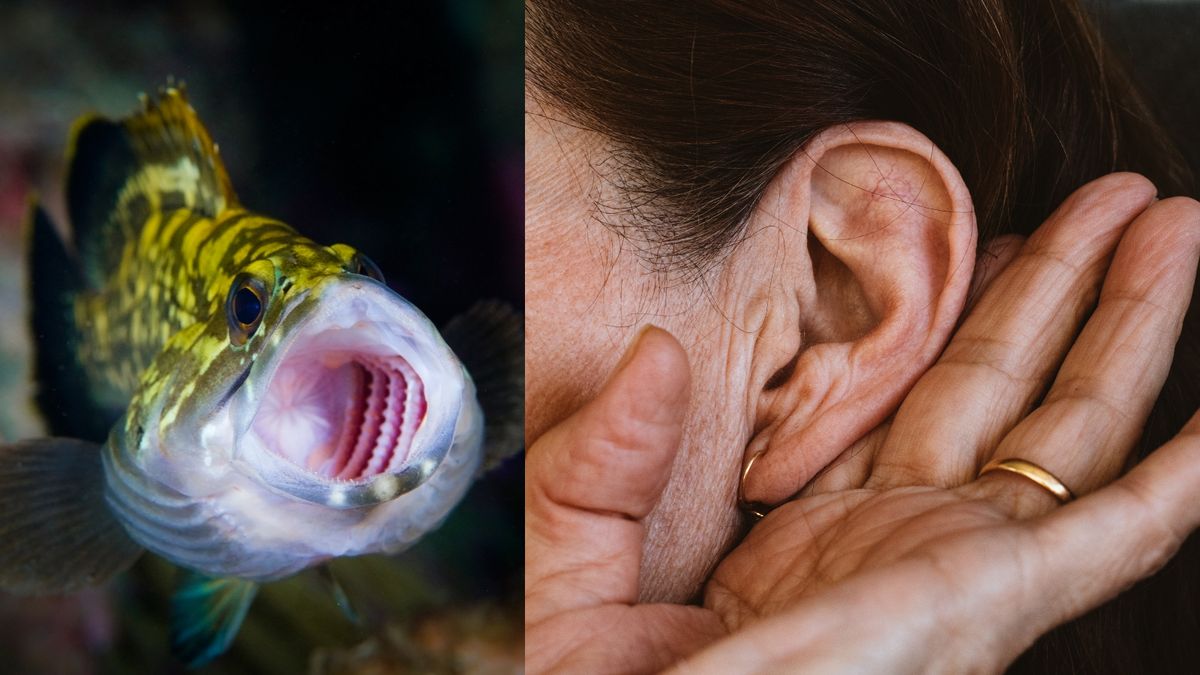
Humans’ outer ears may have evolved from the gills of prehistoric fish, a new study finds.
Gene-editing experiments indicate that cartilage in fish gills migrated into the ear canal millions of years ago during the course of our evolution. Going even further back, our outer ears may have evolutionary roots in ancient marine invertebrates, such as horseshoe crabs, scientists say.
The research sheds new light on the mysterious origins of outer ears, which are unique to mammals. “When we started the project, the evolutionary origin of the outer ear was a complete black box,” study co-author Gage Crump, a professor of stem cell biology and regenerative medicine at the University of Southern California, said in a statement.
Researchers already knew that our middle ears — each of which sits behind the eardrum and comprises three small bones — arose from the jawbones of ancient fish. This example of evolution transforming and repurposing anatomical structures “made us wonder whether the cartilaginous outer ear may also have arisen from some ancestral fish structure,” Crump said.
Related: I’m an evolutionary biologist who investigates real-time evolution in bacteria. These are my 5 must-read science books.
Our outer ears and those of other mammals are made of a subtype of cartilage called elastic cartilage. It is more flexible than either hyaline cartilage or fibrocartilage, which are present in the human nose and in the disks between our vertebrae, respectively.
The key to tracing the origins of humans’ outer ears to fish was the discovery that elastic cartilage is also present in fish gills. “When we started the study, there was very little out there about whether elastic cartilage existed outside of mammals,” Crump said.
The researchers used protein stains to reveal that the gills of zebrafish (Danio rerio), Atlantic salmon (Salmo salar) and three other species of fish contain elastic cartilage. The species are all modern bony fishes, suggesting that elastic cartilage is a general feature in this group, according to the study, which was published Jan. 9 in the journal Nature.
Next, the scientists tested the evolutionary link between elastic cartilage in fish gills and mammalian outer ears. Elastic cartilage doesn’t preserve well in fossils, so the researchers used molecular clues instead. They looked for gene control elements called “enhancers” — short DNA sequences that can activate associated genes when bound by specific proteins.

Because genetic enhancers are highly tissue-specific, researchers can easily detect where the enhancers are active. To test whether enhancer activity — and therefore gene regulation — is similar in fish gills and human outer ears, Crump and his colleagues inserted human outer ear enhancers into zebrafish genomes.
The experiment triggered activity in the gills of zebrafish, hinting at an ancestral link between the genes in human outer ears and fish gills. Then, the researchers conducted the experiment in reverse: They inserted enhancers associated with zebrafish gills into mouse genomes and detected activity in the mice’s outer ears.
Through another series of experiments with tadpoles and green anole lizards (Anolis carolinensis), the team showed that amphibians and reptiles also inherited their gill and ear structures from fish. In lizards, enhancer activity was in the ear canal, which suggests that elastic cartilage had begun migrating from the gills to the outer ear by the time reptiles appeared on Earth around 315 million years ago.
“Our findings suggest that elements of an ancestral gill developmental program were reutilized multiple times through the course of vertebrate evolution to generate diverse gill and ear structures,” the researchers wrote in the study.
Finally, the team found an enhancer in horseshoe crab cells that triggered activity in zebrafish gills. Horseshoe crabs are “living fossils” that emerged around 400 million years ago, and the discovery suggests our outer ears may have much deeper evolutionary roots than previously thought.
Although more research is needed to confirm how deep these roots stretch, “this work provides a new chapter to the evolution of the mammalian ear,” Crump said.
