Close Menu
  • Home
  • UNSUBSCRIBE
  • News
  • Lifestyle
  • Tech
  • Entertainment
  • Sports
  • Travel
Facebook X (Twitter) WhatsApp
Trending
  • New robotic heart mimics common, mysterious condition to help researchers study it
  • Canon EOS R6 III review: A wildlife wonder
  • Medieval babies and adults buried together in Sweden were not related, archaeologists discover — raising big questions about early Christian burial practices
  • NASA is creating a fifth state of matter on the ISS, thanks to an upgrade to a mini-fridge-sized quantum lab
  • New sodium metal battery design charges in just 4 minutes and retains its capacity for years
  • Quantum computing wielded to create extremely rare material critical to nuclear fusion
  • Scientists build tiny ‘diving suit’ for cockroaches, turning them into search-and-rescue cyborgs
  • Physicists develop the first working model of quantum mechanics using only ‘real’ numbers
Facebook X (Twitter) WhatsApp
Baynard Media
  • Home
  • UNSUBSCRIBE
  • News
  • Lifestyle
  • Tech
  • Entertainment
  • Sports
  • Travel
Baynard Media
Home»Lifestyle»Newly discovered near-Earth asteroid isn’t an asteroid at all — it’s Elon Musk’s trashed Tesla
Lifestyle

Newly discovered near-Earth asteroid isn’t an asteroid at all — it’s Elon Musk’s trashed Tesla

EditorBy EditorJanuary 30, 2025No Comments3 Mins Read
Share Facebook Twitter Pinterest LinkedIn Tumblr Reddit Telegram Email
Share
Facebook Twitter LinkedIn Pinterest Email

Astronomers have been left red-faced after announcing the discovery of a new near-Earth asteroid — only to realize that the supposed space rock was the remains of Elon Musk’s cherry-red Tesla Roadster and its spacesuit-clad driver “Starman.”

The misidentified object, which was launched into space on board a SpaceX rocket in 2018, highlights a growing problem in astronomy that could lead to costly errors, researchers say.

On Jan. 2, the International Astronomical Union’s Minor Planet Center (MPC) added a new object, dubbed 2018 CN41, to its list of near-Earth asteroids. The supposed space rock was identified by an unnamed amateur astronomer in Turkey using years of publicly available data, Astronomy.com reported. However, just 17 hours later, the MPC released an editorial notice retracting the discovery after the citizen scientist realized they had made a mistake.

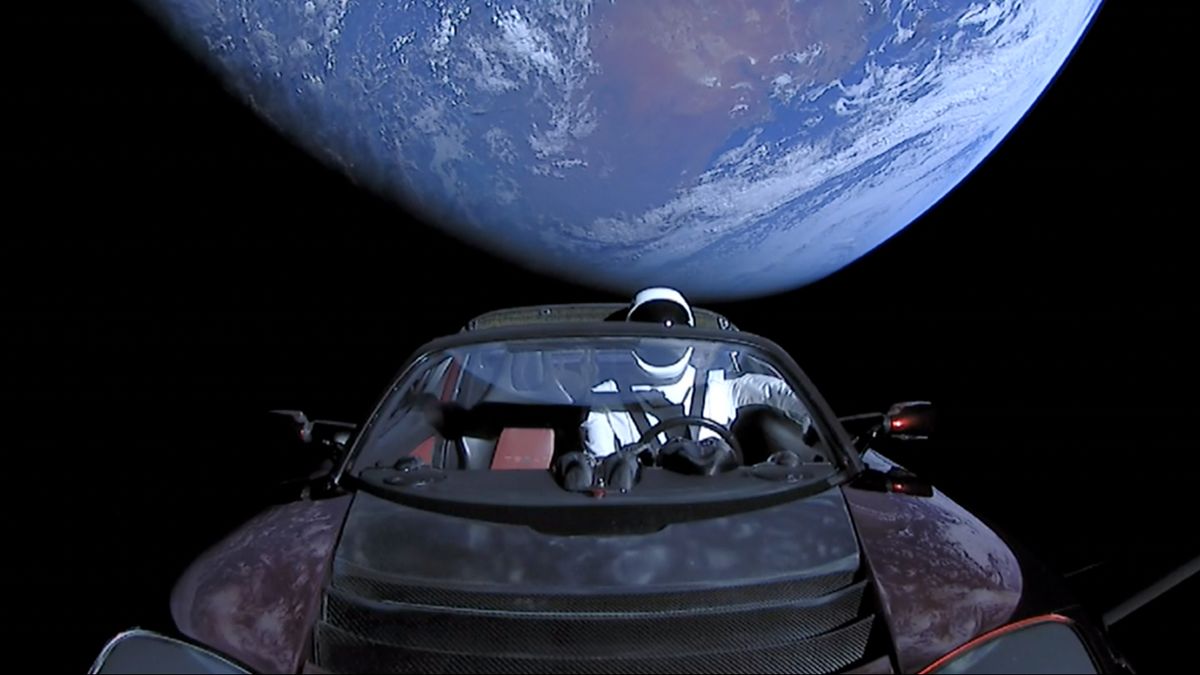
The Tesla Roadster, which was previously used by Elon Musk, was launched into space on Feb. 6, 2018, as the test payload for the maiden launch of SpaceX’s Falcon Heavy rocket. The publicity stunt garnered widespread attention at the time, partly due to Starman — a mannequin in the car’s driving seat that was wearing a likely defective spacesuit and “listening” to David Bowie’s album “Space Oddity” on loop.

The car and its driver headed toward Mars after escaping Earth’s gravity and were supposed to enter a stable orbit around the Red Planet, which raised alarms at the time that it could become a potential Martian “biothreat” if it accidentally crash-landed there. However, the pair overshot their target and instead entered a stable orbit around the sun. Now, it circles the sun and occasionally zooms past Mars.

Related: 15 of the weirdest things we have launched into space

A photo taken from the backseat of the Tesla Roadster showing Starman

The Tesla Roadster and its “driver” Starman were the payload of SpaceX’s first Falcon Heavy rocket launch. (Image credit: SpaceX via Getty Images)

The Tesla has now completed roughly 4.5 trips around the sun, traveling at roughly 45,000 mph (72,000 km/h), according to whereisroadster.com. This means that the car has now exceeded its initial 36,000-mile warranty around 100,00 times.

Get the world’s most fascinating discoveries delivered straight to your inbox.

However, the car is probably unrecognizable now after being exposed to years of intense radiation from the sun and bombarded by tiny fragments of space rocks, which have likely stripped the outer layers of the car and shredded Starman.

Mistaken identity

This is not the first time that human-made objects have been mistaken for near-Earth asteroids. The MPC has temporarily listed a number of spacecraft as space rocks over the last two decades — including the European Space Agency’s Rosetta spacecraft, NASA’s Lucy probe, the joint European-Japanese BepiColombo mission and others — as well as rocket boosters and other debris, according to Astronomy.com.

This type of confusion will also likely increase as more human-made objects are launched into space.

These misidentifications could lead to more false alarms for near-Earth asteroids, which could in turn result in costly errors, Jonathan McDowell, an astronomer at the Harvard and Smithsonian Center for Astrophysics, told Astronomy.com. “Worst case [scenario], you spend a billion [dollars] launching a space probe to study an asteroid and only realize it’s not an asteroid when you get there,” he said.

While space agencies and private companies are required to accurately track their products in orbit around Earth, there is currently no legislation that forces them to do the same for spacecraft and debris that escape Earth’s gravity, like the Tesla Roadster.

However, “such transparency is essential for promoting space situational awareness, reducing interference between missions, [and] avoiding interference with observations of natural objects,” members of the American Astronomical Society warned in a 2024 statement.

Source link

Share. Facebook Twitter Pinterest LinkedIn Tumblr Email
Previous ArticleShop Nintendo Games up to 70% off at Best Buy
Next Article Best Amazon deals of the day: M4 iPad Pro, Google Nest doorbell, Samsung Galaxy Tab S9 FE+, Hisense 65-inch TV, Sony SRS-XG300 speaker
Editor
  • Website

Related Posts

Lifestyle

New robotic heart mimics common, mysterious condition to help researchers study it

July 11, 2026
Lifestyle

Canon EOS R6 III review: A wildlife wonder

July 10, 2026
Lifestyle

Medieval babies and adults buried together in Sweden were not related, archaeologists discover — raising big questions about early Christian burial practices

July 10, 2026
Add A Comment

Comments are closed.

Categories
  • Entertainment
  • Lifestyle
  • News
  • Sports
  • Tech
  • Travel
Recent Posts
  • New robotic heart mimics common, mysterious condition to help researchers study it
  • Canon EOS R6 III review: A wildlife wonder
  • Medieval babies and adults buried together in Sweden were not related, archaeologists discover — raising big questions about early Christian burial practices
  • NASA is creating a fifth state of matter on the ISS, thanks to an upgrade to a mini-fridge-sized quantum lab
  • New sodium metal battery design charges in just 4 minutes and retains its capacity for years
calendar
July 2026
M T W T F S S
 12345
6789101112
13141516171819
20212223242526
2728293031  
« Jun    
Recent Posts
  • New robotic heart mimics common, mysterious condition to help researchers study it
  • Canon EOS R6 III review: A wildlife wonder
  • Medieval babies and adults buried together in Sweden were not related, archaeologists discover — raising big questions about early Christian burial practices
About

Welcome to Baynard Media, your trusted source for a diverse range of news and insights. We are committed to delivering timely, reliable, and thought-provoking content that keeps you informed
and inspired

Categories
  • Entertainment
  • Lifestyle
  • News
  • Sports
  • Tech
  • Travel
Facebook X (Twitter) Pinterest WhatsApp
  • Contact Us
  • About Us
  • Privacy Policy
  • Disclaimer
  • UNSUBSCRIBE
© 2026 copyrights reserved

Type above and press Enter to search. Press Esc to cancel.