Close Menu
  • Home
  • UNSUBSCRIBE
  • News
  • Lifestyle
  • Tech
  • Entertainment
  • Sports
  • Travel
Facebook X (Twitter) WhatsApp
Trending
  • Arthritis drug shows antiviral effects against RSV, the leading cause of infant hospitalization
  • Daddy longlegs may be capturing and devouring frogs in the tropical forests of South America
  • Google wants to release 64 million bacteria-riddled mosquitoes across California and Florida. Here’s why scientists are enthusiastic.
  • ‘In an unrecoverable state’: NASA confirms MAVEN spacecraft is officially dead after loss of signal behind Mars
  • 2 rivers merged to form the Euphrates 3.6 million years ago, eventually leading to the Fertile Crescent
  • NASA confirms fireball meteor exploded over northeastern US with force of 230 tons of TNT
  • Astronauts could use lightning-like plasma jets to kill germs on the moon and Mars, demo hints
  • First whole-genome sequence of a Greenland shark holds clues to their extreme longevity
Facebook X (Twitter) WhatsApp
Baynard Media
  • Home
  • UNSUBSCRIBE
  • News
  • Lifestyle
  • Tech
  • Entertainment
  • Sports
  • Travel
Baynard Media
Home»News»New Zealand scientists suspect specimen of world’s rarest whale died from head injuries
News

New Zealand scientists suspect specimen of world’s rarest whale died from head injuries

EditorBy EditorDecember 13, 2024No Comments3 Mins Read
Share Facebook Twitter Pinterest LinkedIn Tumblr Reddit Telegram Email
Share
Facebook Twitter LinkedIn Pinterest Email

Scientists suspect the first complete specimen ever recorded of the world’s rarest whale died from head injuries, an expert said Friday.

The first dissection of a spade-toothed whale, a type of beaked whale, was completed last week after a painstaking examination at a research center near the New Zealand city of Dunedin, the local people who led the scientific team, Te Rūnanga Ōtākou, said in a statement issued by the New Zealand Department of Conservation.

WHALE CAUGHT ON CAMERA SURPRISING NEW YORK CITY RESIDENTS DURING SWIM NEAR BROOKLYN

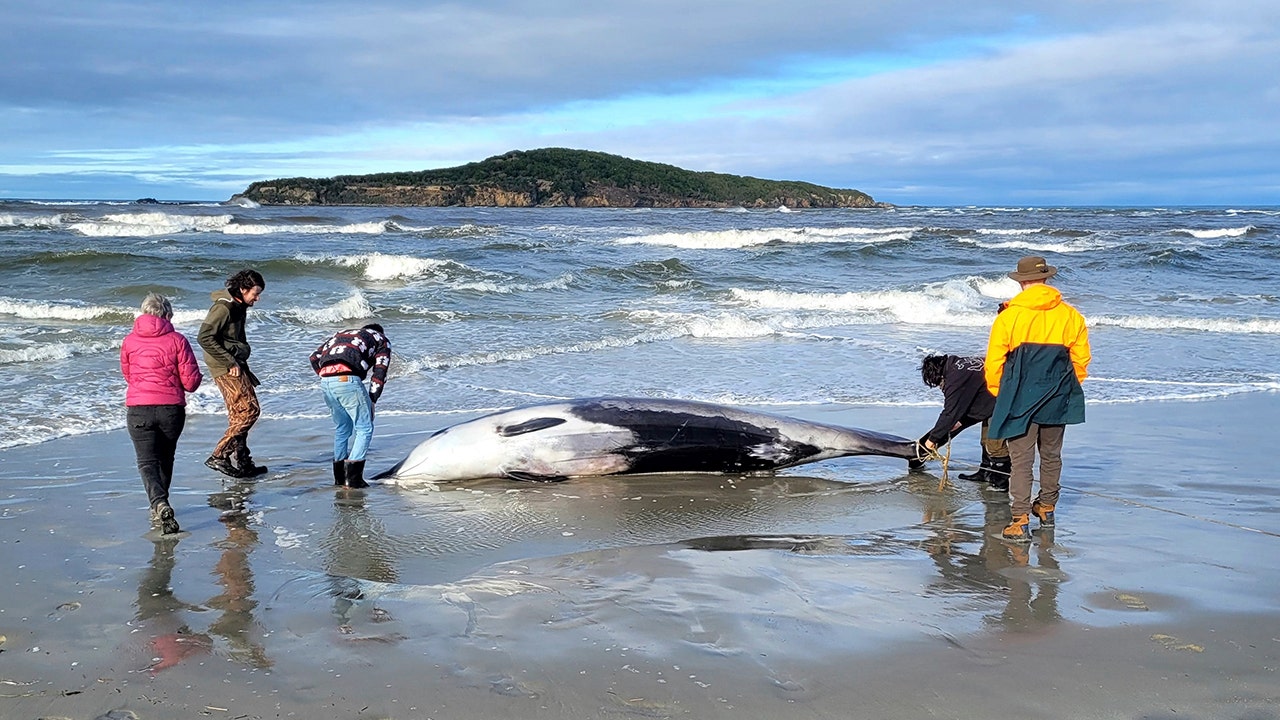
A near-perfectly preserved 5-meter (16-foot) male was found washed up on a South Island beach in July. It was the first complete specimen ever recorded. There have only been seven known sightings and never of a living spade-toothed whale.

New Zealand conservation agency beaked whale expert Anton van Helden said the whale’s broken jaw and bruising to the head and neck led scientists to believe that head trauma may have caused its death.

New Zealand Rarest Whale

In this photo provided by the New Zealand Department of Conservation, rangers inspect what is believed to be a rare spade-toothed whale on July 5, 2024, after it was found washed ashore on a beach near Otago, New Zealand.  (Department of Conservation via AP)

“We don’t know, but we suspect there must have been some sort of trauma, but what caused that could be anyone’s guess,” van Helden said in a statement.

All varieties of beaked whales have different stomach systems and researchers didn’t know how the spade-toothed type processed its food.

The scientific team found the specimen had nine stomach chambers containing remnants of squid and parasitic worms, the statement said.

Among the more interesting finds were tiny vestigial teeth in the upper jaw.

“These little teeth embedded in the gum tells us something about their evolutionary history. It’s remarkable to see this and it’s just another thing that we had no idea about,” van Helden said.

“It’s a week I’ll never forget in my life, it’s certainly a highlight and it’s the start of the storytelling around this beautiful animal,” van Helden added.

The dissection was also notable because scientists and curators worked together with local Māori people to incorporate Indigenous knowledge and customs into each step of the process.

Following the dissection, the local iwi, or tribe, will keep the jawbone and teeth of the whale before its skeleton is displayed in a museum. 3D printing will be used to replicate those parts retained by the iwi.

To Māori, whales are a taonga -– a precious treasure -– and the creature has been treated with the reverence afforded to an ancestor.

CLICK HERE TO GET THE FOX NEWS APP

New Zealand is a whale-stranding hotspot, with more than 5,000 episodes recorded since 1840, according to the Department of Conservation.

The first spade-toothed whale bones were found in 1872 on New Zealand’s Pitt Island. Another discovery was made at an offshore island in the 1950s, and the bones of a third were found on Chile’s Robinson Crusoe Island in 1986.

Source link

Share. Facebook Twitter Pinterest LinkedIn Tumblr Email
Previous ArticleMicrosoft’s controversial Recall feature doesn’t always filter out sensitive information, test shows
Next Article Tip to San Fran police helped FBI identify UnitedHealth CEO suspect, Luigi Mangione: source
Editor
  • Website

Related Posts

News

Omar files new financial form in response to Trump, GOP critics

April 21, 2026
News

Ex-CENTCOM commanderwarns against ‘risky’ US ground op to seize Iran uranium

April 21, 2026
News

Santa Ana’s Upcoming Report on Police Firing on ICE Protesters Lacks Details

April 21, 2026
Add A Comment

Comments are closed.

Categories
  • Entertainment
  • Lifestyle
  • News
  • Sports
  • Tech
  • Travel
Recent Posts
  • Arthritis drug shows antiviral effects against RSV, the leading cause of infant hospitalization
  • Daddy longlegs may be capturing and devouring frogs in the tropical forests of South America
  • Google wants to release 64 million bacteria-riddled mosquitoes across California and Florida. Here’s why scientists are enthusiastic.
  • ‘In an unrecoverable state’: NASA confirms MAVEN spacecraft is officially dead after loss of signal behind Mars
  • 2 rivers merged to form the Euphrates 3.6 million years ago, eventually leading to the Fertile Crescent
calendar
June 2026
M T W T F S S
1234567
891011121314
15161718192021
22232425262728
2930  
« May    
Recent Posts
  • Arthritis drug shows antiviral effects against RSV, the leading cause of infant hospitalization
  • Daddy longlegs may be capturing and devouring frogs in the tropical forests of South America
  • Google wants to release 64 million bacteria-riddled mosquitoes across California and Florida. Here’s why scientists are enthusiastic.
About

Welcome to Baynard Media, your trusted source for a diverse range of news and insights. We are committed to delivering timely, reliable, and thought-provoking content that keeps you informed
and inspired

Categories
  • Entertainment
  • Lifestyle
  • News
  • Sports
  • Tech
  • Travel
Facebook X (Twitter) Pinterest WhatsApp
  • Contact Us
  • About Us
  • Privacy Policy
  • Disclaimer
  • UNSUBSCRIBE
© 2026 copyrights reserved

Type above and press Enter to search. Press Esc to cancel.