Close Menu
  • Home
  • UNSUBSCRIBE
  • News
  • Lifestyle
  • Tech
  • Entertainment
  • Sports
  • Travel
Facebook X (Twitter) WhatsApp
Trending
  • Trump expected to nominate ousted FEMA chief to lead agency again
  • Some polar bears are adapting to their melting habitat. Will it be enough to save the iconic species?
  • Snapchat maker cuts 1,000 jobs in AI-driven restructuring
  • Bassist Melvin Gibbs on ‘How Black Music Took Over the World’
  • Portugal D7 Visa for Foreigners: The Complete Guide
  • Maine Senate candidate Graham Platner apologizes for using ‘R-word’
  • Orange County, No Longer the “Dirty Tricks Capital of California”
  • Colorado River may have pooled and spilled over to form the Grand Canyon, solving a long-standing mystery ‪—‬ but not everyone agrees
Facebook X (Twitter) WhatsApp
Baynard Media
  • Home
  • UNSUBSCRIBE
  • News
  • Lifestyle
  • Tech
  • Entertainment
  • Sports
  • Travel
Baynard Media
Home»Lifestyle»New species of Jurassic ‘sword dragon’ could help solve an evolutionary mystery
Lifestyle

New species of Jurassic ‘sword dragon’ could help solve an evolutionary mystery

EditorBy EditorOctober 10, 2025No Comments3 Mins Read
Share Facebook Twitter Pinterest LinkedIn Tumblr Reddit Telegram Email
Share
Facebook Twitter LinkedIn Pinterest Email

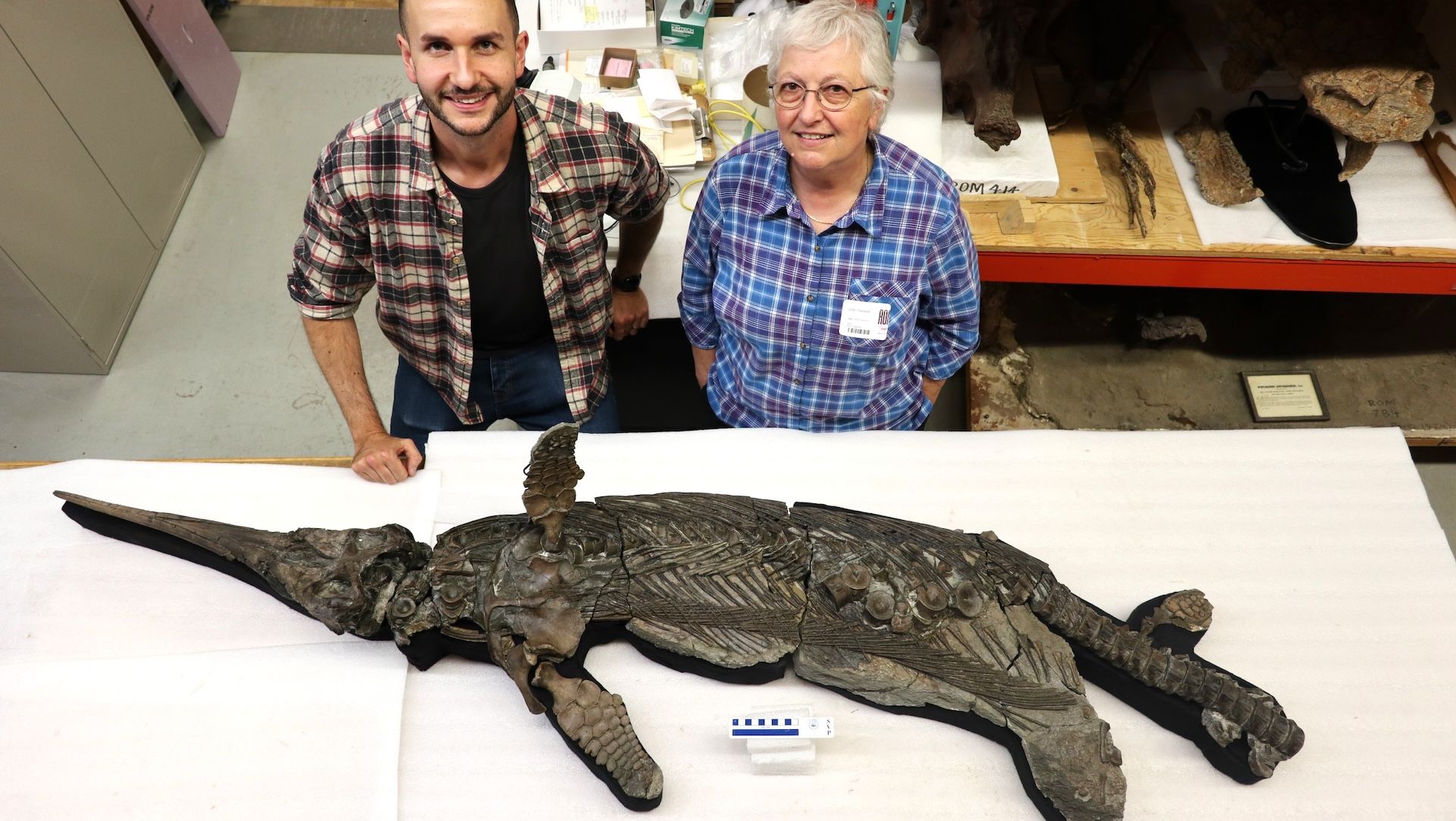
A nearly complete fossil skeleton found on the U.K.’s Jurassic Coast represents a newly identified species of ancient marine reptile that lived alongside dinosaurs.

The ichthyosaur, dubbed Xiphodracon goldencapsis, was likely around 10 feet (3 meters) long when it lived, according to a study published Friday (Oct. 10) in the journal Papers in Palaeontology. It had large eye sockets and a long, narrow snout shaped like a sword.

The specimen dates to a period in the Early Jurassic known as the Pliensbachian, which lasted from about 193 million to 184 million years ago. By studying an ichthyosaur fossil from this period, scientists could learn more about a critical point in these aquatic animals’ evolution, according to the study.


You may like

Fossil collector Chris Moore found the remains in 2001 along the Jurassic Coast, a 96-mile (154 kilometers) stretch of seaboard in Dorset known for being a treasure trove of fossils.

Moore sold the fossil to the Royal Ontario Museum in Canada shortly thereafter. Although it was identified as an ichthyosaur, it wasn’t studied in detail until recently.

“I remember seeing the skeleton for the first time in 2016,” study co-author Dean Lomax, a paleontologist at the University of Manchester and the University of Bristol, said in a statement. “Back then, I knew it was unusual, but I did not expect it to play such a pivotal role in helping to fill a gap in our understanding of a complex faunal turnover during the Pliensbachian.”

A series of views of the Xiphodracon goldencapsis fossil

The ichthyosaur appears to suffered a bite wound to the head by a larger predator, and had malformed bones and teeth indicating serious injury or disease. (Image credit: Dean Lomax, Judy Massare, and Erin Maxwell)

The new genus name, Xiphodracon, comes from the Greek words “xiphos,” meaning sword, and “dracon,” meaning dragon — a reference to ichthyosaurs’ “sea dragons” nickname. Its species name, “goldencapsis,” comes from Golden Cap, the site on the Jurassic Coast where the ichthyosaur was found.

Get the world’s most fascinating discoveries delivered straight to your inbox.

The fossil also hints at how the individual ichthyosaur lived and died.

“The limb bones and teeth are malformed in such a way that points to serious injury or disease while the animal was still alive, and the skull appears to have been bitten by a large predator — likely another much larger species of ichthyosaur — giving us a cause of death for this individual,” study co-author Erin Maxwell, curator of fossil aquatic vertebrates at the State Museum of Natural History Stuttgart in Germany, said in the statement. “Life in the Mesozoic oceans was a dangerous prospect.”

X. goldencapsis could also help to clarify a major shift in ichthyosaur speciation in the early Jurassic. Although scientists have found many ichthyosaur fossils from before and after the Pliensbachian, the two groups have very few species in common, suggesting a major turnover sometime during the Pliensbachian. In fact, ichthyosaur fossils from the Pliensbachian period are rare.

The newly discovered ichthyosaur “is more closely related to species in the later Early Jurassic … and its discovery helps pinpoint when the faunal turnover occurred, being much earlier than expected,” Lomax said. In other words, the shift likely occurred in the early Pliensbachian. However, scientists don’t yet know what caused this upheaval.

For now, the X. goldencapsis fossil will be displayed at the Royal Ontario Museum.

Source link

Share. Facebook Twitter Pinterest LinkedIn Tumblr Email
Previous ArticleMSNBC panel debates if Katie Porter backlash shows double standard for women
Next Article U.S. to send 200 troops to Israel
Editor
  • Website

Related Posts

Lifestyle

Some polar bears are adapting to their melting habitat. Will it be enough to save the iconic species?

April 17, 2026
Lifestyle

Portugal D7 Visa for Foreigners: The Complete Guide

April 17, 2026
Lifestyle

Colorado River may have pooled and spilled over to form the Grand Canyon, solving a long-standing mystery ‪—‬ but not everyone agrees

April 17, 2026
Add A Comment

Comments are closed.

Categories
  • Entertainment
  • Lifestyle
  • News
  • Sports
  • Tech
  • Travel
Recent Posts
  • Trump expected to nominate ousted FEMA chief to lead agency again
  • Some polar bears are adapting to their melting habitat. Will it be enough to save the iconic species?
  • Snapchat maker cuts 1,000 jobs in AI-driven restructuring
  • Bassist Melvin Gibbs on ‘How Black Music Took Over the World’
  • Portugal D7 Visa for Foreigners: The Complete Guide
calendar
April 2026
M T W T F S S
 12345
6789101112
13141516171819
20212223242526
27282930  
« Mar    
Recent Posts
  • Trump expected to nominate ousted FEMA chief to lead agency again
  • Some polar bears are adapting to their melting habitat. Will it be enough to save the iconic species?
  • Snapchat maker cuts 1,000 jobs in AI-driven restructuring
About

Welcome to Baynard Media, your trusted source for a diverse range of news and insights. We are committed to delivering timely, reliable, and thought-provoking content that keeps you informed
and inspired

Categories
  • Entertainment
  • Lifestyle
  • News
  • Sports
  • Tech
  • Travel
Facebook X (Twitter) Pinterest WhatsApp
  • Contact Us
  • About Us
  • Privacy Policy
  • Disclaimer
  • UNSUBSCRIBE
© 2026 copyrights reserved

Type above and press Enter to search. Press Esc to cancel.