Close Menu
  • Home
  • UNSUBSCRIBE
  • News
  • Lifestyle
  • Tech
  • Entertainment
  • Sports
  • Travel
Facebook X (Twitter) WhatsApp
Trending
  • 500-year-old gold dental bridge is earliest known oral care of its kind in Scotland — and it likely held a fake tooth
  • Hantavirus cruise LIVE: Cruise passengers being monitored in several US states as CDC prepares official guidance
  • More doomed Franklin expedition sailors identified, revealing clues about how they tried to find safety
  • Elite warrior’s rare gold sword scabbard discovered by hiker in Norway is ‘among the finest works from the period’
  • New AI model spots pancreatic cancer up to 3 years earlier than human doctors in test
  • Watch NASA’s Curiosity rover ‘struggle’ to remove a rock that got stuck on its robotic arm for nearly a week
  • ‘Almost tragicomical’: Coins minted to protect the English from the Vikings ended up as Viking jewelry, experts discover
  • Andes virus — the only hantavirus strain that can spread between people — identified as culprit on cruise ship
Facebook X (Twitter) WhatsApp
Baynard Media
  • Home
  • UNSUBSCRIBE
  • News
  • Lifestyle
  • Tech
  • Entertainment
  • Sports
  • Travel
Baynard Media
Home»Lifestyle»Nearby exoplanet has grown a tail 44 times longer than Earth — and it’s acting like a giant ‘stellar windsock’
Lifestyle

Nearby exoplanet has grown a tail 44 times longer than Earth — and it’s acting like a giant ‘stellar windsock’

EditorBy EditorDecember 13, 2024No Comments4 Mins Read
Share Facebook Twitter Pinterest LinkedIn Tumblr Reddit Telegram Email
Share
Facebook Twitter LinkedIn Pinterest Email

An alien world near Earth is being trailed by a gigantic tail, stretching longer than 40 Earths as it closely circles its home star. The enormous structure, which is made up of gas leaking from the exoplanet’s atmosphere, is being blown by stellar winds like a giant “windsock,” experts say.

The exoplanet, WASP-69 b, is a gas giant. It’s around the same size as Jupiter but less than a third as massive, and orbits a main sequence star roughly 160 light-years from Earth. It is very close to its star, completing a single trip around the alien sun every 3.9 days.

Since its discovery in 2014, researchers have noticed that WASP-69 b is losing up to 200,000 tons (180,000 metric tons) of mostly helium and some hydrogen gas per second, which is likely being lost as a result of it being superheated by the exoplanet’s star. At this rate, the exoplanet has likely lost up to seven Earth masses during its lifetime, which has lasted around 7 billion years.

Scientists previously speculated that WASP-69 b might have a comet-like tail made up of some of the gas it leaks into space, but this had never been confirmed. However, in a study published Jan. 9 in the journal Astronomy and Astrophysics, researchers analyzed the alien world using data from the W. M. Keck Observatory on Maunakea, Hawaii to precisely measure the planet and its surroundings, and found that it really did have a tail that stretches up to 350,000 miles (560,000 kilometers) long — roughly 44 times as long as Earth is wide.

“Previous observations suggested that WASP-69 b had a modest tail, or no tail at all,” study lead author Dakotah Tyler, an doctoral candidate in astrophysics at UCLA, said in a statement released at the time. “However, we have been able to definitively show that this planet’s helium tail extends at least seven times the radius of the giant [exo]planet itself.”

Related: 32 alien planets that really exist

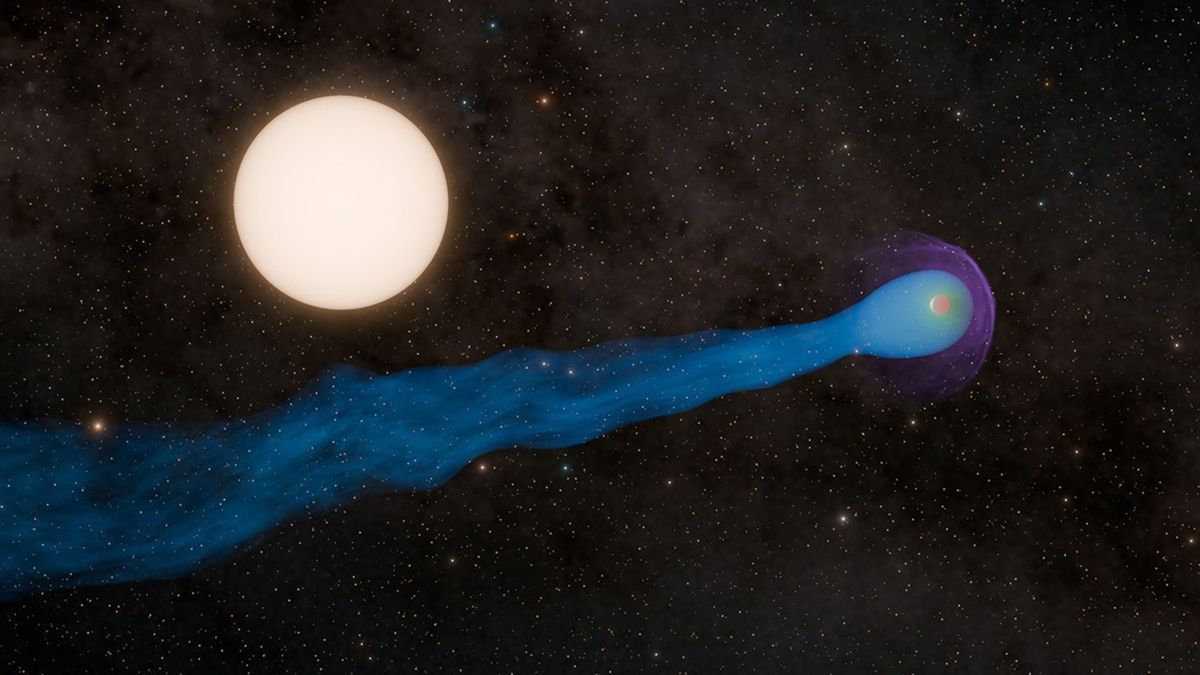
An artist's impression of a star blowing away an exoplanet's atmosphere

Stellar wind is the driving force behind WASP-69 b’s tail, allowing researchers to use the gaseous structure as a “windsock” to learn more about these stellar gusts. (Image credit: W. M. Keck Observatory/Adam Makarenko)

WASP-69 b’s tail forms when “stellar wind” blows the leaking gas away from the exoplanet, creating a trail in its wake. Stellar wind, similar to the sun’s solar wind, is a stream of charged particles that are constantly being spat out by the star. If the stellar wind were to disappear, then the tail would also fade away, researchers wrote.

Get the world’s most fascinating discoveries delivered straight to your inbox.

“If the stellar wind were to taper down, then you could imagine that the planet is still losing some of its atmosphere, but it just isn’t getting shaped into the tail,” Tyler said in a new NASA statement released Dec. 10. Without the stellar wind, that gas escaping on all sides of the planet would be spherical and symmetrical, he said. “But if you crank up the stellar wind, that atmosphere then gets sculpted into a tail.”

The discovery could help us learn more about how gas giants form and evolve over time, and also provides scientists with a rare opportunity to measure the stellar winds of distant stars by using the tail like a giant “windsock,” NASA representatives wrote in the statement.

“These comet-like tails are really valuable because they form when the escaping atmosphere of the planet rams into the stellar wind, which causes the gas to be swept back,” study co-author Erik Petigura, a professor of physics and astronomy at UCLA, said in the earlier statement. “Observing such an extended tail allows us to study these interactions in great detail.”

Source link

Share. Facebook Twitter Pinterest LinkedIn Tumblr Email
Previous ArticleFrance’s Macron names centrist ally François Bayrou as next PM
Next Article Biden channels ‘Ghost of Christmas Past,’ Trump can make education great, and more from Fox News Opinion
Editor
  • Website

Related Posts

Lifestyle

500-year-old gold dental bridge is earliest known oral care of its kind in Scotland — and it likely held a fake tooth

May 8, 2026
Lifestyle

Hantavirus cruise LIVE: Cruise passengers being monitored in several US states as CDC prepares official guidance

May 8, 2026
Lifestyle

More doomed Franklin expedition sailors identified, revealing clues about how they tried to find safety

May 8, 2026
Add A Comment

Comments are closed.

Categories
  • Entertainment
  • Lifestyle
  • News
  • Sports
  • Tech
  • Travel
Recent Posts
  • 500-year-old gold dental bridge is earliest known oral care of its kind in Scotland — and it likely held a fake tooth
  • Hantavirus cruise LIVE: Cruise passengers being monitored in several US states as CDC prepares official guidance
  • More doomed Franklin expedition sailors identified, revealing clues about how they tried to find safety
  • Elite warrior’s rare gold sword scabbard discovered by hiker in Norway is ‘among the finest works from the period’
  • New AI model spots pancreatic cancer up to 3 years earlier than human doctors in test
calendar
May 2026
M T W T F S S
 123
45678910
11121314151617
18192021222324
25262728293031
« Apr    
Recent Posts
  • 500-year-old gold dental bridge is earliest known oral care of its kind in Scotland — and it likely held a fake tooth
  • Hantavirus cruise LIVE: Cruise passengers being monitored in several US states as CDC prepares official guidance
  • More doomed Franklin expedition sailors identified, revealing clues about how they tried to find safety
About

Welcome to Baynard Media, your trusted source for a diverse range of news and insights. We are committed to delivering timely, reliable, and thought-provoking content that keeps you informed
and inspired

Categories
  • Entertainment
  • Lifestyle
  • News
  • Sports
  • Tech
  • Travel
Facebook X (Twitter) Pinterest WhatsApp
  • Contact Us
  • About Us
  • Privacy Policy
  • Disclaimer
  • UNSUBSCRIBE
© 2026 copyrights reserved

Type above and press Enter to search. Press Esc to cancel.