
Close Menu
  • Home
  • UNSUBSCRIBE
  • News
  • Lifestyle
  • Tech
  • Entertainment
  • Sports
  • Travel
Facebook X (Twitter) WhatsApp
Trending
  • Lemur used in ‘lemur yoga’ session dies of human herpesvirus, study finds
  • ‘A fine line between reducing stigma and trivialising conditions’: Social media, self-diagnosis and the glamorization of ADHD
  • New 2D memory device stores data on just a single electron
  • Before we ban kids from social media completely, here’s what we should try first | Jonathan Bellack and Mariana Olaizola Rosenblat
  • Scientists uncover a better way to beat ‘the bends’ — using deep-diving pigs
  • Mars may have been losing its water more than 4 billion years ago, oldest-known Martian meteorite suggests
  • ‘The lance head was still inside the pelvis’: Mass grave found in Austria may hold casualties of unknown ancient Roman battle
  • ‘Full-on berserker mode’: Archaeologists solve mystery of medieval soldiers with gruesome square holes in their skull
Facebook X (Twitter) WhatsApp
Baynard Media
  • Home
  • UNSUBSCRIBE
  • News
  • Lifestyle
  • Tech
  • Entertainment
  • Sports
  • Travel
Baynard Media
Home»Lifestyle»Near-unlimited EV range now a possibility thanks to surprising new technology — solar paint
Lifestyle

Near-unlimited EV range now a possibility thanks to surprising new technology — solar paint

EditorBy EditorDecember 24, 2024No Comments3 Mins Read
Share Facebook Twitter Pinterest LinkedIn Tumblr Reddit Telegram Email
Share
Facebook Twitter LinkedIn Pinterest Email

A new type of solar paint could extend the range of electric vehicles (EVs) to thousands of miles.

Revealing the technology on Nov. 24, automaker Mercedes-Benz representatives said its new photovoltaic paint could power an EV for up to 7,456 miles (12,000 kilometers) per year in optimal lighting conditions.

The “nanoparticle” paint can be applied directly to the body of an EV, reducing dependence on external charging. It is also based on non-toxic and readily available raw materials, making it both environmentally friendly and cost-effective to produce, Mercedes-Benz representatives said in a statement.

The technology could be a game-changer for EVs, particularly in parts of the world that receive lots of sunlight. It would also overcome a key barrier facing current EVs: their comparatively limited range and reliance on charging infrastructure, which varies hugely worldwide.

Related: Future electric cars could go more than 600 miles on a single charge thanks to battery-boosting gel

Most current EVs use high-performance lithium-ion batteries which, while improving every day, are still hindered by long charging times and limited energy density.

Photovoltaic paint converts light energy into an electrical charge via a process known as the photovoltaic effect.

Get the world’s most fascinating discoveries delivered straight to your inbox.

When photons (light particles) hit the paint, semiconductor nanoparticles known as quantum dots absorb the light energy and transfer it to electrons within the material. The movement of electrons creates an electric current, which is collected through tiny conductive layers embedded in the paint. This current can then be directed to the EV’s electrical system to either power its components immediately or charge its battery for later use.

Drivers in LA may never need to charge their EVs again
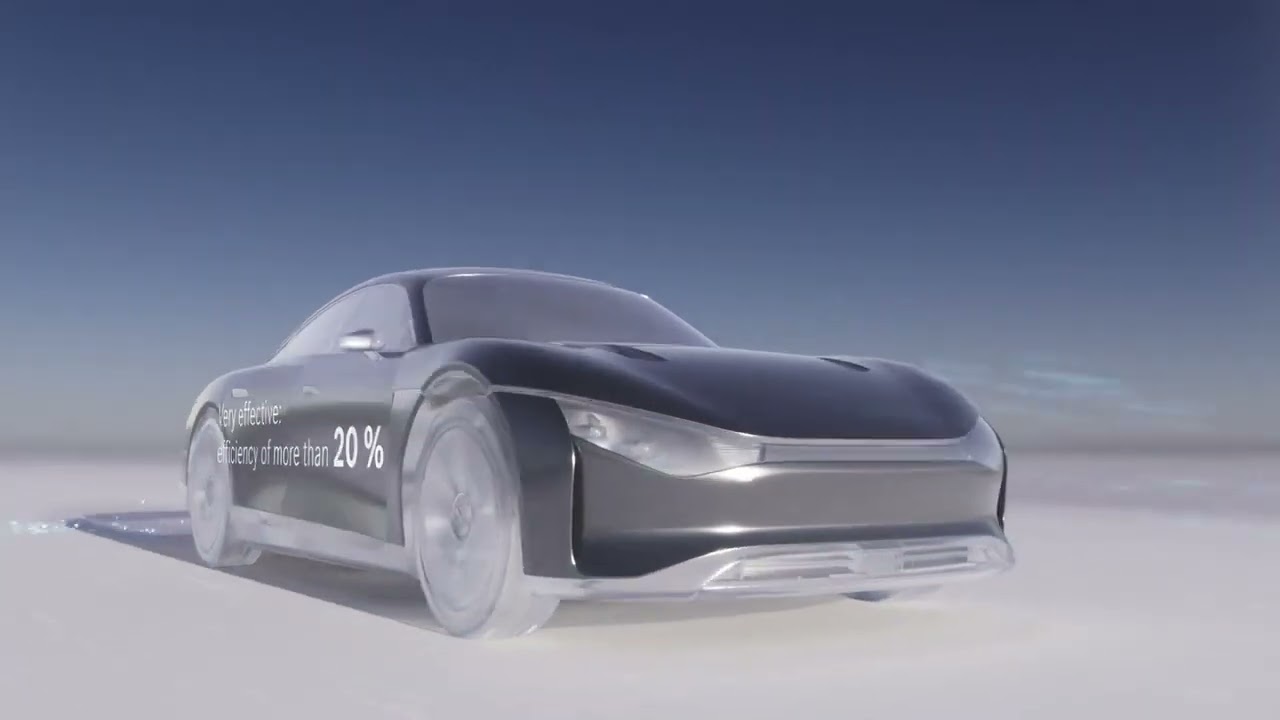
Mercedes-Benz Innovates with Solar-charging Paint – YouTube
Mercedes-Benz Innovates with Solar-charging Paint - YouTube


Watch On

Mercedes-Benz’s solar paint comprises a nanoparticle-based layer beneath the vehicle’s topcoat that allows 94% of the sun’s energy to pass through to the photovoltaic coating underneath. The solar coating is sandwiched between the body panel and the visible layer of paint, meaning it doesn’t affect the vehicle’s appearance.

According to Mercedes-Benz representatives, one paint coating is a mere 5 microns (0.0005 centimeters) thick and weighs just 1.8 ounces (50 grams) per 10.8 square feet (1 square meter, meaning it can be applied to almost any part of the car’s surface akin to “a wafer-thin layer of paste.”

Despite being extremely lightweight, the paint packs an energy efficiency of 20%, meaning one-fifth of sunlight energy that hits its surface is converted into usable power. This is comparable to the efficiency of common solar panels.

The automaker claimed that covering a 118-square-feet (11-square-meter) area — comparable to a mid-size SUV — with the paint generated enough electricity to cover most daily driving needs. For example, drivers in Stuttgart could cover 62% of their daily commute using solar energy alone, while those in sunny Los Angeles might generate enough energy to meet 100% of their driving needs, representatives said.

The photovoltaic system generates energy even when the vehicle is off, assuming there is sunlight. The automaker suggested that excess energy could be fed back into drivers’ homes via bidirectional charging.

Unfortunately, representatives from Mercedes-Benz didn’t specify exactly when (or if) its paint tech would hit the road. Instead, they said their current focus was ensuring it could be applied “on all exterior vehicle surfaces — regardless of their shape and angle.”

Source link

Share. Facebook Twitter Pinterest LinkedIn Tumblr Email
Previous Article4 best VPNs 2024: TunnelBear, NordVPN, and more
Next Article Jacob Elordi's Beard, MGK's Tattoo & More Stars' 2024 Transformations
Editor
  • Website

Related Posts

Lifestyle

Lemur used in ‘lemur yoga’ session dies of human herpesvirus, study finds

August 15, 2026
Lifestyle

‘A fine line between reducing stigma and trivialising conditions’: Social media, self-diagnosis and the glamorization of ADHD

August 15, 2026
Lifestyle

New 2D memory device stores data on just a single electron

August 15, 2026
Add A Comment

Comments are closed.

Categories
  • Entertainment
  • Lifestyle
  • News
  • Sports
  • Tech
  • Travel
Recent Posts
  • Lemur used in ‘lemur yoga’ session dies of human herpesvirus, study finds
  • ‘A fine line between reducing stigma and trivialising conditions’: Social media, self-diagnosis and the glamorization of ADHD
  • New 2D memory device stores data on just a single electron
  • Before we ban kids from social media completely, here’s what we should try first | Jonathan Bellack and Mariana Olaizola Rosenblat
  • Scientists uncover a better way to beat ‘the bends’ — using deep-diving pigs
calendar
August 2026
M T W T F S S
 12
3456789
10111213141516
17181920212223
24252627282930
31  
« Jul    
Recent Posts
  • Lemur used in ‘lemur yoga’ session dies of human herpesvirus, study finds
  • ‘A fine line between reducing stigma and trivialising conditions’: Social media, self-diagnosis and the glamorization of ADHD
  • New 2D memory device stores data on just a single electron
About

Welcome to Baynard Media, your trusted source for a diverse range of news and insights. We are committed to delivering timely, reliable, and thought-provoking content that keeps you informed
and inspired

Categories
  • Entertainment
  • Lifestyle
  • News
  • Sports
  • Tech
  • Travel
Facebook X (Twitter) Pinterest WhatsApp
  • Contact Us
  • About Us
  • Privacy Policy
  • Disclaimer
  • UNSUBSCRIBE
© 2026 copyrights reserved

Type above and press Enter to search. Press Esc to cancel.