Close Menu
  • Home
  • UNSUBSCRIBE
  • News
  • Lifestyle
  • Tech
  • Entertainment
  • Sports
  • Travel
Facebook X (Twitter) WhatsApp
Trending
  • When Spanish Entered a Santa Ana Classroom, Everything Changed
  • Experimental drug doubles one-year survival in pancreatic cancer
  • WrestleMania 42: Bron Breakker costs Seth Rollins match against Gunther
  • Bodycam video released from Chicago officer who fatally shot his partner
  • $3 million prize goes to duo whose research led to first sickle cell CRISPR therapy
  • Nicole Kidman recalls learning of her mother’s death before Venice award
  • Ban on NDAs has narrow path forward after setback in House
  • NIF in Portugal: What it is and How to Apply for it
Facebook X (Twitter) WhatsApp
Baynard Media
  • Home
  • UNSUBSCRIBE
  • News
  • Lifestyle
  • Tech
  • Entertainment
  • Sports
  • Travel
Baynard Media
Home»Lifestyle»‘Near stationary’ Tropical Storm Melissa is moving slower than a person walking — and it may bring deadly flash floods to the Caribbean
Lifestyle

‘Near stationary’ Tropical Storm Melissa is moving slower than a person walking — and it may bring deadly flash floods to the Caribbean

EditorBy EditorOctober 24, 2025No Comments4 Mins Read
Share Facebook Twitter Pinterest LinkedIn Tumblr Reddit Telegram Email
Share
Facebook Twitter LinkedIn Pinterest Email

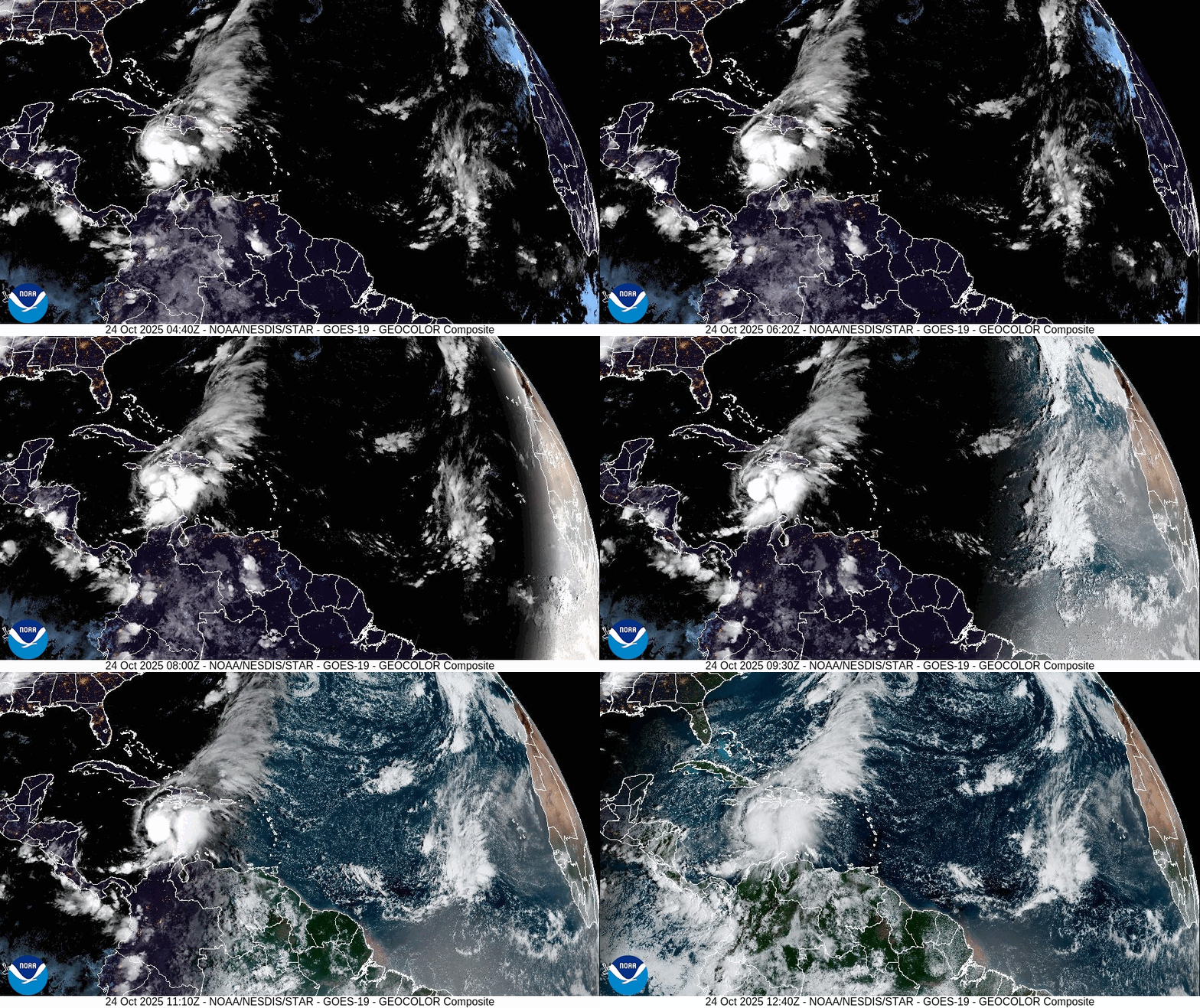
After circling the central Caribbean Sea and remaining ‘near stationary’ this week, Tropical Storm Melissa is now about 160 miles (260 kilometers) southeast of Kingston, Jamaica, and drifting southeastward at 1 mph (1.6 km/h).

The storm’s bafflingly slow advance, which is projected to stay below an average person’s walking speed at around 2 mph (3.2 km/h) over the weekend, could be dire for several Caribbean islands, experts warn.

Tropical Storm Melissa will continue to lumber along a path somewhere between Jamaica and Haiti, with forecasters predicting a slow movement toward the northeast and north in the coming hours, and a westward drift from Saturday (Oct. 25) onward.


You may like

Melissa is expected to bring 8 to 14 inches (20 to 35 centimeters) of rain to parts of the Dominican Republic, Haiti and Jamaica through Sunday (Oct. 26) night, with locally higher amounts possible, according to an update from the National Hurricane Center (NHC) at 8 a.m. ET today (Oct. 24).

“Significant, life-threatening flash flooding and numerous landslides are expected in the southern Dominican Republic and eastern Jamaica, with catastrophic flash flooding and landslides anticipated in southern Haiti,” representatives wrote. “Across northern Dominican Republic, northern Haiti, and western Jamaica, 3 to 5 inches [8 to 13 cm] of rain are expected through Sunday night. Flooding impacts may increase across western Jamaica next week.”

Researchers expect the storm to intensify rapidly into a major Category 3 or above hurricane over the weekend, fueled by near-record-warm Caribbean waters, but the storm is likely to remain incredibly slow-moving, CNN reported.

Melissa is the 13th named storm of the 2025 Atlantic hurricane season. It’s unclear exactly what has been stalling it, but a combination of strong upper-level winds and other dampening conditions across weather systems could be responsible, according to CNN. For instance, the lack of a cold front — a wedge of cold air that pushes warmer air up and causes it to release its energy, creating bad weather — might partially explain Melissa’s crawling speed.

Get the world’s most fascinating discoveries delivered straight to your inbox.

Map showing forecasts for tropical storm Melissa in the Caribbean Sea.

Tropical Storm Melissa is currently about 160 miles southeast of Kingston, Jamaica, but the center of the storm is on the move. (Image credit: NOAA/NWS)

But Melissa’s lagging pace is not as unusual now as it would have been just decades ago. Research indicates that tropical storms are getting slower, particularly as they approach land masses. A 2018 study, for example, found that tropical storms globally slowed by 10% between 1949 and 2016 — and James Kossin, the study’s author, tentatively linked this to human-caused global warming.

“The magnitude of the slowdown varies substantially by region and by latitude, but is generally consistent with expected changes in atmospheric circulation forced by anthropogenic emissions,” Kossin, an atmospheric scientist at the National Oceanic and Atmospheric Administration (NOAA) Center for Weather and Climate and at the University of Wisconsin-Madison, wrote in the study.

In a subsequent study published in 2019, Kossin and a colleague reported that North Atlantic tropical storms have become more likely to “stall” in coastal regions, bringing more rainfall to those areas. The researchers attributed this observation to both slower moving speeds and abrupt changes in direction, noting that tropical storms now spend many hours simply hovering, which is what Melissa is currently doing.

Their results are bolstered by more recent research in the journal PNAS, which revealed that the average duration of tropical cyclones has increased over the past 300 years. Additionally, a 2020 study found that future climate change will draw out tropical storms, particularly in the midlatitudes.

The problem with slow-moving tropical storms is that they can dump huge quantities of rain on certain areas, triggering devastating floods and mudslides. An example of this was Hurricane Harvey’s “stall” over Texas in 2017, which caused the highest rainfall total from a tropical cyclone in U.S. history, according to CNN.

Source link

Share. Facebook Twitter Pinterest LinkedIn Tumblr Email
Previous ArticleJoe Flacco finding peace in solo life away from family after move to Cincinnati
Next Article Mamdani denounces islamophobia directed at his campaign
Editor
  • Website

Related Posts

Lifestyle

Experimental drug doubles one-year survival in pancreatic cancer

April 19, 2026
Lifestyle

$3 million prize goes to duo whose research led to first sickle cell CRISPR therapy

April 19, 2026
Lifestyle

NIF in Portugal: What it is and How to Apply for it

April 19, 2026
Add A Comment

Comments are closed.

Categories
  • Entertainment
  • Lifestyle
  • News
  • Sports
  • Tech
  • Travel
Recent Posts
  • When Spanish Entered a Santa Ana Classroom, Everything Changed
  • Experimental drug doubles one-year survival in pancreatic cancer
  • WrestleMania 42: Bron Breakker costs Seth Rollins match against Gunther
  • Bodycam video released from Chicago officer who fatally shot his partner
  • $3 million prize goes to duo whose research led to first sickle cell CRISPR therapy
calendar
April 2026
M T W T F S S
 12345
6789101112
13141516171819
20212223242526
27282930  
« Mar    
Recent Posts
  • When Spanish Entered a Santa Ana Classroom, Everything Changed
  • Experimental drug doubles one-year survival in pancreatic cancer
  • WrestleMania 42: Bron Breakker costs Seth Rollins match against Gunther
About

Welcome to Baynard Media, your trusted source for a diverse range of news and insights. We are committed to delivering timely, reliable, and thought-provoking content that keeps you informed
and inspired

Categories
  • Entertainment
  • Lifestyle
  • News
  • Sports
  • Tech
  • Travel
Facebook X (Twitter) Pinterest WhatsApp
  • Contact Us
  • About Us
  • Privacy Policy
  • Disclaimer
  • UNSUBSCRIBE
© 2026 copyrights reserved

Type above and press Enter to search. Press Esc to cancel.