Close Menu
  • Home
  • UNSUBSCRIBE
  • News
  • Lifestyle
  • Tech
  • Entertainment
  • Sports
  • Travel
Facebook X (Twitter) WhatsApp
Trending
  • 2 rivers merged to form the Euphrates 3.6 million years ago, eventually leading to the Fertile Crescent
  • NASA confirms fireball meteor exploded over northeastern US with force of 230 tons of TNT
  • Astronauts could use lightning-like plasma jets to kill germs on the moon and Mars, demo hints
  • First whole-genome sequence of a Greenland shark holds clues to their extreme longevity
  • Heading a soccer ball just once is enough to raise levels of proteins associated with brain damage
  • OpenAI’s internal AI model just solved an 80-year-old math problem ‪—‬ and mathematicians verified it
  • Skeletal remains of Queen Elisenda, one of the most powerful rulers in medieval Europe, unearthed in Barcelona — along with several others who bore unexplained stab wounds
  • Tests that measure ‘biological age’ aren’t helpful for tracking your health, scientists say
Facebook X (Twitter) WhatsApp
Baynard Media
  • Home
  • UNSUBSCRIBE
  • News
  • Lifestyle
  • Tech
  • Entertainment
  • Sports
  • Travel
Baynard Media
Home»Lifestyle»NASA telescope spots first alien ‘astrosphere’ around a sun-like star: Space photo of the week
Lifestyle

NASA telescope spots first alien ‘astrosphere’ around a sun-like star: Space photo of the week

EditorBy EditorMarch 1, 2026No Comments3 Mins Read
Share Facebook Twitter Pinterest LinkedIn Tumblr Reddit Telegram Email
Share
Facebook Twitter LinkedIn Pinterest Email

quick facts

What it is: HD 61005, a sun-like star nicknamed the “Moth”

Where it is: About 117 light-years away in the constellation Puppis

When it was shared: Feb. 23, 2026

The sun orbits the center of the Milky Way wrapped in a protective bubble of its own making, dubbed the heliosphere. And for the first time, astronomers have spotted a similar protective bubble forming around an alien star.

Created by the solar wind — a stream of charged particles constantly pouring out from the sun — the heliosphere acts as a magnetic shield against interstellar radiation. Where the heliosphere ends, interstellar space begins, making it the outermost boundary of the solar system.

A star called HD 61005 has just been confirmed to have its own heliosphere, or “astrosphere.” And since HD 61005 is much younger than the sun (about 100 million years compared to 4.6 billion years), the discovery also offers astronomers a rare glimpse into what our home star may have looked like in its infancy.


You may like

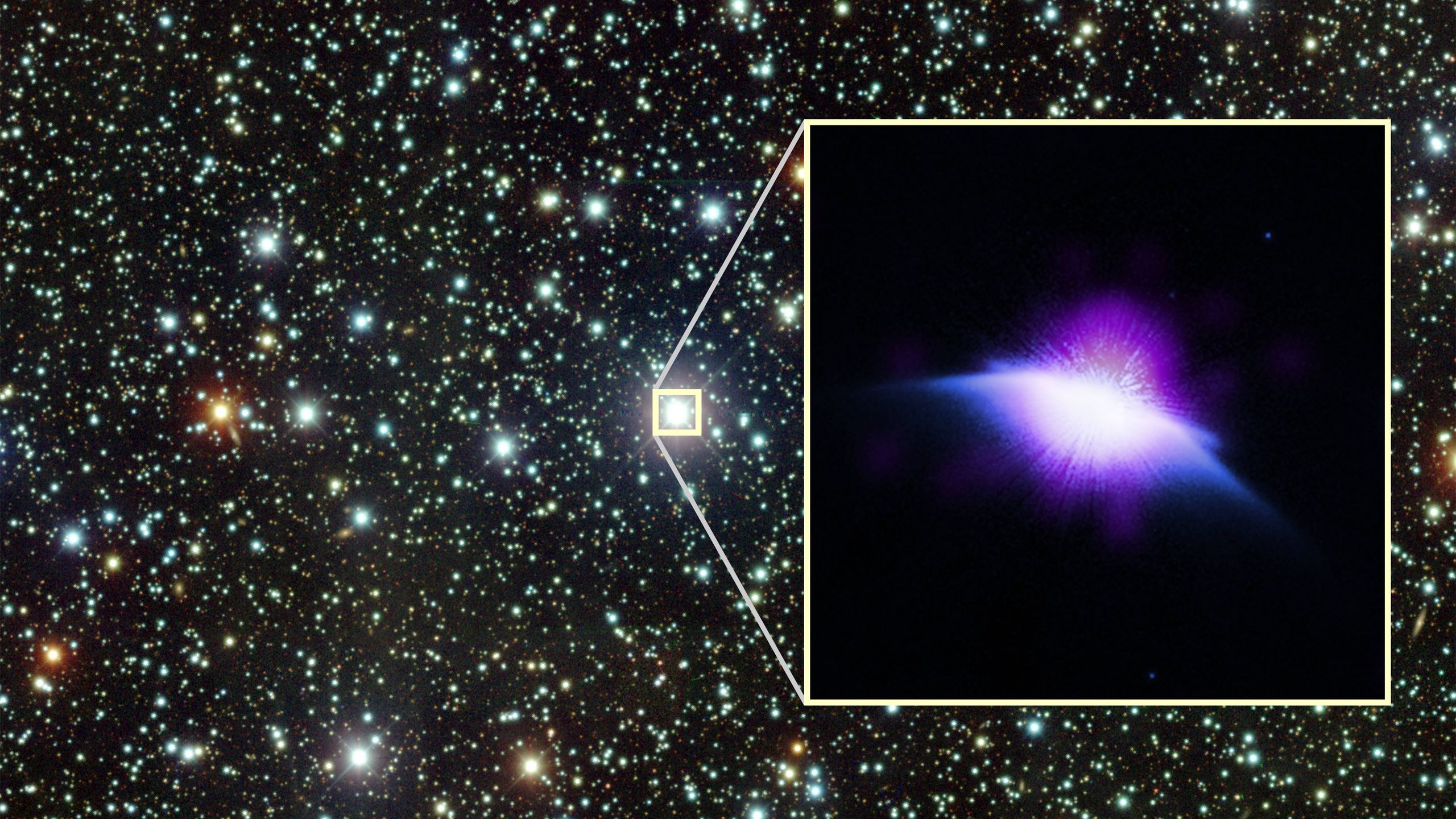
This groundbreaking image uses X-ray data from NASA’s Chandra X-ray Observatory (purple and white in the image) alongside infrared (blue and white) and optical (red, green and blue) observations from other telescopes, including the Hubble Space Telescope and the Cerro Tololo Inter-American Observatory in Chile. Combining the data has enabled astronomers to capture a striking portrait of a stellar wind bubble in action.

Purple light streams off a a white star in space

A zoomed-in view of the ‘Moth’ and its astrosphere (Image credit: X-ray: NASA/CXC/John Hopkins Univ./C.M. Lisse et al.; Infrared: NASA/ESA/STIS; Image Processing: NASA/CXC/SAO/N. Wolk)

At the center of the image, there’s a brilliant white X-ray core. Surrounding it is a neon-purple glow marking the astrosphere itself.

One of HD 61005’s most distinctive features is a wedge-shaped dust tail trailing behind it that looks like a pair of wings. This debris, left over from the star’s formation, has been swept backward as the star speeds through space, and its unusual shape has earned HD 61005 the nickname the “Moth.”

“There’s a saying about a moth being drawn to a flame,” Brad Snios, a physicist formerly from the Harvard & Smithsonian Center for Astrophysics, said in a statement. “In the case of HD 61005, the ‘Moth’ can’t easily escape from the flame because it was born around it.”

Get the world’s most fascinating discoveries delivered straight to your inbox.

Though similar in mass and temperature to the sun, HD 61005 is far younger and more active. Its stellar winds are estimated to be about three times faster and 25 times denser than those currently emitted by the sun. If it replaced the sun in the solar system, then our heliosphere would be up to 10 times wider, according to NASA.

Capturing the first alien astrosphere has been an ongoing mission since the 1990s. The breakthrough was made possible because HD 61005’s powerful wind collides with an unusually dense region of interstellar material, generating X-rays detectable by Chandra.

It’s the first clue to what may have surrounded the early solar system billions of years ago — and perhaps how young planetary systems evolve in their cosmic neighborhoods.


Source link

Share. Facebook Twitter Pinterest LinkedIn Tumblr Email
Previous ArticleGet the Microsoft Office tools you’ve always relied on — now with AI capabilities
Next Article Measles outbreaks could cost the U.S. over a $1 billion a year, if vaccine rates decline
Editor
  • Website

Related Posts

Lifestyle

2 rivers merged to form the Euphrates 3.6 million years ago, eventually leading to the Fertile Crescent

June 2, 2026
Lifestyle

NASA confirms fireball meteor exploded over northeastern US with force of 230 tons of TNT

June 2, 2026
Lifestyle

Astronauts could use lightning-like plasma jets to kill germs on the moon and Mars, demo hints

June 1, 2026
Add A Comment

Comments are closed.

Categories
  • Entertainment
  • Lifestyle
  • News
  • Sports
  • Tech
  • Travel
Recent Posts
  • 2 rivers merged to form the Euphrates 3.6 million years ago, eventually leading to the Fertile Crescent
  • NASA confirms fireball meteor exploded over northeastern US with force of 230 tons of TNT
  • Astronauts could use lightning-like plasma jets to kill germs on the moon and Mars, demo hints
  • First whole-genome sequence of a Greenland shark holds clues to their extreme longevity
  • Heading a soccer ball just once is enough to raise levels of proteins associated with brain damage
calendar
June 2026
M T W T F S S
1234567
891011121314
15161718192021
22232425262728
2930  
« May    
Recent Posts
  • 2 rivers merged to form the Euphrates 3.6 million years ago, eventually leading to the Fertile Crescent
  • NASA confirms fireball meteor exploded over northeastern US with force of 230 tons of TNT
  • Astronauts could use lightning-like plasma jets to kill germs on the moon and Mars, demo hints
About

Welcome to Baynard Media, your trusted source for a diverse range of news and insights. We are committed to delivering timely, reliable, and thought-provoking content that keeps you informed
and inspired

Categories
  • Entertainment
  • Lifestyle
  • News
  • Sports
  • Tech
  • Travel
Facebook X (Twitter) Pinterest WhatsApp
  • Contact Us
  • About Us
  • Privacy Policy
  • Disclaimer
  • UNSUBSCRIBE
© 2026 copyrights reserved

Type above and press Enter to search. Press Esc to cancel.