Close Menu
  • Home
  • UNSUBSCRIBE
  • News
  • Lifestyle
  • Tech
  • Entertainment
  • Sports
  • Travel
Facebook X (Twitter) WhatsApp
Trending
  • ‘A disease anywhere can be a disease everywhere tomorrow morning’: Public health expert on Ebola and the threat of future outbreaks
  • Thanks to natural selection, Indigenous Andeans may digest potatoes better than anyone else in the world, study finds
  • Doctors need to understand patients' lived experiences to treat them well — but medical schools may stop requiring that training
  • This yeast-based 3D printed biomaterial could one day replace your wallpaper and drapes
  • Flesh-eating screwworm found in Texas cow. Are humans at risk?
  • New Velociraptor cousin was a ‘4-winged’ dragon that hunted prey from the trees of ancient China, fossil find hints
  • AI models are teaching each other ‘violent and antisocial’ traits through hidden data signals, study finds — and scientists can’t figure out why
  • Scientists race to collect the last seeds from a critically endangered tree before it goes extinct
Facebook X (Twitter) WhatsApp
Baynard Media
  • Home
  • UNSUBSCRIBE
  • News
  • Lifestyle
  • Tech
  • Entertainment
  • Sports
  • Travel
Baynard Media
Home»Lifestyle»NASA supercomputer reveals strange spiral structure at the edge of our solar system
Lifestyle

NASA supercomputer reveals strange spiral structure at the edge of our solar system

EditorBy EditorFebruary 23, 2025No Comments3 Mins Read
Share Facebook Twitter Pinterest LinkedIn Tumblr Reddit Telegram Email
Share
Facebook Twitter LinkedIn Pinterest Email

The Oort cloud — the mysterious shell of icy objects at the edge of the solar system — might sport a pair of spiral arms that make it resemble a miniature galaxy, new research suggests.

The exact shape of the Oort cloud and how it is affected by forces beyond our solar system have, so far, remained mysterious. Now, researchers have developed a new model that suggests the inner structure of the Oort cloud may look like a spiral disk. They published their findings Feb. 16 on the preprint server arXiv, meaning the work has not been peer-reviewed yet.

The Oort cloud began as the unused remnants of the solar system’s giant planets (Jupiter, Neptune, Uranus and Saturn) after their formation 4.6 billion years ago. Some of these remnants are so large, they could be considered dwarf planets.

As these planets began orbiting the sun, their movements kicked the excess material far beyond Pluto’s orbit, where they reside today. The Oort cloud’s inner edge sits roughly 2,000 to 5,000 astronomical units from the sun, and its outer edge is located between 10,000 and 100,000 AU away. (One AU is approximately 93 million miles, or 150 million kilometers — roughly the average distance from Earth to the sun.)

Related: Planet Nine: Is the search for this elusive world nearly over?

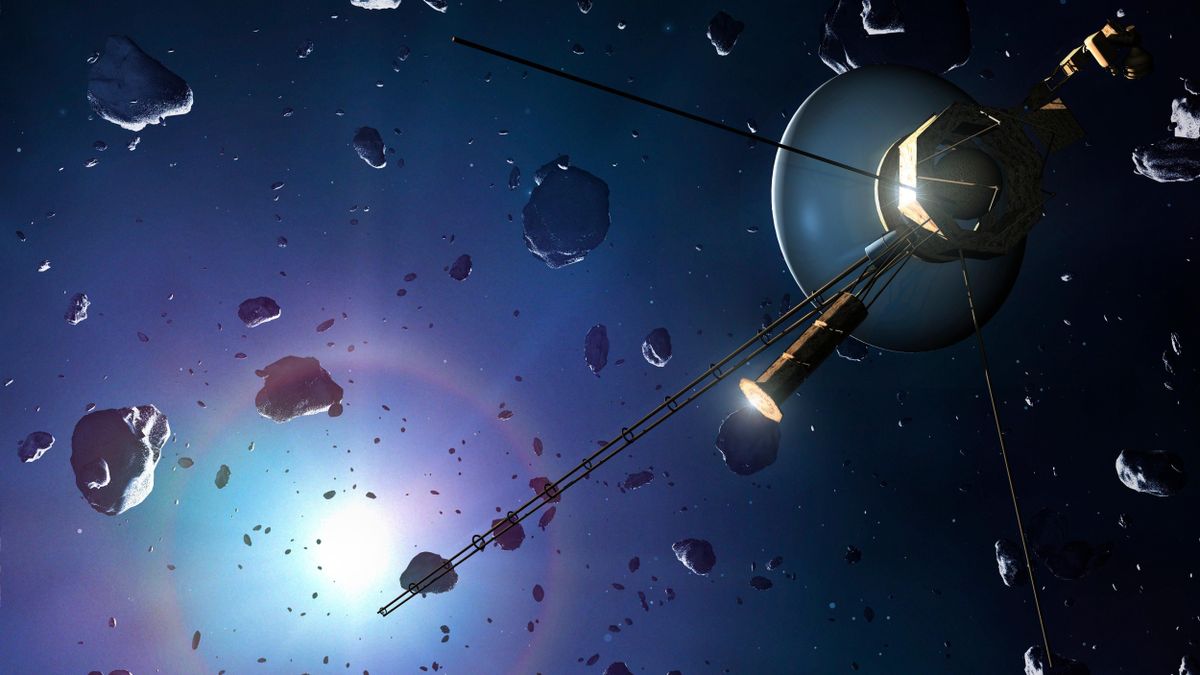
This means that, even at its current speed of around a million miles (1.6 million kilometers) a day, NASA’s Voyager 1 spacecraft won’t reach the Oort cloud for 300 years and won’t exit it for another 300,000.

This extreme distance means the bodies in the cloud are too small and faint — and moving too slowly — to be directly imaged even by the most powerful telescopes. Most of our evidence for it comes from long-period comets — “snowballs” of ice and dust punted from the cloud to orbit around the sun by gravitational perturbations.

Get the world’s most fascinating discoveries delivered straight to your inbox.

Spirals within spirals?

The Oort cloud and its spiral arms.

The Oort cloud and its spiral arms. (Image credit: Nesvorný et al.)

To better understand what the Oort cloud could look like, the researchers behind the new study used information from the orbits of comets and gravitational forces from within and beyond our solar system to build a model of the Oort cloud’s structure.

One key to understanding the shape of the Oort cloud is “galactic tide” — the tugs made by stars, black holes and our galaxy’s center that have a crucial influence on the Oort cloud’s objects but, for objects closer to the sun, are masked by our star’s gravity.

When the scientists ran this model through NASA’s Pleiades supercomputer, it spit out a structure for the inner part of the cloud (the most densely populated region, located 1,000 to 10,000 AU from the sun) that resembles the spiral disk of the Milky Way. According to the model, the arms of this inner Oort cloud stretch 15,000 AU from end to end.

To confirm this structure through observations, researchers will need to track the objects directly or pick out the light reflected from them from all the other background and foreground sources. Both are incredibly difficult tasks that have yet to have any resources dedicated to them.

But the researchers think that, if we are to understand where comets come from, how our solar system evolved and the cloud’s continuing impact on our cosmic neighborhood, it might be a good idea to start looking.

Source link

Share. Facebook Twitter Pinterest LinkedIn Tumblr Email
Previous ArticleKylie Jenner’s Hairstylist Jesus Guerrero Dead at 34
Next Article Sen. Booker says ‘we are seeing real crises’ across U.S. from Trump and Musk cuts: Full interview
Editor
  • Website

Related Posts

Lifestyle

‘A disease anywhere can be a disease everywhere tomorrow morning’: Public health expert on Ebola and the threat of future outbreaks

June 8, 2026
Lifestyle

Thanks to natural selection, Indigenous Andeans may digest potatoes better than anyone else in the world, study finds

June 8, 2026
Lifestyle

Doctors need to understand patients' lived experiences to treat them well — but medical schools may stop requiring that training

June 8, 2026
Add A Comment

Comments are closed.

Categories
  • Entertainment
  • Lifestyle
  • News
  • Sports
  • Tech
  • Travel
Recent Posts
  • ‘A disease anywhere can be a disease everywhere tomorrow morning’: Public health expert on Ebola and the threat of future outbreaks
  • Thanks to natural selection, Indigenous Andeans may digest potatoes better than anyone else in the world, study finds
  • Doctors need to understand patients' lived experiences to treat them well — but medical schools may stop requiring that training
  • This yeast-based 3D printed biomaterial could one day replace your wallpaper and drapes
  • Flesh-eating screwworm found in Texas cow. Are humans at risk?
calendar
June 2026
M T W T F S S
1234567
891011121314
15161718192021
22232425262728
2930  
« May    
Recent Posts
  • ‘A disease anywhere can be a disease everywhere tomorrow morning’: Public health expert on Ebola and the threat of future outbreaks
  • Thanks to natural selection, Indigenous Andeans may digest potatoes better than anyone else in the world, study finds
  • Doctors need to understand patients' lived experiences to treat them well — but medical schools may stop requiring that training
About

Welcome to Baynard Media, your trusted source for a diverse range of news and insights. We are committed to delivering timely, reliable, and thought-provoking content that keeps you informed
and inspired

Categories
  • Entertainment
  • Lifestyle
  • News
  • Sports
  • Tech
  • Travel
Facebook X (Twitter) Pinterest WhatsApp
  • Contact Us
  • About Us
  • Privacy Policy
  • Disclaimer
  • UNSUBSCRIBE
© 2026 copyrights reserved

Type above and press Enter to search. Press Esc to cancel.