Close Menu
  • Home
  • UNSUBSCRIBE
  • News
  • Lifestyle
  • Tech
  • Entertainment
  • Sports
  • Travel
Facebook X (Twitter) WhatsApp
Trending
  • James Webb telescope just spotted the oldest, closest pair of black holes in the early universe
  • Saving old trees may protect people’s health more than planting new ones, study of Chicago neighborhoods finds
  • Memory may not work how we thought, study of mice in artificial hibernation finds
  • Romans unceremoniously dumped plague victims down a well, mysterious mass grave in Croatia suggest
  • New AI lets robots complete tasks twice as fast
  • Mammal ancestors may have given live birth 90 million years earlier than we thought, rewriting evolutionary timelines
  • How to see and photograph the partial lunar eclipse on August 27-28
  • Watch now! The Aug. 12 total solar eclipse has begun (live stream)
Facebook X (Twitter) WhatsApp
Baynard Media
  • Home
  • UNSUBSCRIBE
  • News
  • Lifestyle
  • Tech
  • Entertainment
  • Sports
  • Travel
Baynard Media
Home»Lifestyle»NASA spacecraft snaps images of lunar transit and Earth eclipse on the same day — see the photos
Lifestyle

NASA spacecraft snaps images of lunar transit and Earth eclipse on the same day — see the photos

EditorBy EditorJuly 29, 2025No Comments3 Mins Read
Share Facebook Twitter Pinterest LinkedIn Tumblr Reddit Telegram Email
Share
Facebook Twitter LinkedIn Pinterest Email

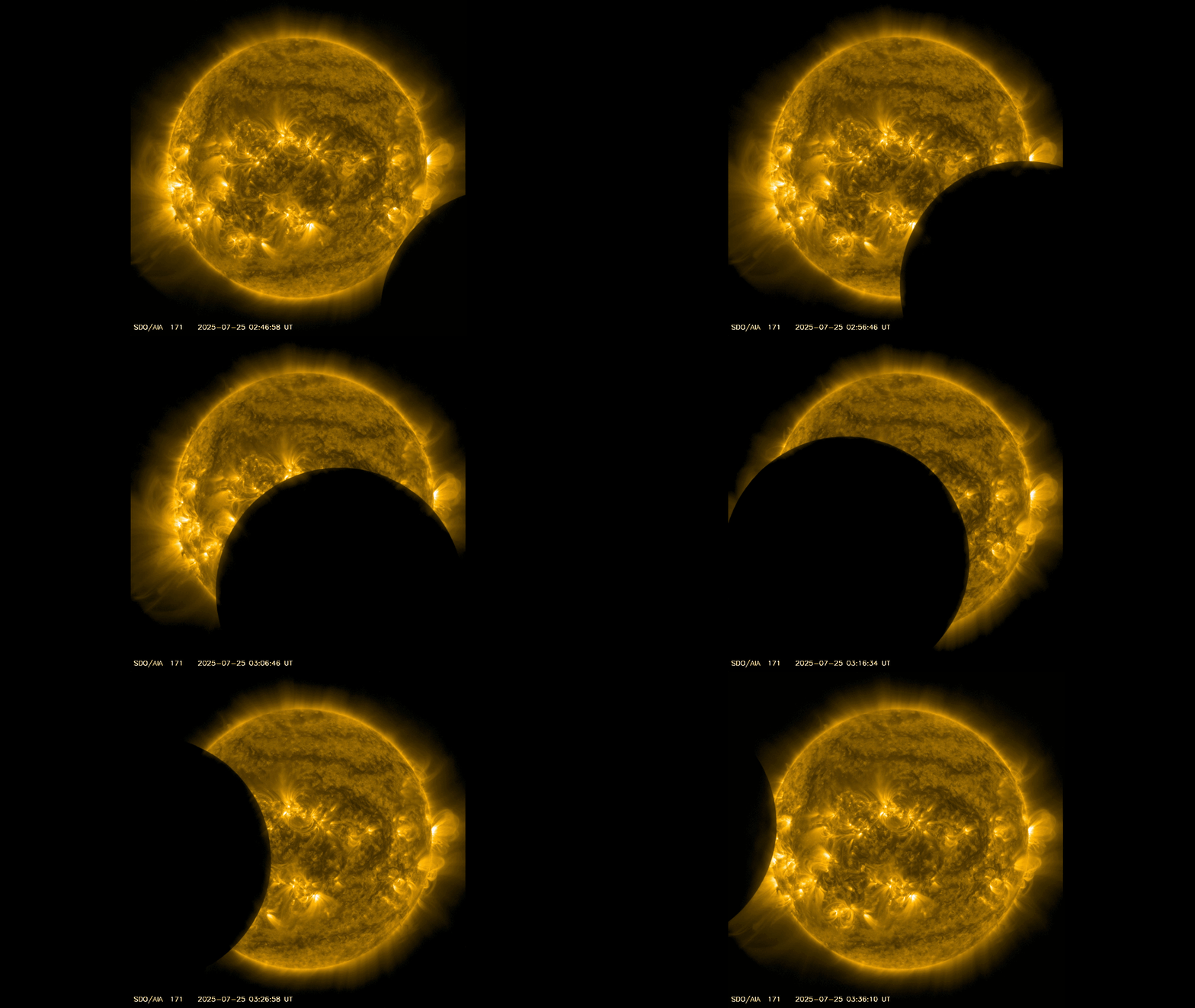
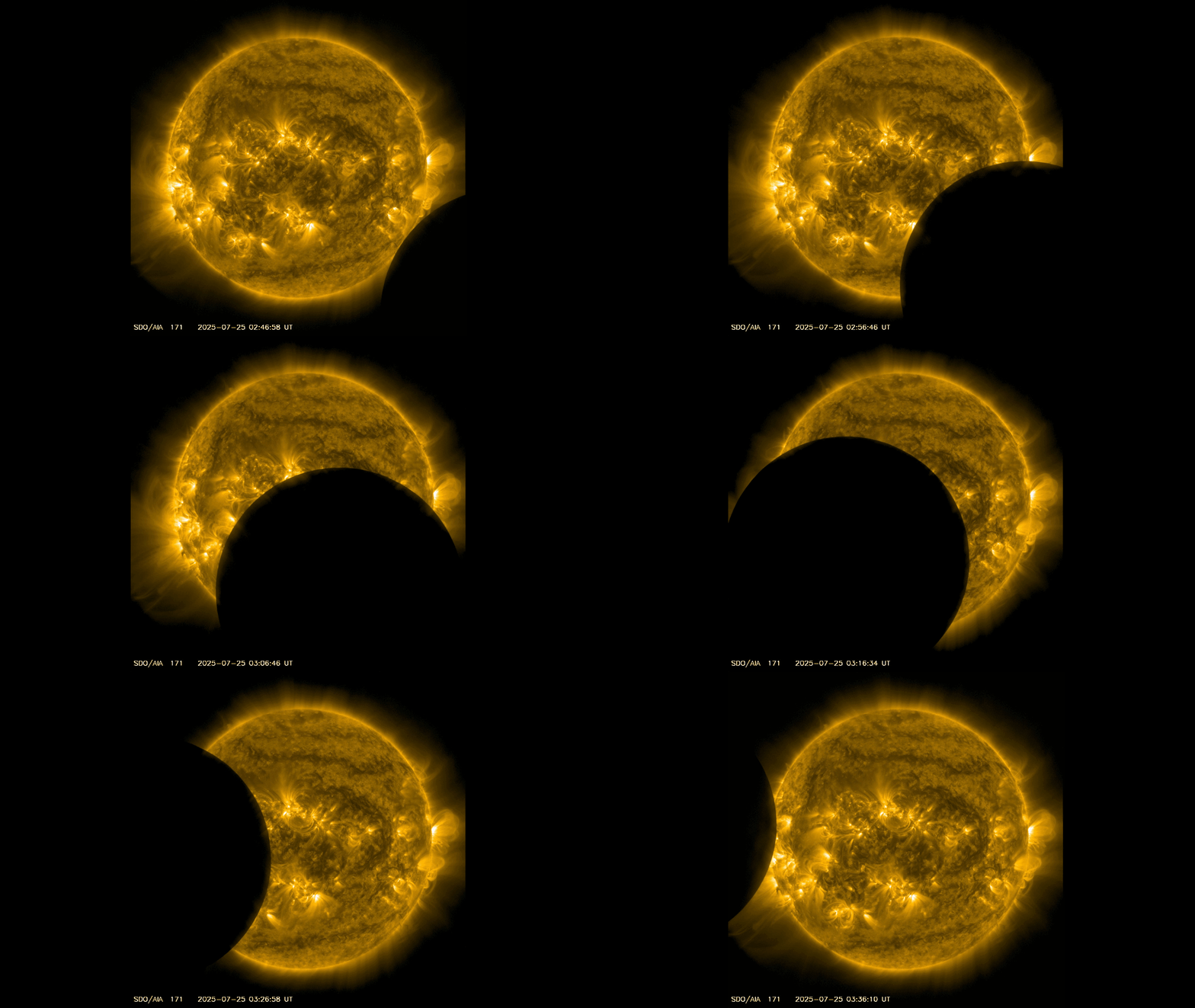
An Earth-orbiting spacecraft just experienced an unusual phenomenon: a lunar transit and an Earth eclipse on the same day.

On July 25, at different times, both the moon and Earth passed between NASA’s Solar Dynamics Observatory (SDO) and the sun.

SDO studies the sun‘s activity, including the solar wind (the stream of charged particles flowing from the sun), solar flares and changes in the sun’s magnetic field. These data help scientists forecast solar activity that can affect Earth. The spacecraft launched in February 2010 and has been observing the sun almost continuously since May of that year.


You may like

To keep a constant eye on the sun, SDO is in a geosynchronous orbit around Earth, meaning it circles the planet once every day. The plane of its orbit is angled relative to Earth’s rotational axis, which keeps the planet out of the way of its observations. This means the spacecraft usually has a view of the sun.

But occasionally, the moon blocks that view. Several times per year, the moon partially eclipses the sun from SDO’s perspective. The July 25 lunar transit, which began around 2:45 UTC, was SDO’s fourth partial eclipse since April, according to SDO’s blog. It was also the deepest, covering up to 62% of the sun’s disk and lasting about 50 minutes.

Earth also occasionally passes between SDO and the sun. SDO’s orbit is designed to minimize these interruptions to the craft’s regular observations, but roughly twice per year, Earth blocks out the sun for a short period each day. Each of these “eclipse seasons” lasts around three weeks, according to NASA. SDO is in the midst of its 31st eclipse season, which began July 10 and will last until Aug. 7.

Beginning around 6:30 UTC, about three hours after the moon finished its transit, Earth completely blocked SDO’s view of the sun. The total eclipse ended shortly before 8:00 UTC, according to the Solar Dynamics Observatory blog.

Get the world’s most fascinating discoveries delivered straight to your inbox.

The two events look a bit different in SDO’s images of the sun. Because Earth’s atmosphere absorbs some sunlight, its shadow has a fuzzy edge. Meanwhile, the moon, which has no atmosphere, carves a crisp circle out of the sun’s disk.

This isn’t the first time both Earth and the moon have gotten in SDO’s way on the same day. In 2015 — and again in 2016 — both bodies eclipsed the sun from SDO’s perspective at the same time, resulting in a “double eclipse.”

Earth-bound eclipse spotters will have to wait a few more weeks to catch the next event. A partial solar eclipse will be visible from New Zealand and parts of Australia on Sept. 21. The next total solar eclipse — which will be visible from parts of Greenland, Iceland, Russia, Spain and Portugal — will occur on Aug. 12, 2026.


Sun quiz: How well do you know our home star?

Source link

Share. Facebook Twitter Pinterest LinkedIn Tumblr Email
Previous ArticleSenate confirms Trump pick Wright to lead Nuclear Regulatory Commission
Next Article The suspected gunman is dead, sources say
Editor
  • Website

Related Posts

Lifestyle

James Webb telescope just spotted the oldest, closest pair of black holes in the early universe

August 14, 2026
Lifestyle

Saving old trees may protect people’s health more than planting new ones, study of Chicago neighborhoods finds

August 14, 2026
Lifestyle

Memory may not work how we thought, study of mice in artificial hibernation finds

August 13, 2026
Add A Comment

Comments are closed.

Categories
  • Entertainment
  • Lifestyle
  • News
  • Sports
  • Tech
  • Travel
Recent Posts
  • James Webb telescope just spotted the oldest, closest pair of black holes in the early universe
  • Saving old trees may protect people’s health more than planting new ones, study of Chicago neighborhoods finds
  • Memory may not work how we thought, study of mice in artificial hibernation finds
  • Romans unceremoniously dumped plague victims down a well, mysterious mass grave in Croatia suggest
  • New AI lets robots complete tasks twice as fast
calendar
August 2026
M T W T F S S
 12
3456789
10111213141516
17181920212223
24252627282930
31  
« Jul    
Recent Posts
  • James Webb telescope just spotted the oldest, closest pair of black holes in the early universe
  • Saving old trees may protect people’s health more than planting new ones, study of Chicago neighborhoods finds
  • Memory may not work how we thought, study of mice in artificial hibernation finds
About

Welcome to Baynard Media, your trusted source for a diverse range of news and insights. We are committed to delivering timely, reliable, and thought-provoking content that keeps you informed
and inspired

Categories
  • Entertainment
  • Lifestyle
  • News
  • Sports
  • Tech
  • Travel
Facebook X (Twitter) Pinterest WhatsApp
  • Contact Us
  • About Us
  • Privacy Policy
  • Disclaimer
  • UNSUBSCRIBE
© 2026 copyrights reserved

Type above and press Enter to search. Press Esc to cancel.