
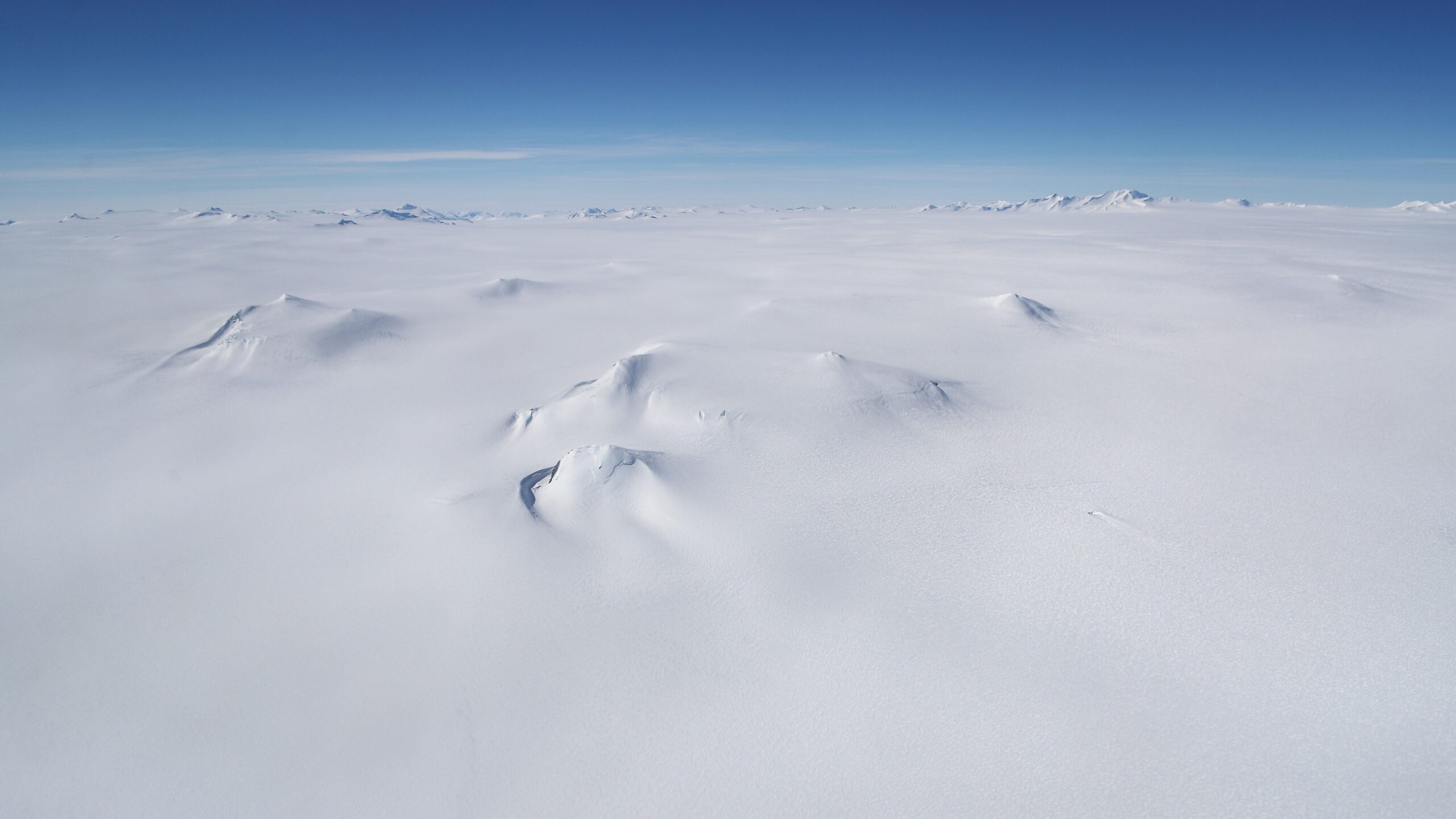
Antarctica has gained ice in recent years, despite increasing average global temperatures and climate change, a new study finds.
Using data from NASA satellites, researchers from Tongji University in Shanghai tracked changes in Antarctica’s ice sheet over more than two decades. The overall trend is one of substantial ice loss on the continent, but from 2021 to 2023, Antarctica gained some of that lost ice back.
However, this isn’t a sign that global warming and climate change have miraculously reversed. Picture a long ski slope with a small jump at the end. That’s what a line through the Antarctic ice sheet data looks like when plotted on a graph. While there have been some recent ice gains, they don’t even begin to make up for almost 20 years of losses.
Most of the gains have already been attributed to an anomaly that saw increased precipitation (snow and some rain) fall over Antarctica, which caused more ice to form. Antarctica’s ice levels fluctuate from year to year, and the gains appear to have slowed since the study period ended at the beginning of 2024. The levels reported by NASA thus far in 2025 look similar to what they were back in 2020, just before the abrupt gain.
Related: What’s hiding under Antarctica’s ice?
The ice sheet covering Antarctica is the largest mass of ice on Earth. Bigger than the whole of the U.S., the sheet holds 90% of the world’s fresh water, according to the Antarctic and Southern Ocean Coalition, an environmental non-governmental organization. Antarctica is also surrounded by sea ice (frozen ocean water), which expands in the winter and retreats to the Antarctic coastline in the summer.
This latest study, published March 19 in the journal Science China Earth Sciences, analyzed data from NASA’s Gravity Recovery And Climate Experiment (GRACE) and GRACE Follow-On satellites that have been monitoring this ice sheet since 2002. Studying changes to the sheet is important because any melt releases water into the ocean, which is a major driver of rising sea levels.
The satellite data revealed that the sheet experienced a sustained period of ice loss between 2002 and 2020. The ice loss accelerated in the latter half of that period, increasing from an average loss of about 81 billion tons (74 billion metric tons) per year between 2002 and 2010, to a loss of about 157 billion tons (142 billion metric tons) between 2011 and 2020, according to the study. However, the trend then shifted.
The ice sheet gained mass from 2021 to 2023 at an average rate of about 119 billion tons (108 metric tons) per year. Four glaciers in eastern Antarctica also flipped from accelerated ice loss to significant mass gain.

“This isn’t particularly strange,” said Tom Slater, a research fellow in environmental science at Northumbria University in the U.K. who wasn’t involved in the study. “In a warmer climate the atmosphere can hold more moisture — this raises the likelihood of extreme weather such as the heavy snowfall which caused the recent mass gain in East Antarctica,” he told Live Science in an email.
A 2023 study documented Antarctica’s unprecedented mass gain between 2021 and 2022. That study, written by many of the same authors behind the new study, found that a high precipitation anomaly was responsible for the gain in ice. The latest study suggests that the trend continued until at least 2023.
Slater noted that researchers expect the ice gains to be temporary.
“Almost all of Antarctica’s grounded ice losses come from glaciers elsewhere which are speeding up and flowing into the warming ocean,” Slater said. “This is still happening — while the recent snowfall has temporarily offset these losses, they haven’t stopped so it’s not expected this is a long-term change in Antarctica’s behaviour.”
A warming world
Climate change doesn’t mean that everywhere on Earth will get hotter at the same rate, so a single region will never tell the whole story of our warming world. Historically, temperatures over much of Antarctica have remained relatively stable, particularly compared to the Arctic, which has cooked four times faster than the rest of the globe. Antarctica’s sea ice has also been much more stable relative to the Arctic, but that’s been changing in recent years.
In 2023, Antarctic sea ice hit record lows, which researchers concluded was extremely unlikely to happen without climate change. Meanwhile, global sea ice cover is consistently dropping to record lows or near-record lows, while global temperatures are consistently at record or near-record highs.
In 2015, world leaders signed the Paris Agreement, an international treaty promising to limit global warming to preferably below 2.7 degrees Fahrenheit (1.5 degrees Celsius) and well below 3.6 F (2 C). However, that first promise is on the line: April 2025 was the 21st out of the last 22 months to breach the 2.7 F limit, according to the European Union’s Copernicus Climate Change Service.
