Close Menu
  • Home
  • UNSUBSCRIBE
  • News
  • Lifestyle
  • Tech
  • Entertainment
  • Sports
  • Travel
Facebook X (Twitter) WhatsApp
Trending
  • Chinese medical practitioners used extremely toxic plant as a topical anesthetic 600 years ago, study finds
  • Bead net funerary shroud: A 2,500-year-old beaded veil from Egypt depicting the deceased’s transformation into Osiris
  • Rare genetic disease makes scientists reconsider what the ‘seat of fear’ in the brain really is
  • It’s illegal to repair most of our devices. There’s a surprising reason for that.
  • Jupiter’s Ganymede, the largest moon in the solar system, may be heating up
  • Bizarre patterns on Venus have scientists puzzled
  • Scientists trained an AI model using an IBM quantum computer — and it answered questions correctly that the base model couldn’t
  • How did animals survive the asteroid that killed the dinosaurs?
Facebook X (Twitter) WhatsApp
Baynard Media
  • Home
  • UNSUBSCRIBE
  • News
  • Lifestyle
  • Tech
  • Entertainment
  • Sports
  • Travel
Baynard Media
Home»Lifestyle»NASA diagnoses fracture in a ‘huge cosmic bone’ using X-ray observatory
Lifestyle

NASA diagnoses fracture in a ‘huge cosmic bone’ using X-ray observatory

EditorBy EditorMay 15, 2025No Comments2 Mins Read
Share Facebook Twitter Pinterest LinkedIn Tumblr Reddit Telegram Email
Share
Facebook Twitter LinkedIn Pinterest Email

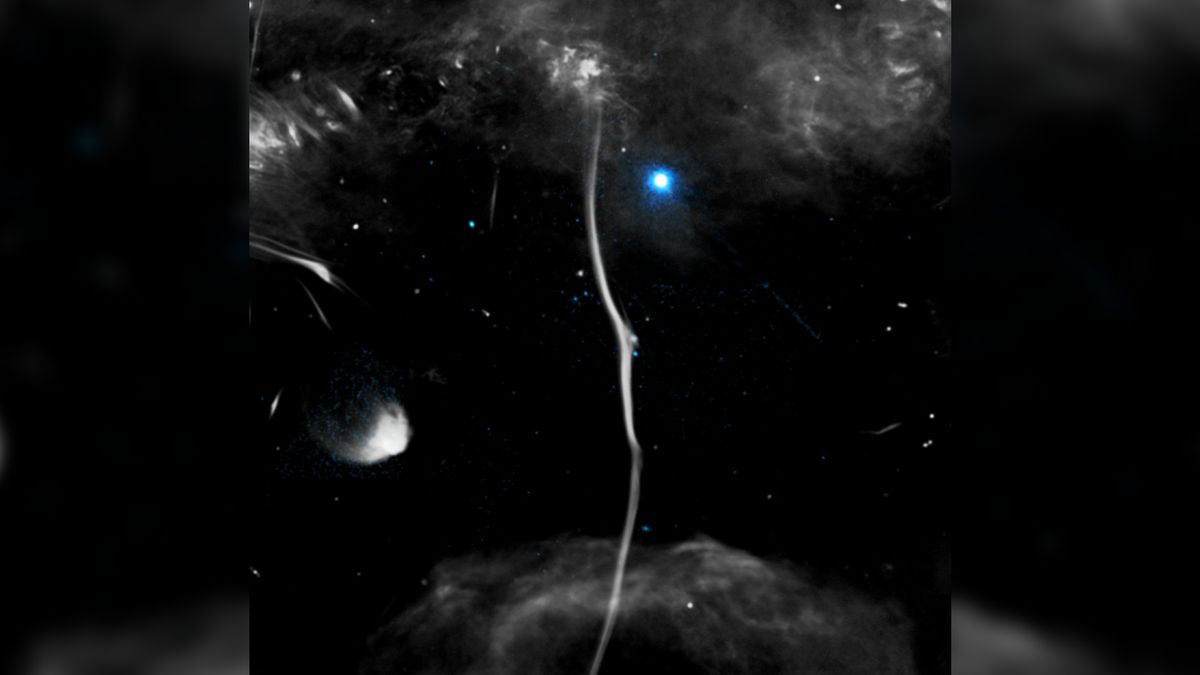
Have you ever had an X-ray taken of your bones? Well, so has the Milky Way. NASA’s Chandra X-ray Observatory regularly images our home galaxy, and a recent scan caught something that might be familiar to some of you: a fractured “bone.”

The bone-like structure in the image above was imaged using radio data from MeerKAT radio array in South Africa and the National Science Foundation’s Very Large Array in New Mexico — you’ll notice a slight fracture in the structure a little more than a third of the way down.

Overlaying Chandra’s X-ray data (shown in bright blue) with the radio data reveals the likely cause of the fracture to be an impact from a pulsar, a rapidly spinning neutron star that sends out pulses of radiation at regular intervals. Of course, the ghostly structure isn’t a real bone, but rather a galactic center filament, one of many massive structures created by radio waves threaded along magnetic fields at the center of the Milky Way galaxy.


You may like

The particular cosmic “bone” shown here is G359.13142-0.20005 (G359.13 for short, or sometimes referred to as the Snake), and it’s one of the brightest and longest galactic center filaments we’ve spotted. Located some 26,000 light-years from Earth, it’s about 230 light-years long.

Scientists suspect that the pulsar slammed into G359.13 at a staggering speed between one million and two million miles per hour (1.6 million to 3.2 million km per hour).

Related: Did astronomers just discover the smallest galaxy in the universe?

a thin line of white stretches from top to bottom between two wispy clouds of white gas on a black background

The “fracture” in galactic center filament G359.13142-0.20005 appears to be a pulsar. (Image credit: X-ray: NASA/CXC/Northwestern Univ./F. Yusef-Zadeh et al; Radio: NRF/SARAO/MeerKat; Image Processing: NASA/CXC/SAO/N. Wolk)

Given that neutron stars are extremely dense — in fact, they’re the densest known stars in the universe — it’s no surprise that a high-speed collision easily distorted the filament’s magnetic field, creating the fracture.

Get the world’s most fascinating discoveries delivered straight to your inbox.

Since it’s not likely that the Milky Way will be able to bind a 230-light-year-long galactic center filament in a cast, we’re going to have to hope this fracture will heal itself over the millennia.

This research has been published in the May 2024 issue of the Monthly Notices of the Royal Astronomical Society.

Originally posted on Space.com.

Source link

Share. Facebook Twitter Pinterest LinkedIn Tumblr Email
Previous ArticleGarmin Vivoactive 6 review: Light, sleek and beginner-friendly
Next Article Celestron SkyMaster Pro ED 15×70 binocular review
Editor
  • Website

Related Posts

Lifestyle

Chinese medical practitioners used extremely toxic plant as a topical anesthetic 600 years ago, study finds

May 26, 2026
Lifestyle

Bead net funerary shroud: A 2,500-year-old beaded veil from Egypt depicting the deceased’s transformation into Osiris

May 25, 2026
Lifestyle

Rare genetic disease makes scientists reconsider what the ‘seat of fear’ in the brain really is

May 25, 2026
Add A Comment

Comments are closed.

Categories
  • Entertainment
  • Lifestyle
  • News
  • Sports
  • Tech
  • Travel
Recent Posts
  • Chinese medical practitioners used extremely toxic plant as a topical anesthetic 600 years ago, study finds
  • Bead net funerary shroud: A 2,500-year-old beaded veil from Egypt depicting the deceased’s transformation into Osiris
  • Rare genetic disease makes scientists reconsider what the ‘seat of fear’ in the brain really is
  • It’s illegal to repair most of our devices. There’s a surprising reason for that.
  • Jupiter’s Ganymede, the largest moon in the solar system, may be heating up
calendar
May 2026
M T W T F S S
 123
45678910
11121314151617
18192021222324
25262728293031
« Apr    
Recent Posts
  • Chinese medical practitioners used extremely toxic plant as a topical anesthetic 600 years ago, study finds
  • Bead net funerary shroud: A 2,500-year-old beaded veil from Egypt depicting the deceased’s transformation into Osiris
  • Rare genetic disease makes scientists reconsider what the ‘seat of fear’ in the brain really is
About

Welcome to Baynard Media, your trusted source for a diverse range of news and insights. We are committed to delivering timely, reliable, and thought-provoking content that keeps you informed
and inspired

Categories
  • Entertainment
  • Lifestyle
  • News
  • Sports
  • Tech
  • Travel
Facebook X (Twitter) Pinterest WhatsApp
  • Contact Us
  • About Us
  • Privacy Policy
  • Disclaimer
  • UNSUBSCRIBE
© 2026 copyrights reserved

Type above and press Enter to search. Press Esc to cancel.