Close Menu
  • Home
  • UNSUBSCRIBE
  • News
  • Lifestyle
  • Tech
  • Entertainment
  • Sports
  • Travel
Facebook X (Twitter) WhatsApp
Trending
  • New robotic heart mimics common, mysterious condition to help researchers study it
  • Canon EOS R6 III review: A wildlife wonder
  • Medieval babies and adults buried together in Sweden were not related, archaeologists discover — raising big questions about early Christian burial practices
  • NASA is creating a fifth state of matter on the ISS, thanks to an upgrade to a mini-fridge-sized quantum lab
  • New sodium metal battery design charges in just 4 minutes and retains its capacity for years
  • Quantum computing wielded to create extremely rare material critical to nuclear fusion
  • Scientists build tiny ‘diving suit’ for cockroaches, turning them into search-and-rescue cyborgs
  • Physicists develop the first working model of quantum mechanics using only ‘real’ numbers
Facebook X (Twitter) WhatsApp
Baynard Media
  • Home
  • UNSUBSCRIBE
  • News
  • Lifestyle
  • Tech
  • Entertainment
  • Sports
  • Travel
Baynard Media
Home»Lifestyle»NASA celebrates America’s 250th birthday with red, white and blue snaps of the cosmos — Space photo of the week
Lifestyle

NASA celebrates America’s 250th birthday with red, white and blue snaps of the cosmos — Space photo of the week

EditorBy EditorJuly 5, 2026No Comments3 Mins Read
Share Facebook Twitter Pinterest LinkedIn Tumblr Reddit Telegram Email
Share
Facebook Twitter LinkedIn Pinterest Email

quick facts

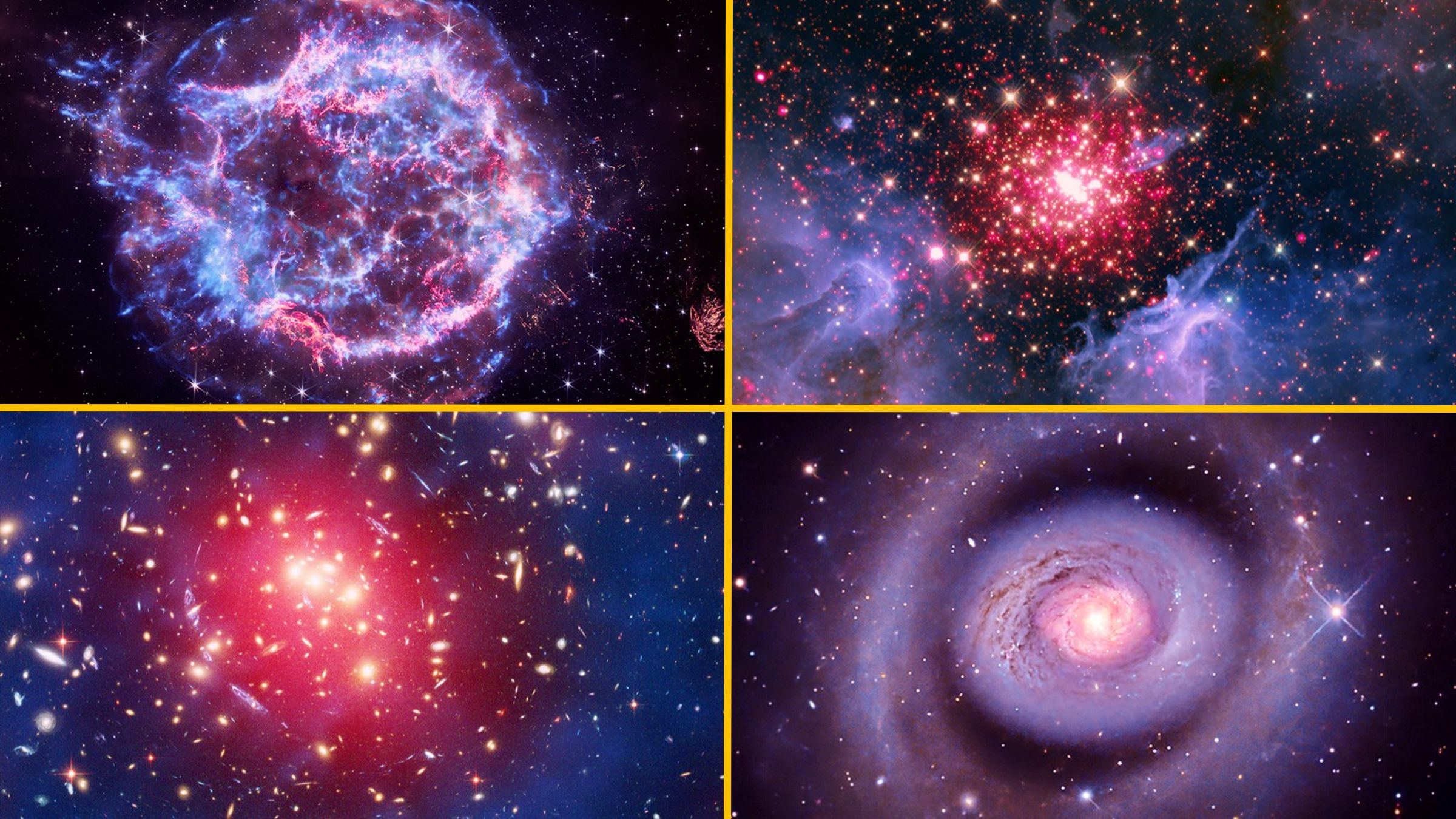
What it is: A collection of “red, white and blue” images to celebrate the 250th birthday of the United States.

Where it is: Between 11,000 light-years and 19 million light-years from Earth

When it was shared: June 30, 2026.

NASA has marked the 250th birthday of the U.S. with a striking new collection of cosmic images from its Chandra X-ray Observatory, presenting four deep-space objects in red, white and blue.

The image set combines X-ray data from Chandra — which has been orbiting Earth since 1999 — with observations from NASA’s Hubble and James Webb Space Telescopes (JWST), as well as multiple ground-based observatories. Together, the images showcase some of the universe’s most dramatic environments, from the remains of an exploded star to a massive galaxy cluster shaped by dark matter — each rendered in patriotic colors.

Arguably the image most reminiscent of Fourth of July fireworks is that of Cassiopeia A, a famous supernova remnant about 11,000 light-years away in the constellation Cassiopeia (top left). Chandra’s X-ray data, shown in blue and purple, reveal the blast wave from a massive stellar explosion and trace elements such as iron, calcium and oxygen. Meanwhile, infrared data from JWST has been overlaid in red and white, highlighting the expanding shell of debris and cosmic dust. It’s all the result of a massive star that exploded about 340 years ago, according to NASA.

Latest Videos From

On the top-right is NGC 3603, a giant nebula 20,000 light-years away in the Carina spiral arm of the Milky Way. Here it appears as a glowing field of highly active, newly formed stars. Chandra’s X-ray observations reveal the light coming from the nebula, while Hubble data in optical, infrared and ultraviolet light show its glittering array of stars, as well as dust and gas. NGC 3603 is the largest nebula seen in visible light in our galaxy.

NGC 4736, also known as M94, is something else entirely. Pictured bottom-right, it’s a spiral galaxy about 19 million light-years from Earth in the constellation Canes Venatici. Its famed for the faint arms outside of its oval-shaped core region — known as a “starburst ring,” where new stars are forming. It’s shown here with Chandra’s X-ray data layered with visible-light imagery captured by ground-based astrophotographers.


You may like

The final image features ZwCl 0024+1652 (bottom-left), a distant galaxy cluster where Hubble data has helped astronomers infer the presence of dark matter. About five billion light-years away in the constellation Pisces, Chandra’s X-rays reveal a vast reservoir of superheated gas in ZwCl 0024+1652 — shown in red — that contains more mass than the cluster’s galaxies combined.

The release of the new photos also includes novel sonifications for NGC 3603, NGC 4736 and ZwCl 0024+1652, transforming astronomical data into sound. The project allows audiences to experience space through both sight and hearing.

Get the world’s most fascinating discoveries delivered straight to your inbox.


TOPICS


space photo of the week

Source link

Share. Facebook Twitter Pinterest LinkedIn Tumblr Email
Previous ArticleSuperintelligent AI in space could explain the Fermi Paradox
Next Article Has there ever been a period in human history without war?
Editor
  • Website

Related Posts

Lifestyle

New robotic heart mimics common, mysterious condition to help researchers study it

July 11, 2026
Lifestyle

Canon EOS R6 III review: A wildlife wonder

July 10, 2026
Lifestyle

Medieval babies and adults buried together in Sweden were not related, archaeologists discover — raising big questions about early Christian burial practices

July 10, 2026
Add A Comment

Comments are closed.

Categories
  • Entertainment
  • Lifestyle
  • News
  • Sports
  • Tech
  • Travel
Recent Posts
  • New robotic heart mimics common, mysterious condition to help researchers study it
  • Canon EOS R6 III review: A wildlife wonder
  • Medieval babies and adults buried together in Sweden were not related, archaeologists discover — raising big questions about early Christian burial practices
  • NASA is creating a fifth state of matter on the ISS, thanks to an upgrade to a mini-fridge-sized quantum lab
  • New sodium metal battery design charges in just 4 minutes and retains its capacity for years
calendar
July 2026
M T W T F S S
 12345
6789101112
13141516171819
20212223242526
2728293031  
« Jun    
Recent Posts
  • New robotic heart mimics common, mysterious condition to help researchers study it
  • Canon EOS R6 III review: A wildlife wonder
  • Medieval babies and adults buried together in Sweden were not related, archaeologists discover — raising big questions about early Christian burial practices
About

Welcome to Baynard Media, your trusted source for a diverse range of news and insights. We are committed to delivering timely, reliable, and thought-provoking content that keeps you informed
and inspired

Categories
  • Entertainment
  • Lifestyle
  • News
  • Sports
  • Tech
  • Travel
Facebook X (Twitter) Pinterest WhatsApp
  • Contact Us
  • About Us
  • Privacy Policy
  • Disclaimer
  • UNSUBSCRIBE
© 2026 copyrights reserved

Type above and press Enter to search. Press Esc to cancel.