Close Menu
  • Home
  • UNSUBSCRIBE
  • News
  • Lifestyle
  • Tech
  • Entertainment
  • Sports
  • Travel
Facebook X (Twitter) WhatsApp
Trending
  • How did animals survive the asteroid that killed the dinosaurs?
  • ‘We can identify these really early, before the clinical diagnosis’: Epigenetic markers may help explain why Native Hawaiians are aging faster
  • Catapult the cow: 6 medieval castles that were never conquered
  • China launches ‘human artificial embryos’ to space for the first time
  • NASA’s Psyche spacecraft beams back blue images of Mars on its way to a metal asteroid
  • Science news this week: Laotian ‘death jar’, climate change threatens rice crops, and an asthma drug treats tough cancer
  • DNA sequencing is rewriting our understanding of historic outbreaks, but it can’t tell the whole story
  • AI-generated images are making it impossible to distinguish truth from fiction. We need laws and AI watermarks to protect our shared reality.
Facebook X (Twitter) WhatsApp
Baynard Media
  • Home
  • UNSUBSCRIBE
  • News
  • Lifestyle
  • Tech
  • Entertainment
  • Sports
  • Travel
Baynard Media
Home»Lifestyle»Narusawa Ice Cave: The lava tube brimming with 10-foot-high ice pillars at the base of Mount Fuji
Lifestyle

Narusawa Ice Cave: The lava tube brimming with 10-foot-high ice pillars at the base of Mount Fuji

EditorBy EditorSeptember 5, 2025No Comments4 Mins Read
Share Facebook Twitter Pinterest LinkedIn Tumblr Reddit Telegram Email
Share
Facebook Twitter LinkedIn Pinterest Email

QUICK FACTS

Name: Narusawa Hyoketsu Ice Cave

Location: Fuji Five Lakes area, Japan

Coordinates: 35.475766342241734, 138.6658965143265

Why it’s incredible: The cave was created by lava from Mount Fuji and now holds giant ice pillars.

The Narusawa Ice Cave is a lava tube that is brimming with icicles and ice pillars at the base of Mount Fuji in Japan.

Lava tubes are natural tunnels that form beneath solidified lava flows after a volcanic eruption. Lava hardens faster in the top layers of a lava flow, where the molten rock comes into contact with cool air, than in the middle layers, where it stays red hot and fluid. As a result, when a volcano stops erupting, the core of a lava flow drains away while the outside hardens, leaving an empty conduit, or cave.

The Narusawa Ice Cave is one of several caves that formed during a violent eruption of Mount Fuji in A.D. 864. The eruption took place on the northeast side of the volcano, with lava spewing from a new vent called Mount Nagao rather than from Mount Fuji’s central summit crater.


You may like

The eruption lasted 10 days and created the large lava plain that’s now covered by the Aokigahara Forest, a dense woodland also known as the “Sea of Trees.” The blast also split a lake in half, carving out two of the five Fuji volcanic lakes.

The ice cave is one of the three largest caves in this area, along with Fugaku Wind Cave and Lake Sai Bat Cave (also called Lake Saiko Bat Cave). Narusawa Ice Cave is 490 feet (150 meters) long and up to 12 feet (3.6 m) high, according to Wind Cave & Ice Cave, the company that manages and offers tours of the cave. The average temperature in the cave is only slightly above 37 degrees Fahrenheit (3 degrees Celsius) due its particular geology, meaning that any moisture is likely to freeze, especially in the winter.

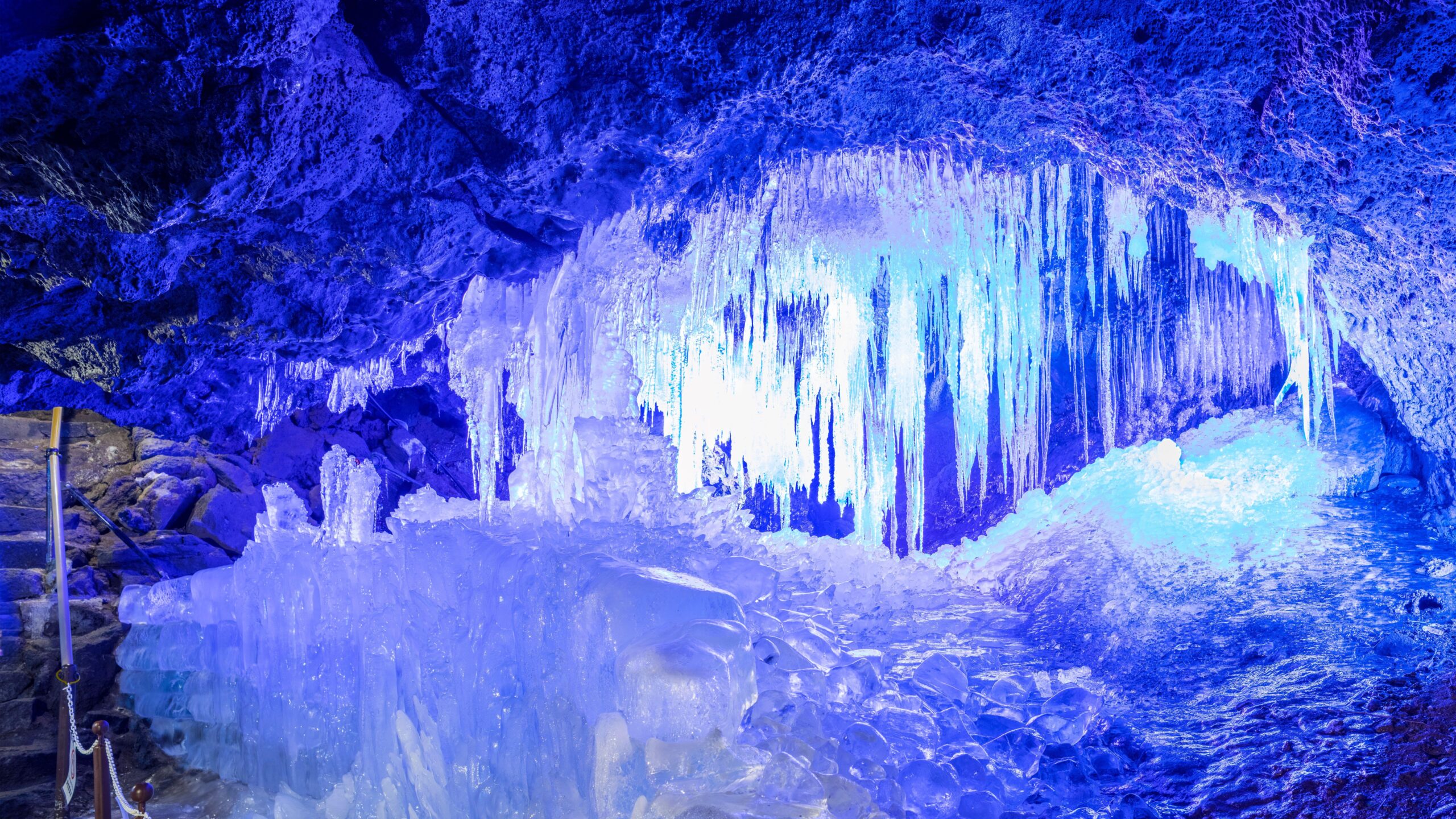
Water that drips from the ceiling of the cave forms stalactites and stalagmites that meet in the middle during the coldest months. The best time to visit Narusawa Ice Cave is in winter or early spring, when these ice pillars can reach up to 1.6 feet (0.5 m) thick and 10 feet (3 m) tall, according to Wind Cave & Ice Cave.

Related: See what would happen to Tokyo if Mount Fuji erupted ‘without any warning’ in new AI-generated video

Get the world’s most fascinating discoveries delivered straight to your inbox.

Ice pillars inside the Narusawa Ice Cave. The cave is illuminated with blue light.

Ice pillars in the Narusawa Ice Cave can be up to 10 feet high and 1.6 feet thick. (Image credit: amana images inc. via Alamy)

The cave is a tourist attraction, but historically, it was used to keep seeds and silkworm cocoons cool. People carved rectangular blocks out of the ice pillars, which they then stacked to create an icebox or refrigerator of sorts, according to Wind Cave & Ice Cave.

“To prevent growth of the cocoons and to preserve the quality of seeds and promote budding, they were stored in a refrigerated environment,” the company states on its website.

The cave also holds the remains of ancient trees, which were knocked down by lava flows during the A.D. 864 eruption, pictures on the website show.

The Narusawa Ice Cave sits just half a mile (800 m) east of Fugaku Wind Cave, which extends much deeper belowground, boasts impressive lava formations and houses unusual moss colonies, according to the Japan National Tourism Organization. There is no echo in the wind cave because the walls of pure basaltic rock absorb sound — and unlike in the ice cave, there isn’t any frozen water for sound waves to bounce off of.


Discover more incredible places, where we highlight the fantastic history and science behind some of the most dramatic landscapes on Earth.

Source link

Share. Facebook Twitter Pinterest LinkedIn Tumblr Email
Previous ArticleEagles’ Jalen Carter speaks on spitting incident
Next Article Eagles’ Jalen Carter Ejected for Spitting on Cowboys’ Dak Prescott
Editor
  • Website

Related Posts

Lifestyle

How did animals survive the asteroid that killed the dinosaurs?

May 24, 2026
Lifestyle

‘We can identify these really early, before the clinical diagnosis’: Epigenetic markers may help explain why Native Hawaiians are aging faster

May 24, 2026
Lifestyle

Catapult the cow: 6 medieval castles that were never conquered

May 24, 2026
Add A Comment

Comments are closed.

Categories
  • Entertainment
  • Lifestyle
  • News
  • Sports
  • Tech
  • Travel
Recent Posts
  • How did animals survive the asteroid that killed the dinosaurs?
  • ‘We can identify these really early, before the clinical diagnosis’: Epigenetic markers may help explain why Native Hawaiians are aging faster
  • Catapult the cow: 6 medieval castles that were never conquered
  • China launches ‘human artificial embryos’ to space for the first time
  • NASA’s Psyche spacecraft beams back blue images of Mars on its way to a metal asteroid
calendar
May 2026
M T W T F S S
 123
45678910
11121314151617
18192021222324
25262728293031
« Apr    
Recent Posts
  • How did animals survive the asteroid that killed the dinosaurs?
  • ‘We can identify these really early, before the clinical diagnosis’: Epigenetic markers may help explain why Native Hawaiians are aging faster
  • Catapult the cow: 6 medieval castles that were never conquered
About

Welcome to Baynard Media, your trusted source for a diverse range of news and insights. We are committed to delivering timely, reliable, and thought-provoking content that keeps you informed
and inspired

Categories
  • Entertainment
  • Lifestyle
  • News
  • Sports
  • Tech
  • Travel
Facebook X (Twitter) Pinterest WhatsApp
  • Contact Us
  • About Us
  • Privacy Policy
  • Disclaimer
  • UNSUBSCRIBE
© 2026 copyrights reserved

Type above and press Enter to search. Press Esc to cancel.