Close Menu
  • Home
  • UNSUBSCRIBE
  • News
  • Lifestyle
  • Tech
  • Entertainment
  • Sports
  • Travel
Facebook X (Twitter) WhatsApp
Trending
  • 2 vanished ‘super Earths’ once orbited near Uranus and Neptune, new study hints
  • Ditch full of 7,000-year-old headless human skeletons discovered in Slovakia, baffling archaeologists
  • Manhattan Project physicist Richard Feynman’s forgotten notes on ‘the restaurant problem’ deciphered after 50 years
  • Doctors need to understand patients’ lived experiences to treat them well—but medical schools may stop requiring that training | Naa Asheley Ashitey
  • Italian teenagers discover 1,800-year-old Roman luxury house underneath their high school gym
  • Roman bath clog: The world’s oldest shower shoes were found at a fort along Hadrian’s Wall
  • Sea ice loss in the Arctic has triggered a critical tipping point that’s destroying the food chain
  • ‘A disease anywhere can be a disease everywhere tomorrow morning’: Public health expert on Ebola and the threat of future outbreaks
Facebook X (Twitter) WhatsApp
Baynard Media
  • Home
  • UNSUBSCRIBE
  • News
  • Lifestyle
  • Tech
  • Entertainment
  • Sports
  • Travel
Baynard Media
Home»Lifestyle»Mysterious 300,000-year-old Greek cave skull was neither human nor Neanderthal, study finds
Lifestyle

Mysterious 300,000-year-old Greek cave skull was neither human nor Neanderthal, study finds

EditorBy EditorAugust 22, 2025No Comments3 Mins Read
Share Facebook Twitter Pinterest LinkedIn Tumblr Reddit Telegram Email
Share
Facebook Twitter LinkedIn Pinterest Email

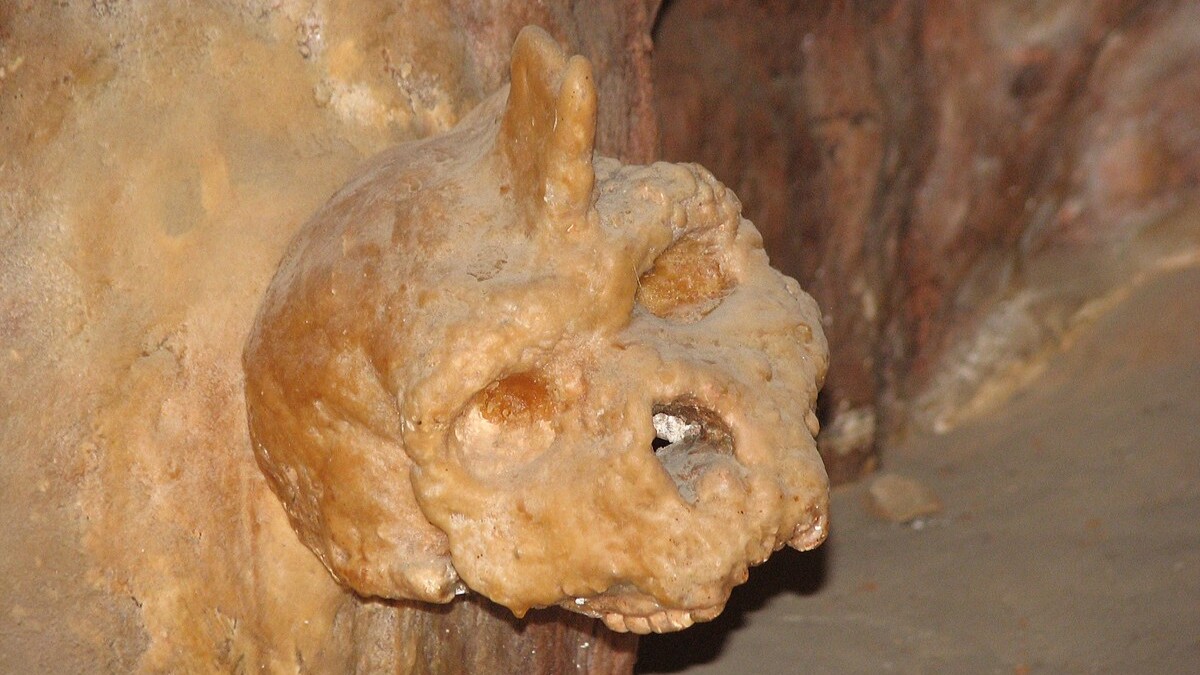
A mysterious skull with a stalagmite growing out of its head is about 300,000 years old and neither human nor Neanderthal, a new study finds.

The skull was reportedly discovered attached to the wall of Petralona Cave in northern Greece in 1960. Researchers have since argued about its position on the human family tree and had trouble figuring out its age — until now.

In the new study, published online Aug. 14 in the Journal of Human Evolution, researchers dated calcite (a mineral form of calcium carbonate often found in caves) protruding out of the skull to find that it was at least 277,000 years old. They don’t know precisely how long the skull was in the cave before it began acquiring calcite, but the new estimate helps narrow down previous attempts to date the skull, which have ranged from 170,000 to 700,000 years old.


You may like

The findings support previous suggestions that the Petralona individual lived in Pleistocene-era Europe alongside Neanderthals, but was part of a different human group, broadly called Homo heidelbergensis.

The Petralona fossil is distinct from H. sapiens and Neanderthals, study co-author Chris Stringer, a paleoanthropologist at the Natural History Museum in London, told Live Science, “and the new age estimate supports the persistence and coexistence of this population alongside the evolving Neanderthal lineage in the later Middle Pleistocene of Europe”.

Related: ‘It makes no sense to say there was only one origin of Homo sapiens’: How the evolutionary record of Asia is complicating what we know about our species

The Petralona skull, sometimes called the “Petralona Man,” was almost certainly male based on the fossil’s size and robustness, according to Stringer. He also said that the skull’s teeth had moderate wear, so it likely belonged to a young adult.

Get the world’s most fascinating discoveries delivered straight to your inbox.

While records of the skull’s discovery are poor, Stringer noted that there’s evidence to support the idea that it was stuck to the wall by calcite encrustations — the same kind that were protruding out of the skull.

To estimate the age of the calcite, researchers used a method called uranium-series dating. Calcite contains a small amount of uranium, which decays into another radioactive element called thorium over a fixed period. This fixed rate of decay means that researchers can calculate ages based on the calcite’s ratio of uranium to thorium. The skull calcite dates back to around 286,000 years ago, with a high degree of confidence that it’s at least 277,000 years old.

The dating research also suggested that calcite grew quite rapidly in the cave. Stringer noted that it likely didn’t take long for the skull to acquire its first layer of calcite, which would mean the skull is around 300,000 years old. However, the skull could be older than 300,000 years old if the calcite took longer to form.

The estimate of 300,000 years old fits with Stringer and colleagues’ analysis of a similar fossil from Zambia in Africa known as the Kabwe skull. Their 2019 study dated the Kabwe skull, which is often assigned to H. heidelbergensis, at 299,000 years old.

“That fossil is closely comparable to the Petralona one, and I would classify them both as Homo heidelbergensis,” Stringer said.

Source link

Share. Facebook Twitter Pinterest LinkedIn Tumblr Email
Previous ArticleDNA testing for migrants at border urged to stop child trafficking
Next Article Kilmar Abrego Garcia is released from federal custody in Tennessee
Editor
  • Website

Related Posts

Lifestyle

2 vanished ‘super Earths’ once orbited near Uranus and Neptune, new study hints

June 9, 2026
Lifestyle

Ditch full of 7,000-year-old headless human skeletons discovered in Slovakia, baffling archaeologists

June 9, 2026
Lifestyle

Manhattan Project physicist Richard Feynman’s forgotten notes on ‘the restaurant problem’ deciphered after 50 years

June 9, 2026
Add A Comment

Comments are closed.

Categories
  • Entertainment
  • Lifestyle
  • News
  • Sports
  • Tech
  • Travel
Recent Posts
  • 2 vanished ‘super Earths’ once orbited near Uranus and Neptune, new study hints
  • Ditch full of 7,000-year-old headless human skeletons discovered in Slovakia, baffling archaeologists
  • Manhattan Project physicist Richard Feynman’s forgotten notes on ‘the restaurant problem’ deciphered after 50 years
  • Doctors need to understand patients’ lived experiences to treat them well—but medical schools may stop requiring that training | Naa Asheley Ashitey
  • Italian teenagers discover 1,800-year-old Roman luxury house underneath their high school gym
calendar
June 2026
M T W T F S S
1234567
891011121314
15161718192021
22232425262728
2930  
« May    
Recent Posts
  • 2 vanished ‘super Earths’ once orbited near Uranus and Neptune, new study hints
  • Ditch full of 7,000-year-old headless human skeletons discovered in Slovakia, baffling archaeologists
  • Manhattan Project physicist Richard Feynman’s forgotten notes on ‘the restaurant problem’ deciphered after 50 years
About

Welcome to Baynard Media, your trusted source for a diverse range of news and insights. We are committed to delivering timely, reliable, and thought-provoking content that keeps you informed
and inspired

Categories
  • Entertainment
  • Lifestyle
  • News
  • Sports
  • Tech
  • Travel
Facebook X (Twitter) Pinterest WhatsApp
  • Contact Us
  • About Us
  • Privacy Policy
  • Disclaimer
  • UNSUBSCRIBE
© 2026 copyrights reserved

Type above and press Enter to search. Press Esc to cancel.