Close Menu
  • Home
  • UNSUBSCRIBE
  • News
  • Lifestyle
  • Tech
  • Entertainment
  • Sports
  • Travel
Facebook X (Twitter) WhatsApp
Trending
  • Heart issues tied to ‘microdamage’ in the brain might raise risk of memory loss, study hints
  • Neanderthals and modern humans may have shared culture 59,000 years ago in Turkey, study finds
  • Scientists just created the most lifelike cell ever made in the lab ‪— but experts say it’s not ‘truly autonomous’
  • ‘What we found was striking’: Physicists take the closest-ever look at a black hole’s mysterious event horizon
  • Diagnostic dilemma: Huge mass in woman’s stomach was likely caused by Ozempic-style drug — and dissolved with diet soda
  • The Stargazer: A 5,000-year-old marble statuette of a Stone Age woman looking skyward
  • James Webb telescope’s largest-ever map of the universe unmasks hidden corners
  • Science news this week: James Webb telescope finds a never-before-seen substance, China’s ‘Great Green Wall’ grows faster than natural trees, and a Medici murder mystery is solved
Facebook X (Twitter) WhatsApp
Baynard Media
  • Home
  • UNSUBSCRIBE
  • News
  • Lifestyle
  • Tech
  • Entertainment
  • Sports
  • Travel
Baynard Media
Home»Lifestyle»More than 1,300 coins buried buried during Roman emperor Nero’s reign found in England
Lifestyle

More than 1,300 coins buried buried during Roman emperor Nero’s reign found in England

EditorBy EditorJanuary 23, 2025No Comments3 Mins Read
Share Facebook Twitter Pinterest LinkedIn Tumblr Reddit Telegram Email
Share
Facebook Twitter LinkedIn Pinterest Email

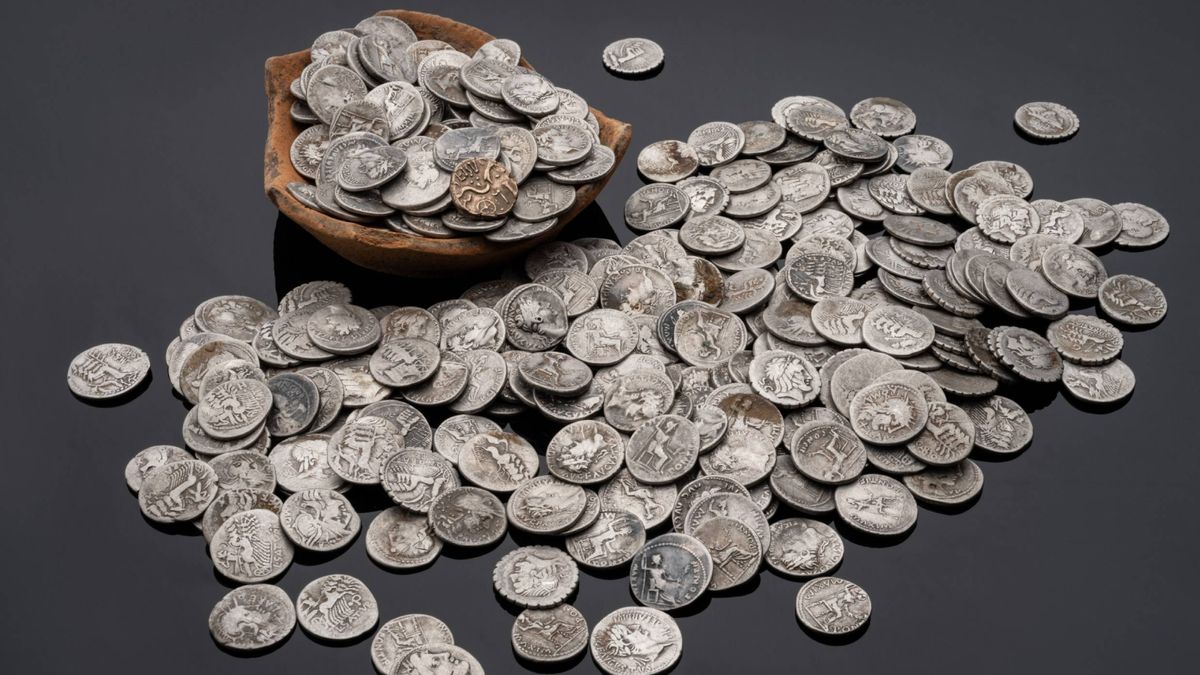
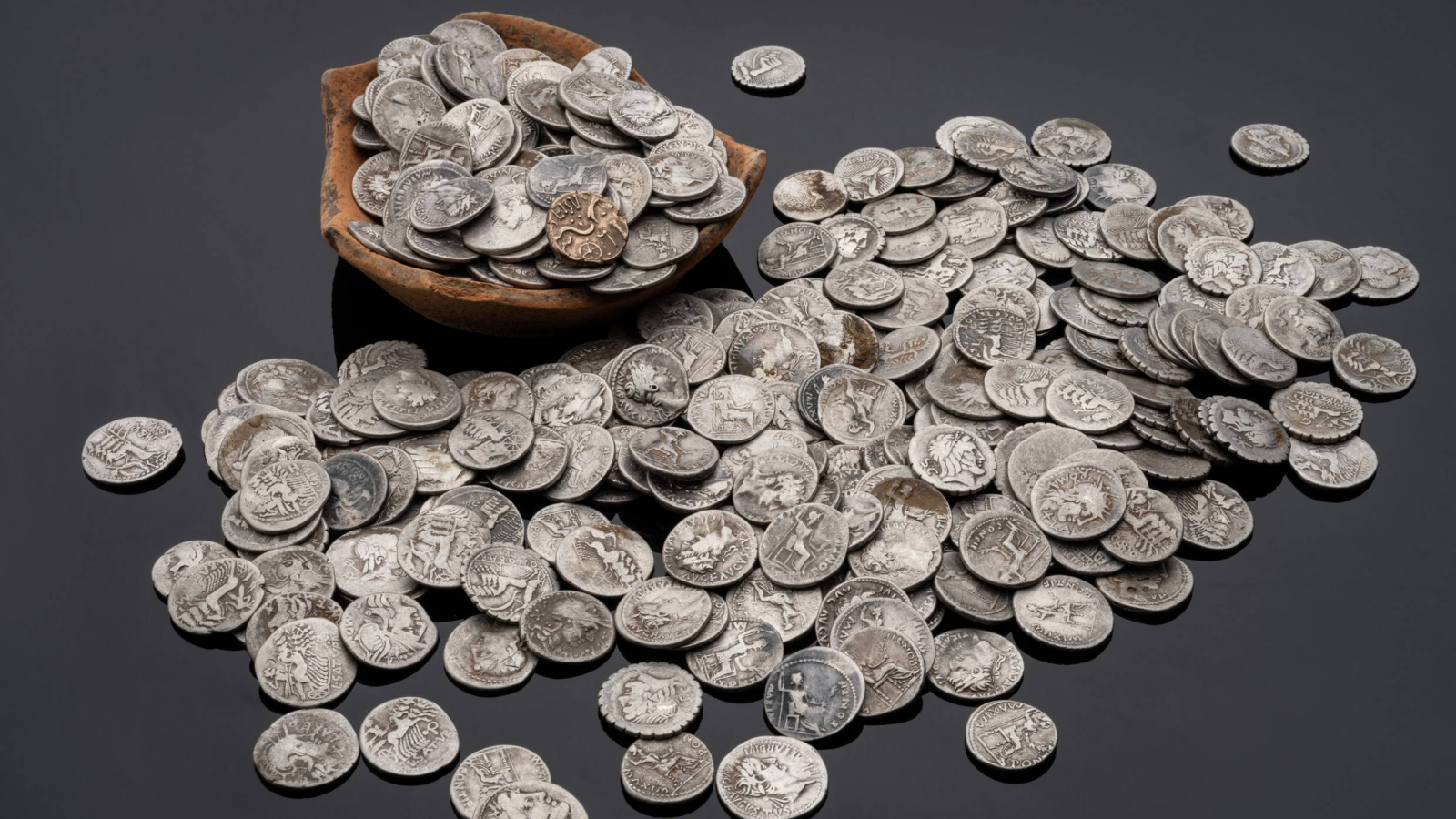
A hoard of 1,368 coins, most of them silver, has been discovered in a pot by a metal detectorist in Worcestershire, a county in England.

The hoard was buried around A.D. 55, a time when the Roman Empire, led by emperor Nero (reign circa A.D. 54 to 68), was struggling to take control of England. His predecessor Claudius (reign A.D. 41 to 54) had invaded Britain and gained control of large amounts of England, but resistance continued into Nero’s reign. In A.D. 60, a rebellion launched by Boudica, the queen of a British tribe known as the Iceni, nearly succeeded in driving the Romans from the island before the empire put the rebellion down.

Although Nero’s forces managed to squash the Iceni rebellion, his reign is often considered a tumultuous one. He had both his mother and wife killed during his rule. A great fire ravaged Rome in A.D. 64 and, according to an apocryphal story, Nero played a fiddle during it. In A.D. 68, the Praetorian guard, the forces in charge of protecting the emperor, removed Nero as ruler and soon after he died by suicide.

While the coins were buried during Nero’s reign, some of them were minted earlier. All but one of the coins in the hoard are silver denarii, a standard Roman coin, that were minted between 157 B.C. and A.D. 55, according to a statement from Museums Worcestershire. The one gold coin in the hoard was minted between A.D. 20 and 45 for a tribe called the Dobunni who were based in Worcestershire and nearby areas, the statement reported.

Related: 1,700-year-old Roman hoard includes gold coins depicting illegitimate emperor

“The coins almost certainly entered the region by means of the Roman army,” the statement noted. “Their sheer number means that the hoard would have represented a very considerable sum of cash at the time it was buried.”

It’s unknown why the hoard was hidden, but “one theory is that the hoard represents the savings of a wealthy local farmer, who made his money by supplying the Roman army with grain and livestock,” the museum said.

Get the world’s most fascinating discoveries delivered straight to your inbox.

At the time the hoard was buried, Worcestershire was located on the frontier of the Roman Empire, according to the statement. This raises a question of whether battles or conflicts in the area might have prompted its owner to hide it.

The hoard was found in late 2023 and analyzed in greater detail in 2024, when it was declared “treasure,” a government designation given to artifacts made of precious metal that are at least 300 years old. It has been valued at £100,000 ($123,100). The museum is trying to raise money to acquire the hoard.

“The fundraising campaign is doing really well, people are being incredibly generous and it’s clear to see that there’s real passion for the Hoard to stay in Worcestershire,” Helen Large, a spokesperson for Museums Worcestershire, told Live Science in an email.

Source link

Share. Facebook Twitter Pinterest LinkedIn Tumblr Email
Previous ArticleSamsung Galaxy Buds2 Pro are just $99.99 at Amazon
Next Article Trump’s threat against Moscow on Ukraine seen as an insulting false start by some in Russia
Editor
  • Website

Related Posts

Lifestyle

Heart issues tied to ‘microdamage’ in the brain might raise risk of memory loss, study hints

July 7, 2026
Lifestyle

Neanderthals and modern humans may have shared culture 59,000 years ago in Turkey, study finds

July 7, 2026
Lifestyle

Scientists just created the most lifelike cell ever made in the lab ‪— but experts say it’s not ‘truly autonomous’

July 7, 2026
Add A Comment

Comments are closed.

Categories
  • Entertainment
  • Lifestyle
  • News
  • Sports
  • Tech
  • Travel
Recent Posts
  • Heart issues tied to ‘microdamage’ in the brain might raise risk of memory loss, study hints
  • Neanderthals and modern humans may have shared culture 59,000 years ago in Turkey, study finds
  • Scientists just created the most lifelike cell ever made in the lab ‪— but experts say it’s not ‘truly autonomous’
  • ‘What we found was striking’: Physicists take the closest-ever look at a black hole’s mysterious event horizon
  • Diagnostic dilemma: Huge mass in woman’s stomach was likely caused by Ozempic-style drug — and dissolved with diet soda
calendar
July 2026
M T W T F S S
 12345
6789101112
13141516171819
20212223242526
2728293031  
« Jun    
Recent Posts
  • Heart issues tied to ‘microdamage’ in the brain might raise risk of memory loss, study hints
  • Neanderthals and modern humans may have shared culture 59,000 years ago in Turkey, study finds
  • Scientists just created the most lifelike cell ever made in the lab ‪— but experts say it’s not ‘truly autonomous’
About

Welcome to Baynard Media, your trusted source for a diverse range of news and insights. We are committed to delivering timely, reliable, and thought-provoking content that keeps you informed
and inspired

Categories
  • Entertainment
  • Lifestyle
  • News
  • Sports
  • Tech
  • Travel
Facebook X (Twitter) Pinterest WhatsApp
  • Contact Us
  • About Us
  • Privacy Policy
  • Disclaimer
  • UNSUBSCRIBE
© 2026 copyrights reserved

Type above and press Enter to search. Press Esc to cancel.