Close Menu
  • Home
  • UNSUBSCRIBE
  • News
  • Lifestyle
  • Tech
  • Entertainment
  • Sports
  • Travel
Facebook X (Twitter) WhatsApp
Trending
  • Chinese medical practitioners used extremely toxic plant as a topical anesthetic 600 years ago, study finds
  • Bead net funerary shroud: A 2,500-year-old beaded veil from Egypt depicting the deceased’s transformation into Osiris
  • Rare genetic disease makes scientists reconsider what the ‘seat of fear’ in the brain really is
  • It’s illegal to repair most of our devices. There’s a surprising reason for that.
  • Jupiter’s Ganymede, the largest moon in the solar system, may be heating up
  • Bizarre patterns on Venus have scientists puzzled
  • Scientists trained an AI model using an IBM quantum computer — and it answered questions correctly that the base model couldn’t
  • How did animals survive the asteroid that killed the dinosaurs?
Facebook X (Twitter) WhatsApp
Baynard Media
  • Home
  • UNSUBSCRIBE
  • News
  • Lifestyle
  • Tech
  • Entertainment
  • Sports
  • Travel
Baynard Media
Home»Lifestyle»Mind-reading brain implant converts brain signals to speech
Lifestyle

Mind-reading brain implant converts brain signals to speech

EditorBy EditorApril 4, 2025No Comments3 Mins Read
Share Facebook Twitter Pinterest LinkedIn Tumblr Reddit Telegram Email
Share
Facebook Twitter LinkedIn Pinterest Email

A brain implant that uses artificial intelligence (AI) can almost instantaneously decode a person’s thoughts and stream them through a speaker, new research shows. This is the first time researchers have achieved near-synchronous brain-to-voice streaming.

The experimental mind-reading technology is designed to give a synthetic voice to people with severe paralysis who cannot speak. It works by putting electrodes onto the brain’s surface as part of an implant called a neuroprosthesis, which allows scientists to identify and interpret speech signals.

The brain-computer interface (BCI) uses AI to decode neural signals and can stream intended speech from the brain in close to real time, according to a statement released by the University of California (UC), Berkeley. The team previously unveiled an earlier version of the technology in 2023, but the new version is quicker and less robotic.
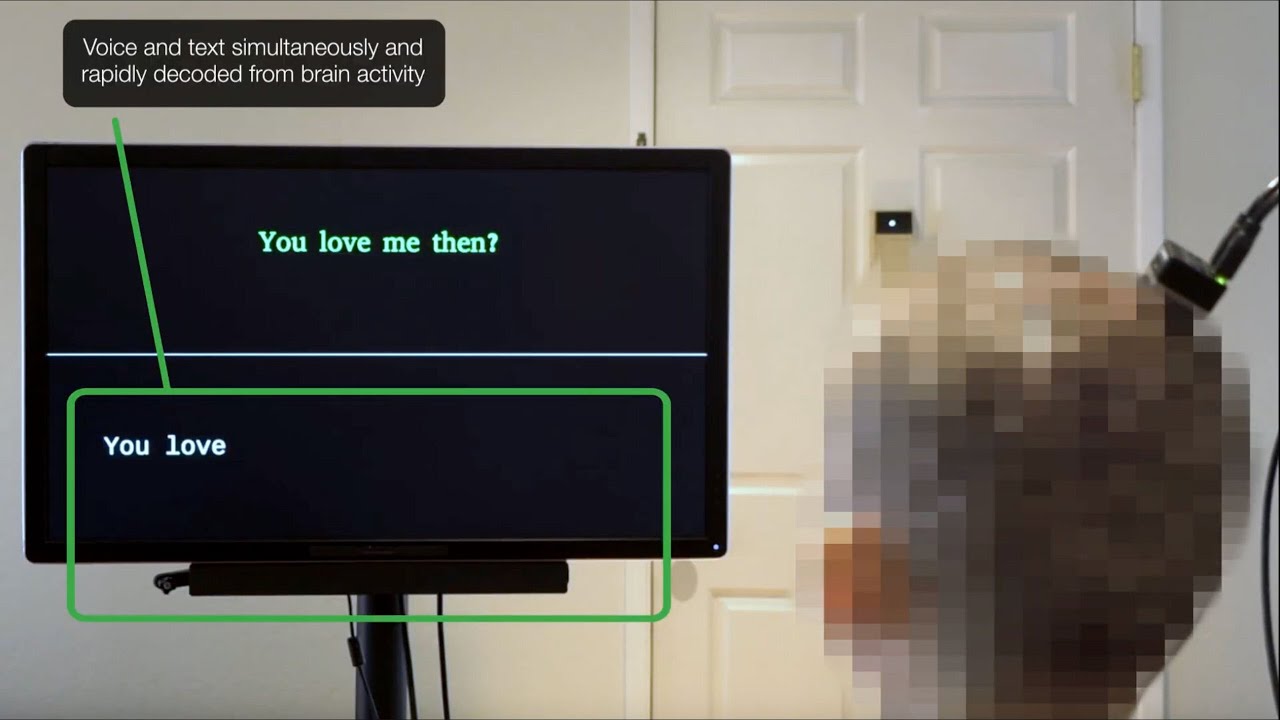
A streaming brain-to-voice neuroprosthesis to restore naturalistic communication – YouTube
A streaming brain-to-voice neuroprosthesis to restore naturalistic communication - YouTube


Watch On

“Our streaming approach brings the same rapid speech decoding capacity of devices like Alexa and Siri to neuroprostheses,” study co-principal investigator Gopala Anumanchipalli, an assistant professor of electrical engineering and computer sciences at UC Berkeley, said in the statement. “Using a similar type of algorithm, we found that we could decode neural data and, for the first time, enable near-synchronous voice streaming.”

Anumanchipalli and his colleagues shared their findings in a study published Monday (March 31) in the journal Nature Neuroscience.

Related: AI analysis of 100 hours of real conversations — and the brain activity underpinning them — reveals how humans understand language

The first person to trial this technology, identified as Ann, suffered a stroke in 2005 that left her severely paralyzed and unable to speak. She has since allowed researchers to implant 253 electrodes onto her brain to monitor the part of our brains that controls speech — called the motor cortex — to help develop synthetic speech technologies.

Get the world’s most fascinating discoveries delivered straight to your inbox.

“We are essentially intercepting signals where the thought is translated into articulation and in the middle of that motor control,” study co-lead author Cheol Jun Cho, a doctoral student in electrical engineering and computer sciences at UC Berkeley, said in the statement. “So what we’re decoding is after a thought has happened, after we’ve decided what to say, after we’ve decided what words to use and how to move our vocal-tract muscles.”

AI decodes data sampled by the implant to help convert neural activity into synthetic speech. The team trained their AI algorithm by having Ann silently attempt to speak sentences that appeared on a screen before her, and then by matching the neural activity to the words she wanted to say.

The system sampled brain signals every 80 milliseconds (0.08 seconds) and could detect words and convert them into speech with a delay of up to around 3 seconds, according to the study. That’s a little slow compared to normal conversation, but faster than the previous version, which had a delay of about 8 seconds and could only process whole sentences.

The new system benefits from converting shorter windows of neural activity than the old one, so it can continuously process individual words rather than waiting for a finished sentence. The researchers say the new study is a step toward achieving more natural-sounding synthetic speech with BCIs.

“This proof-of-concept framework is quite a breakthrough,” Cho said. “We are optimistic that we can now make advances at every level. On the engineering side, for example, we will continue to push the algorithm to see how we can generate speech better and faster.”

Source link

Share. Facebook Twitter Pinterest LinkedIn Tumblr Email
Previous ArticleHas the sun already passed solar maximum?
Next Article Using AI makes you dumber, scary new Microsoft study finds
Editor
  • Website

Related Posts

Lifestyle

Chinese medical practitioners used extremely toxic plant as a topical anesthetic 600 years ago, study finds

May 26, 2026
Lifestyle

Bead net funerary shroud: A 2,500-year-old beaded veil from Egypt depicting the deceased’s transformation into Osiris

May 25, 2026
Lifestyle

Rare genetic disease makes scientists reconsider what the ‘seat of fear’ in the brain really is

May 25, 2026
Add A Comment

Comments are closed.

Categories
  • Entertainment
  • Lifestyle
  • News
  • Sports
  • Tech
  • Travel
Recent Posts
  • Chinese medical practitioners used extremely toxic plant as a topical anesthetic 600 years ago, study finds
  • Bead net funerary shroud: A 2,500-year-old beaded veil from Egypt depicting the deceased’s transformation into Osiris
  • Rare genetic disease makes scientists reconsider what the ‘seat of fear’ in the brain really is
  • It’s illegal to repair most of our devices. There’s a surprising reason for that.
  • Jupiter’s Ganymede, the largest moon in the solar system, may be heating up
calendar
May 2026
M T W T F S S
 123
45678910
11121314151617
18192021222324
25262728293031
« Apr    
Recent Posts
  • Chinese medical practitioners used extremely toxic plant as a topical anesthetic 600 years ago, study finds
  • Bead net funerary shroud: A 2,500-year-old beaded veil from Egypt depicting the deceased’s transformation into Osiris
  • Rare genetic disease makes scientists reconsider what the ‘seat of fear’ in the brain really is
About

Welcome to Baynard Media, your trusted source for a diverse range of news and insights. We are committed to delivering timely, reliable, and thought-provoking content that keeps you informed
and inspired

Categories
  • Entertainment
  • Lifestyle
  • News
  • Sports
  • Tech
  • Travel
Facebook X (Twitter) Pinterest WhatsApp
  • Contact Us
  • About Us
  • Privacy Policy
  • Disclaimer
  • UNSUBSCRIBE
© 2026 copyrights reserved

Type above and press Enter to search. Press Esc to cancel.