

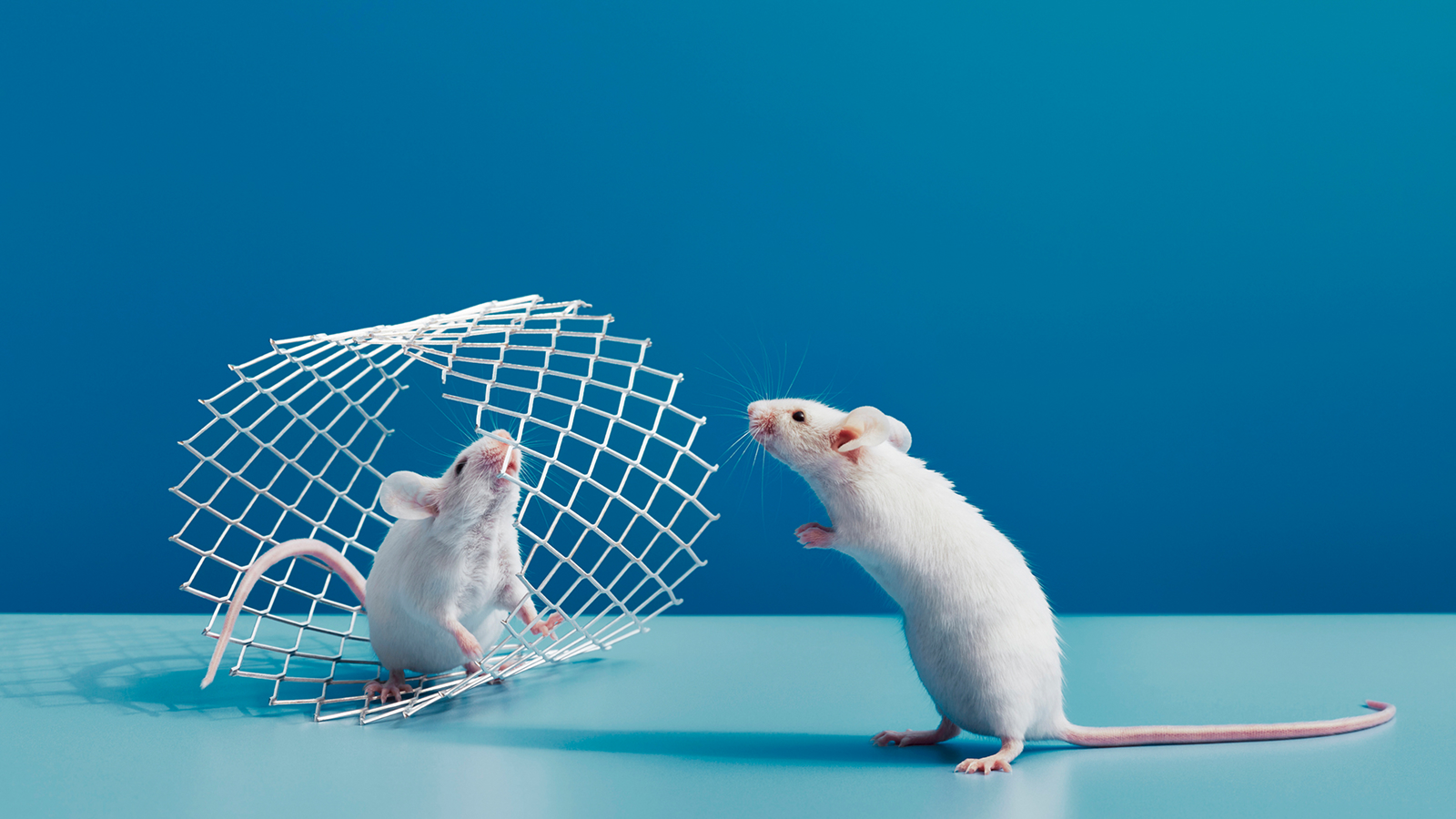
Mice appear to administer first-aid if they find a fellow mouse unconscious, scientists have discovered.
They attempt to revive companions by licking at their faces, or even by pulling at their mouths or tongues, according to a study published Feb. 21 in the journal Science.
More aggressive mouth-pulling, biting and licking behaviors were seen in mice that had spent more time with the mouse in need of help, resulting in a faster recovery, the researchers report.
“The most striking discovery in this study is the existence of instinctive emergency responses in animals to revive unconscious — and even freshly deceased — partners. This study provides the first documented evidence of resuscitation-like behavior in naïve, untrained mice,” study lead author Wenjian Sun, a researcher at the University of Southern California, told Live Science in an email.
Helping other animals that are injured or sick has been observed in a number of species, including dolphins, elephants, and non-human primates, Sun explained.
Related: Ants perform life saving operations — the only animal other than humans known to do so
“These behaviors often include touching, grooming, nudging, and, in some cases, more intense physical actions such as striking. However, specific behaviors like tongue biting and tongue pulling, as observed in this study, have not been previously reported,” Sun said.
In the paper, the researchers describe how dozens of mice reacted after being introduced to another mouse in a state of need. These states included the other mouse being stressed and unconscious.
Mice spent more time in physical contact with the other mouse if it was unconscious rather than awake, with the intensity of the grooming increasing over time if the other was unconscious. Mice spent an average of 47% of the 13-minute test interacting with an unconscious partner.
Grooming increased in vigor over the test period from sniffing and licking to biting at the other mouse’s mouth and tongue, with more aggressive actions being seen in pairs of mice that were more familiar with one another. Over 50% of the mice ended up pulling at the tongues of their unconscious companion.
The mice were also able to detect that their companion was unconscious without relying on visual cues, initiating the grooming behaviors even in the dark.
The more intense grooming behaviors were correlated with better recovery in the unconscious mice, with a more rapid return to consciousness afterwards. When their companion awoke, the first-aider mouse stopped performing the grooming behaviors.
“The animal appears to be able to recognize the unconscious state of its partner, with the unresponsiveness triggering the behavior and regaining of responsiveness terminating the behavior,” Sun said.
While these findings indicate that mice have an instinct to help others like humans do, the researchers can’t be certain why they act in this way.
“We do not exclude the possibility that the animal is simply driven by instinctive impulses to perform these actions — an instinct that may have evolved over time during evolution — rather than acting with a conscious intent to revive its partner,” Sun said.
In another paper, also published on Feb. 21 in Science, other researchers from the University of California, Los Angeles describe the neuronal mechanisms behind this behavior. They found that the grooming is likely driven by the release of oxytocin — a hormone that plays a crucial role in social bonding, sex, and childbirth — in areas of the brain called the amygdala and hypothalamus.
“Inactivation of oxytocin neurons or blocking oxytocin receptors impaired the behavior, confirming that oxytocin is essential for this emergency response. This aligns with the oxytocin’s well-known role as the ‘love hormone’ which is associated with trust and affection in humans and promotes social bonding,” Sun explained.
“Since oxytocin receptors are expressed in many brain regions, future research will focus on identifying the specific neural circuits involved in this behavior.”
