Close Menu
  • Home
  • UNSUBSCRIBE
  • News
  • Lifestyle
  • Tech
  • Entertainment
  • Sports
  • Travel
Facebook X (Twitter) WhatsApp
Trending
  • Chinese medical practitioners used extremely toxic plant as a topical anesthetic 600 years ago, study finds
  • Bead net funerary shroud: A 2,500-year-old beaded veil from Egypt depicting the deceased’s transformation into Osiris
  • Rare genetic disease makes scientists reconsider what the ‘seat of fear’ in the brain really is
  • It’s illegal to repair most of our devices. There’s a surprising reason for that.
  • Jupiter’s Ganymede, the largest moon in the solar system, may be heating up
  • Bizarre patterns on Venus have scientists puzzled
  • Scientists trained an AI model using an IBM quantum computer — and it answered questions correctly that the base model couldn’t
  • How did animals survive the asteroid that killed the dinosaurs?
Facebook X (Twitter) WhatsApp
Baynard Media
  • Home
  • UNSUBSCRIBE
  • News
  • Lifestyle
  • Tech
  • Entertainment
  • Sports
  • Travel
Baynard Media
Home»Lifestyle»Malia Bee Pendant: A 3,800-year-old accessory found in a Minoan ‘pit of gold’
Lifestyle

Malia Bee Pendant: A 3,800-year-old accessory found in a Minoan ‘pit of gold’

EditorBy EditorAugust 25, 2025No Comments3 Mins Read
Share Facebook Twitter Pinterest LinkedIn Tumblr Reddit Telegram Email
Share
Facebook Twitter LinkedIn Pinterest Email

QUICK FACTS

Name: Malia Bee Pendant

What it is: A gold pendant

Where it is from: Malia, Crete

When it was made: Between 1800 and 1700 B.C.

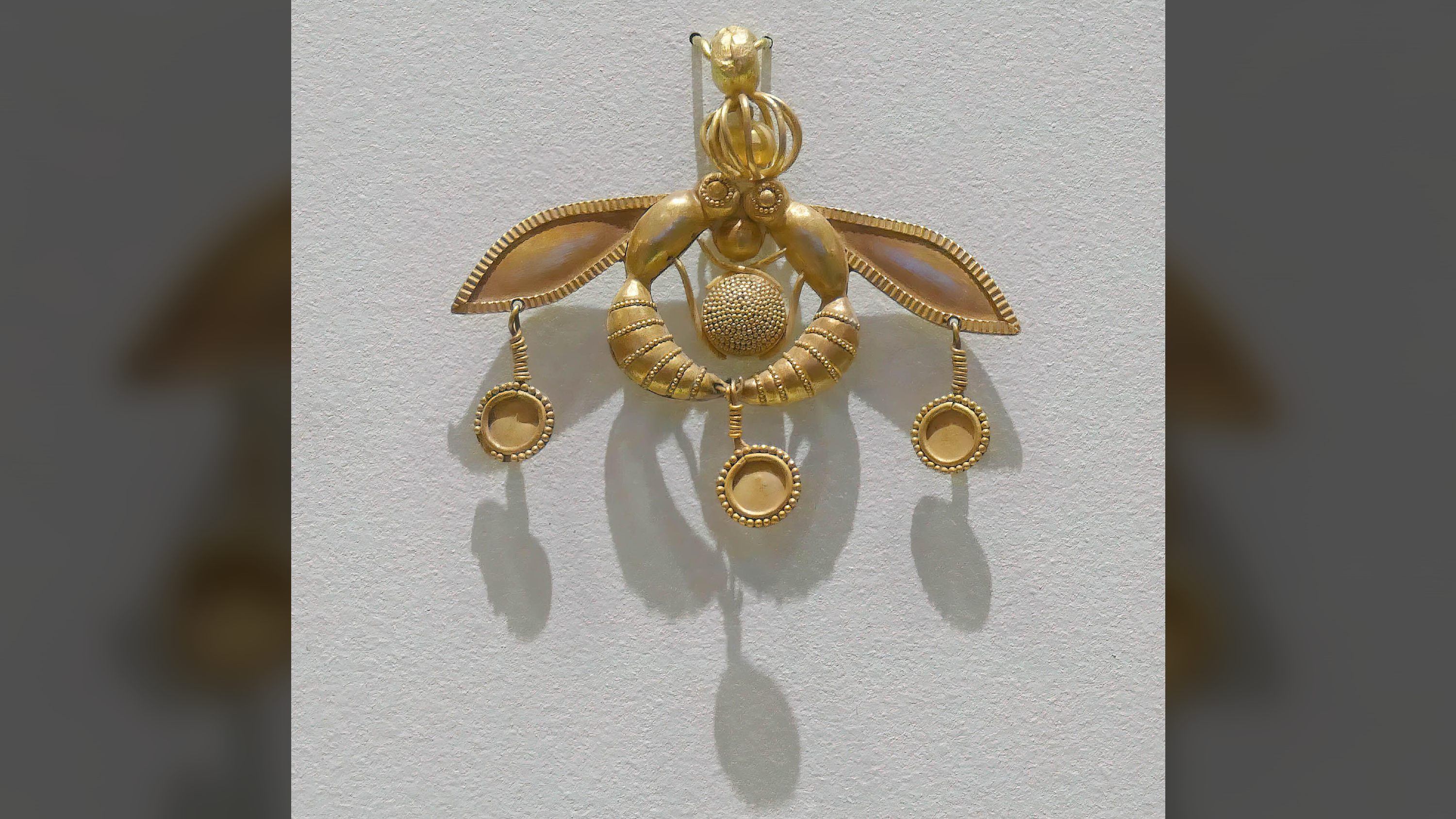
This gold pendant was discovered in 1930 at the cemetery of Chrysolakkos, which means “pit of gold,” in the ancient Minoan town of Malia in Crete. Although the famed archaeologist Sir Arthur Evans suggested the jewelry depicted bees, the identity of the insects on the pendant and the meaning behind the design have been debated for nearly a century.

According to the Heraklion Archaeological Museum in Crete, where the pendant is on display, it is 1.8 inches (4.6 centimeters) long and weighs 0.2 ounces (5.5 grams) — about as much as a U.S. quarter. The ancient goldsmith combined several techniques to create the piece — filigree, granulation, repoussé and incised decoration — and the pendant is considered a “masterpiece of Minoan miniature art,” according to the museum.

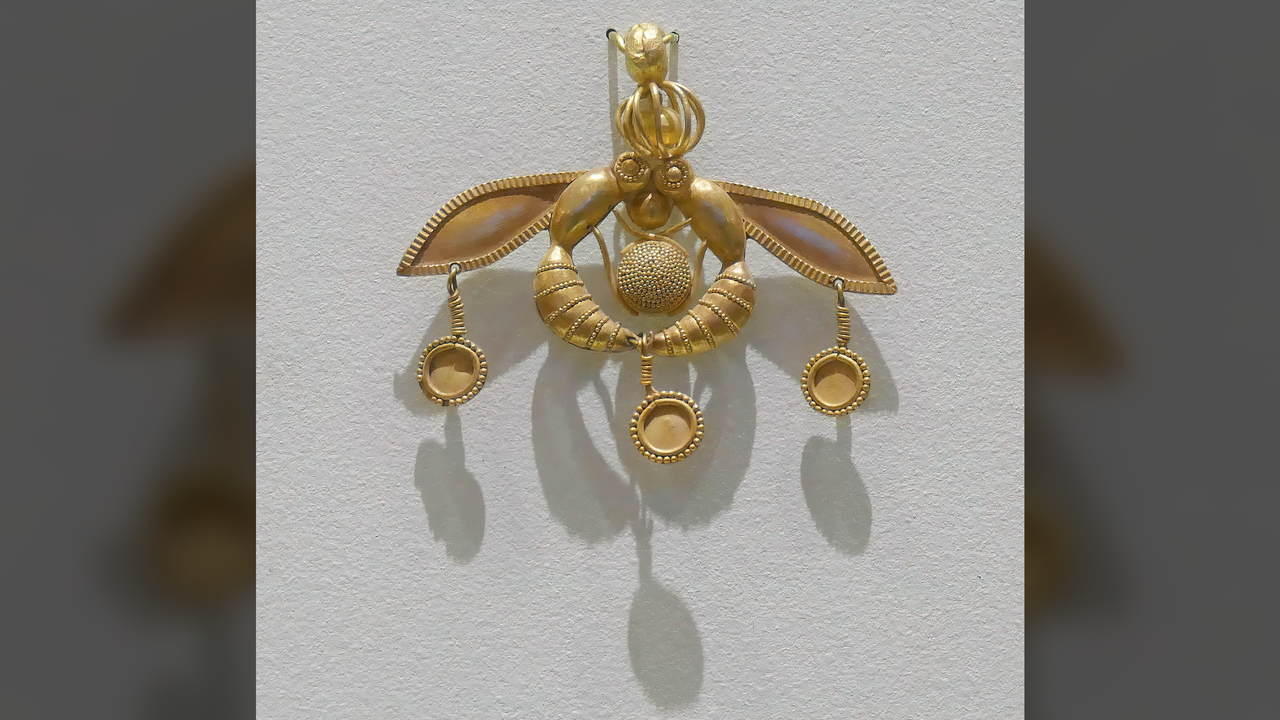
The pendant depicts two insects facing each other, with their heads and abdomens joined and their wings spread backward. Two legs of each insect appear to grasp a series of concentrically placed gold beads. Three small discs dangle from the wings and joined abdomens.


You may like

Some researchers suggest this accessory shows European honeybees (Apis mellifera) in the process of making honey, arguing that the bees are holding a honeycomb and have a drop of honey in their mouths.

“Honey and wax were important elements of the Minoan economy,” according to the Heraklion Archaeological Museum, “while bees also appear to have been important Minoan religious symbols.”

But this interpretation does not account for the three dangling circles, a group of researchers led by botanist E. Charles Nelson wrote in a 2021 study. These circles may represent the fruits of the Mediterranean hartwort (Tordylium apulum), an edible herb that’s common in Crete and produces clusters of disc-shaped fruit with beaded margins.

Related: Pazuzu figurine: An ancient statue of the Mesopotamian ‘demon’ god who inspired ‘The Exorcist’

Get the world’s most fascinating discoveries delivered straight to your inbox.

If the dangling discs represent this fruit, the insects being depicted may not be bees, the researchers argued. The insects on the pendant more closely resemble the mammoth wasp (Megascolia maculata), they said. When it feeds on flowering plants like the Mediterranean hartwort, the mammoth wasp appears to grab the pollen-producing parts of flowers, curling its abdomen around them, with its wings swept backward.

MORE ASTONISHING ARTIFACTS

Exactly what the ancient goldsmith intended to represent with the pendant is still an open question. It’s possible they wanted to depict bees and erroneously used wasps as a model. Regardless, experts agree that the pendant’s creator was extremely skillful at working with gold.

“While the Malia pendant is often viewed as being associated with the craft of beekeeping,” this may not be the case, Nelson and colleagues argued in the study. But in the end, “the jewel represents — indeed celebrates — the natural world of Crete.”

Source link

Share. Facebook Twitter Pinterest LinkedIn Tumblr Email
Previous ArticleCalifornia loses PREP funding after refusing to remove gender content
Next Article Rihanna’s multibillion-dollar brand invested in the WNBA — and it’s just the start
Editor
  • Website

Related Posts

Lifestyle

Chinese medical practitioners used extremely toxic plant as a topical anesthetic 600 years ago, study finds

May 26, 2026
Lifestyle

Bead net funerary shroud: A 2,500-year-old beaded veil from Egypt depicting the deceased’s transformation into Osiris

May 25, 2026
Lifestyle

Rare genetic disease makes scientists reconsider what the ‘seat of fear’ in the brain really is

May 25, 2026
Add A Comment

Comments are closed.

Categories
  • Entertainment
  • Lifestyle
  • News
  • Sports
  • Tech
  • Travel
Recent Posts
  • Chinese medical practitioners used extremely toxic plant as a topical anesthetic 600 years ago, study finds
  • Bead net funerary shroud: A 2,500-year-old beaded veil from Egypt depicting the deceased’s transformation into Osiris
  • Rare genetic disease makes scientists reconsider what the ‘seat of fear’ in the brain really is
  • It’s illegal to repair most of our devices. There’s a surprising reason for that.
  • Jupiter’s Ganymede, the largest moon in the solar system, may be heating up
calendar
May 2026
M T W T F S S
 123
45678910
11121314151617
18192021222324
25262728293031
« Apr    
Recent Posts
  • Chinese medical practitioners used extremely toxic plant as a topical anesthetic 600 years ago, study finds
  • Bead net funerary shroud: A 2,500-year-old beaded veil from Egypt depicting the deceased’s transformation into Osiris
  • Rare genetic disease makes scientists reconsider what the ‘seat of fear’ in the brain really is
About

Welcome to Baynard Media, your trusted source for a diverse range of news and insights. We are committed to delivering timely, reliable, and thought-provoking content that keeps you informed
and inspired

Categories
  • Entertainment
  • Lifestyle
  • News
  • Sports
  • Tech
  • Travel
Facebook X (Twitter) Pinterest WhatsApp
  • Contact Us
  • About Us
  • Privacy Policy
  • Disclaimer
  • UNSUBSCRIBE
© 2026 copyrights reserved

Type above and press Enter to search. Press Esc to cancel.