Close Menu
  • Home
  • UNSUBSCRIBE
  • News
  • Lifestyle
  • Tech
  • Entertainment
  • Sports
  • Travel
Facebook X (Twitter) WhatsApp
Trending
  • New robotic heart mimics common, mysterious condition to help researchers study it
  • Canon EOS R6 III review: A wildlife wonder
  • Medieval babies and adults buried together in Sweden were not related, archaeologists discover — raising big questions about early Christian burial practices
  • NASA is creating a fifth state of matter on the ISS, thanks to an upgrade to a mini-fridge-sized quantum lab
  • New sodium metal battery design charges in just 4 minutes and retains its capacity for years
  • Quantum computing wielded to create extremely rare material critical to nuclear fusion
  • Scientists build tiny ‘diving suit’ for cockroaches, turning them into search-and-rescue cyborgs
  • Physicists develop the first working model of quantum mechanics using only ‘real’ numbers
Facebook X (Twitter) WhatsApp
Baynard Media
  • Home
  • UNSUBSCRIBE
  • News
  • Lifestyle
  • Tech
  • Entertainment
  • Sports
  • Travel
Baynard Media
Home»Lifestyle»Magnetic signals from Earth’s tides revealed in unprecedented detail
Lifestyle

Magnetic signals from Earth’s tides revealed in unprecedented detail

EditorBy EditorJanuary 24, 2025No Comments3 Mins Read
Share Facebook Twitter Pinterest LinkedIn Tumblr Reddit Telegram Email
Share
Facebook Twitter LinkedIn Pinterest Email

Scientists have captured magnetic signatures from Earth’s ocean tides in the finest detail yet.

These faint signals, which certain satellites can detect when flying at very low orbits, may hold clues about magma distribution beneath the seabed, according to a statement from the European Space Agency (ESA).

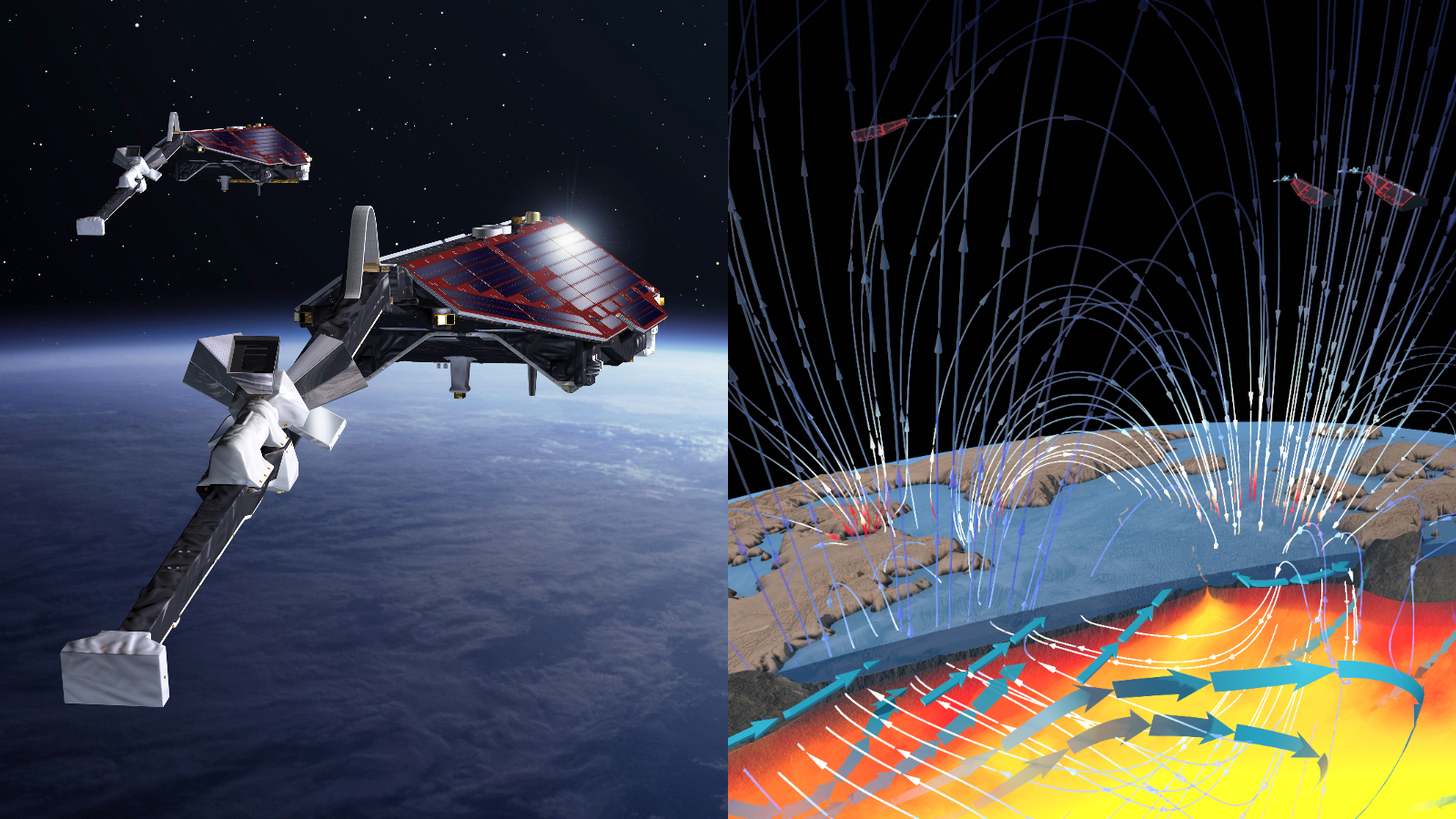
As seawater ripples over our planet’s magnetic field, it generates weak electric currents that in turn produce magnetic signals detectable from space. In a new study, published Dec. 2, 2024 in the journal Philosophical Transactions of the Royal Society A, researchers deciphered these signals using data from ESA’s ongoing Swarm mission, which comprises three satellites that measure Earth’s magnetic field.

“These are among the smallest signals detected by the Swarm mission so far,” study lead author Alexander Grayver, a geophysist and senior lecturer at the University of Cologne in Germany, said in the statement.

Earth’s magnetic field results from a swirling sea of electrically charged molten iron in the planet’s outer core. Heat currents and Earth’s spin both fuel the movement of this liquid iron. The core’s movement creates a giant, bipolar envelope that extends into space, shielding us from cosmic radiation and charged particles emitted by the sun.

Related: Listen to haunting sounds of Earth’s magnetic field flipping 41,000 years ago in eerie new animation

Swarm launched in 2013 and has been collecting information about Earth’s magnetic field ever since. But clear signals created by ocean tides are difficult to obtain, because they are so faint they hardly ever break through the widespread “noise” in space, according to the statement.

Get the world’s most fascinating discoveries delivered straight to your inbox.

In the late 2010s, several factors aligned that enabled Swarm to record the magnetic signatures of ocean tides in unprecedented detail. One of these factors was a dramatic reduction in the sun’s activity, and another was the closeness of Swarm satellites to Earth.

“The data are particularly good because they were gathered during a period of solar minimum, when there was less noise due to space weather,” Grayver said.

The sun follows a roughly 11-year cycle that dictates the level of activity at its surface. At the solar maximum, the sun emits huge waves of electromagnetic radiation and charged particles that obscure measurements of magnetic signals from Earth. Activity dies down during the solar minimum, making it easier for satellites to pick up these signals.

ESA initially planned to end the Swarm mission in 2017, but its valuable results prompted the agency to extend it. Over the years, drag has pulled the satellites closer to Earth, enabling the instruments on board to pick up faint signals that they could not have detected in their original, higher orbits.

“This is one of the benefits of flying missions for longer than originally planned, Anja Strømme, ESA’s Swarm mission manager, said in the statement. “You can tackle scientific questions that weren’t originally envisaged.”

The new study shows that satellites can peer through the depths of Earth’s oceans and extract useful information, Strømme said.

Swarm could stay operational until 2030, when the next solar minimum is due. Scientists hope that this will provide another rare opportunity to detect hidden ocean signals.

Source link

Share. Facebook Twitter Pinterest LinkedIn Tumblr Email
Previous ArticleStuff Your Kindle Day Jan. 23: Free historical cozy mystery e-books
Next Article Stuff Your Kindle Day Jan. 23: Free contemporary cozy mystery e-books
Editor
  • Website

Related Posts

Lifestyle

New robotic heart mimics common, mysterious condition to help researchers study it

July 11, 2026
Lifestyle

Canon EOS R6 III review: A wildlife wonder

July 10, 2026
Lifestyle

Medieval babies and adults buried together in Sweden were not related, archaeologists discover — raising big questions about early Christian burial practices

July 10, 2026
Add A Comment

Comments are closed.

Categories
  • Entertainment
  • Lifestyle
  • News
  • Sports
  • Tech
  • Travel
Recent Posts
  • New robotic heart mimics common, mysterious condition to help researchers study it
  • Canon EOS R6 III review: A wildlife wonder
  • Medieval babies and adults buried together in Sweden were not related, archaeologists discover — raising big questions about early Christian burial practices
  • NASA is creating a fifth state of matter on the ISS, thanks to an upgrade to a mini-fridge-sized quantum lab
  • New sodium metal battery design charges in just 4 minutes and retains its capacity for years
calendar
July 2026
M T W T F S S
 12345
6789101112
13141516171819
20212223242526
2728293031  
« Jun    
Recent Posts
  • New robotic heart mimics common, mysterious condition to help researchers study it
  • Canon EOS R6 III review: A wildlife wonder
  • Medieval babies and adults buried together in Sweden were not related, archaeologists discover — raising big questions about early Christian burial practices
About

Welcome to Baynard Media, your trusted source for a diverse range of news and insights. We are committed to delivering timely, reliable, and thought-provoking content that keeps you informed
and inspired

Categories
  • Entertainment
  • Lifestyle
  • News
  • Sports
  • Tech
  • Travel
Facebook X (Twitter) Pinterest WhatsApp
  • Contact Us
  • About Us
  • Privacy Policy
  • Disclaimer
  • UNSUBSCRIBE
© 2026 copyrights reserved

Type above and press Enter to search. Press Esc to cancel.