Close Menu
  • Home
  • UNSUBSCRIBE
  • News
  • Lifestyle
  • Tech
  • Entertainment
  • Sports
  • Travel
Facebook X (Twitter) WhatsApp
Trending
  • New robotic heart mimics common, mysterious condition to help researchers study it
  • Canon EOS R6 III review: A wildlife wonder
  • Medieval babies and adults buried together in Sweden were not related, archaeologists discover — raising big questions about early Christian burial practices
  • NASA is creating a fifth state of matter on the ISS, thanks to an upgrade to a mini-fridge-sized quantum lab
  • New sodium metal battery design charges in just 4 minutes and retains its capacity for years
  • Quantum computing wielded to create extremely rare material critical to nuclear fusion
  • Scientists build tiny ‘diving suit’ for cockroaches, turning them into search-and-rescue cyborgs
  • Physicists develop the first working model of quantum mechanics using only ‘real’ numbers
Facebook X (Twitter) WhatsApp
Baynard Media
  • Home
  • UNSUBSCRIBE
  • News
  • Lifestyle
  • Tech
  • Entertainment
  • Sports
  • Travel
Baynard Media
Home»Lifestyle»Kneeling Bull: A half-bull, half-human silver figurine from ancient Iran
Lifestyle

Kneeling Bull: A half-bull, half-human silver figurine from ancient Iran

EditorBy EditorSeptember 8, 2025No Comments3 Mins Read
Share Facebook Twitter Pinterest LinkedIn Tumblr Reddit Telegram Email
Share
Facebook Twitter LinkedIn Pinterest Email

QUICK FACTS

Name: Kneeling Bull

What it is: A silver human-animal hybrid statuette

Where it is from: Ancient Elam, southwestern Iran

When it was made: 3100 to 2900 B.C.

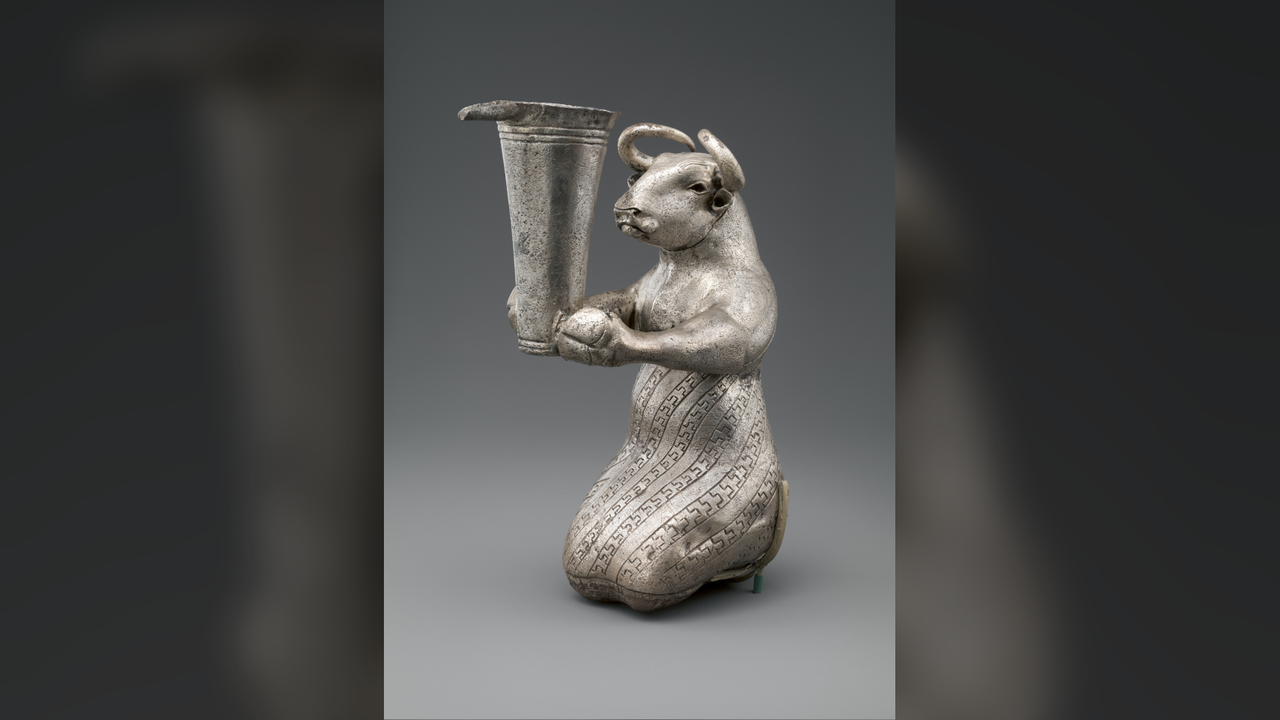
This 5,000-year-old silver figurine depicts a bull kneeling in a human-like pose and holding a spouted vessel. It was made in southern Mesopotamia by someone from the Proto-Elamite culture, the oldest civilization in Iran, and was likely used in a ritual or ceremony.

The bull is in the collection of the Metropolitan Museum of Art in New York City. It stands 6.4 inches (16.3 centimeters) tall and was made from 98.5% pure silver, according to a 1970 study by then-Met conservator Kate Lefferts. Inside the hollow figurine, Lefferts found five limestone pebbles, which were likely included by the artist to create a rattling sound. Fiber adhered to the statue was made from animal yarn.

In a 1970 study, Donald Hansen, then a fine arts professor at New York University, described the figurine as a remarkable blend of part-human and part-animal characteristics. The bovine head, complete with curved horns, rests atop human-like shoulders, and the creature is clothed in a decorated robe that covers its kneeling legs. The bull’s outstretched arms are human-like but end in hooves that hold a vessel. The figurine does not have a flat base, Hansen noted, which means it could not have stood on its own on a hard surface.


You may like

Related: Haniwa Dancers: 1,500-year-old ghostly figurines thought to hold the souls of the dead

MORE ASTONISHING ARTIFACTS

The figurine was made in Elam, an ancient region that corresponds to modern-day southwestern Iran. This area was the seat of the Proto-Elamite, an early Near East civilization in the Copper Age. The Proto-Elamites invented cylinder seals — cylinders that were engraved with figural scenes and were used for administrative purposes — many of which depict animals in human-like poses. The Kneeling Bull was likely made in this Proto-Elamite tradition of creating mythical-but-realistic-looking animal-human hybrids.

It is unclear why someone decided to make the Kneeling Bull five millennia ago. But the limestone pebbles inside the statuette and the fabric adhering to it suggest it was used in a ritual or ceremony, according to Hansen. It may have even been a “foundation figurine.” These items were intentionally buried during the construction of Proto-Elamite temples to symbolically mark sacred ground. If the Kneeling Bull was created as a foundation figurine, it was never meant to be seen again.

Get the world’s most fascinating discoveries delivered straight to your inbox.

Source link

Share. Facebook Twitter Pinterest LinkedIn Tumblr Email
Previous ArticleJock taxes burden athletes and entertainers beyond Swift and Kelce
Next Article Gunmen kill at least five people at Jerusalem bus stop
Editor
  • Website

Related Posts

Lifestyle

New robotic heart mimics common, mysterious condition to help researchers study it

July 11, 2026
Lifestyle

Canon EOS R6 III review: A wildlife wonder

July 10, 2026
Lifestyle

Medieval babies and adults buried together in Sweden were not related, archaeologists discover — raising big questions about early Christian burial practices

July 10, 2026
Add A Comment

Comments are closed.

Categories
  • Entertainment
  • Lifestyle
  • News
  • Sports
  • Tech
  • Travel
Recent Posts
  • New robotic heart mimics common, mysterious condition to help researchers study it
  • Canon EOS R6 III review: A wildlife wonder
  • Medieval babies and adults buried together in Sweden were not related, archaeologists discover — raising big questions about early Christian burial practices
  • NASA is creating a fifth state of matter on the ISS, thanks to an upgrade to a mini-fridge-sized quantum lab
  • New sodium metal battery design charges in just 4 minutes and retains its capacity for years
calendar
July 2026
M T W T F S S
 12345
6789101112
13141516171819
20212223242526
2728293031  
« Jun    
Recent Posts
  • New robotic heart mimics common, mysterious condition to help researchers study it
  • Canon EOS R6 III review: A wildlife wonder
  • Medieval babies and adults buried together in Sweden were not related, archaeologists discover — raising big questions about early Christian burial practices
About

Welcome to Baynard Media, your trusted source for a diverse range of news and insights. We are committed to delivering timely, reliable, and thought-provoking content that keeps you informed
and inspired

Categories
  • Entertainment
  • Lifestyle
  • News
  • Sports
  • Tech
  • Travel
Facebook X (Twitter) Pinterest WhatsApp
  • Contact Us
  • About Us
  • Privacy Policy
  • Disclaimer
  • UNSUBSCRIBE
© 2026 copyrights reserved

Type above and press Enter to search. Press Esc to cancel.