Close Menu
  • Home
  • UNSUBSCRIBE
  • News
  • Lifestyle
  • Tech
  • Entertainment
  • Sports
  • Travel
Facebook X (Twitter) WhatsApp
Trending
  • Researcher discovers shortcut to Mars that could cut travel time in half — if we build the right spacecraft
  • Canadian ’emoji’ lake vanishes after dramatic, landslide-like collapse — Earth from space
  • The universe may end trillions of years sooner than we thought
  • ‘They weren’t burned by accident’: Mysterious green rocks discovered high in Pyrenees reveal ancient copper-smelting camp
  • Full moon helps paint vibrant, muddy ‘brushstrokes’ in Indonesian river — Earth from space
  • Estrogen in both the male and female brain shapes responses to trauma, study suggests
  • NASA just released 12,000 more Artemis II photos ‪—‬ here are a dozen of our favorites
  • Hantavirus infects at least 1 on cruise ship, while 5 others fall ill: Here’s what we know
Facebook X (Twitter) WhatsApp
Baynard Media
  • Home
  • UNSUBSCRIBE
  • News
  • Lifestyle
  • Tech
  • Entertainment
  • Sports
  • Travel
Baynard Media
Home»Lifestyle»Jupiter is shrinking and used to be twice as big, mind-boggling study reveals
Lifestyle

Jupiter is shrinking and used to be twice as big, mind-boggling study reveals

EditorBy EditorMay 23, 2025No Comments3 Mins Read
Share Facebook Twitter Pinterest LinkedIn Tumblr Reddit Telegram Email
Share
Facebook Twitter LinkedIn Pinterest Email

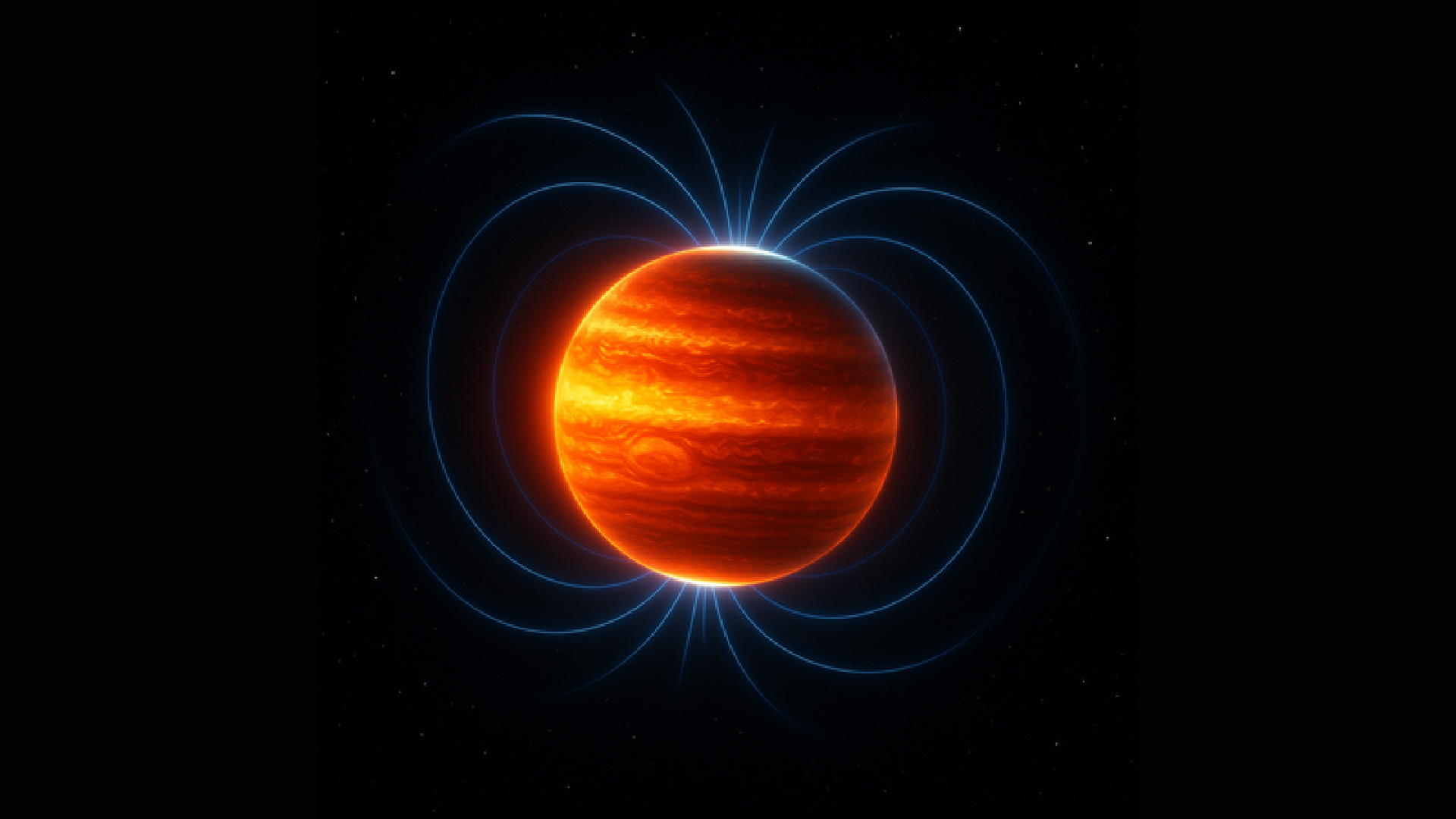
Jupiter, the solar system’s largest planet, used to be even bigger, according to a new study.

The cloud of gas and dust from which the sun and planets formed dissipated around 4.5 billion years ago. At that time, Jupiter was at least twice its current size, and its magnetic field was about 50 times stronger, researchers found. The findings, which the team described in a study published May 20 in the journal Nature Astronomy, could help scientists develop a clearer picture of the early solar system.

“Our ultimate goal is to understand where we come from, and pinning down the early phases of planet formation is essential to solving the puzzle,” study co-author Konstantin Batygin, a planetary scientist at Caltech, said in a statement. “This brings us closer to understanding how not only Jupiter but the entire solar system took shape.”


You may like

Jupiter’s immense gravity — along with the sun’s — helped fashion the solar system, shaping the orbits of other planets and rocky bodies. But how the giant planet itself formed remains opaque.

To gain a better picture of Jupiter’s early days, the researchers studied the present-day, slightly tilted orbits of two of Jupiter’s moons, Amalthea and Thebe. The paths these moons chart are similar to what they were when they first formed, but the moons have been pulled slightly over time by their larger, volcanically active neighbor Io. By analyzing the discrepancies between the actual changes and those expected from Io’s nudges, the researchers could work out Jupiter’s original size.

Related: ‘This has left us scratching our heads’: Astronomers stumped by James Webb telescope’s latest views of Jupiter

When the solar nebula dissipated, marking the end of planet formation, Jupiter’s radius would have been between two and 2.5 times its current size to give Amalthea and Thebe their current orbits, the scientists calculated. Over time, the planet has shrunk to its current size as its surface cools. Then, the team used the radius to calculate the strength of the planet’s magnetic field, which would have been around 21 milliteslas — about 50 times stronger than its current value and 400 times stronger than Earth’s.

Get the world’s most fascinating discoveries delivered straight to your inbox.

“It’s astonishing that even after 4.5 billion years, enough clues remain to let us reconstruct Jupiter’s physical state at the dawn of its existence,” study co-author Fred Adams, an astrophysicist at the University of Michigan, said in the statement.

The findings sharpen researchers’ view of the solar system at a critical transition point in its history. The calculations also don’t depend on how Jupiter formed — a process that’s still not understood in detail — relying instead on directly observable quantities.

“What we’ve established here is a valuable benchmark,” Batygin said in the statement. “A point from which we can more confidently reconstruct the evolution of our solar system.”

Jupiter is currently shrinking by about 2 centimeters per year, according to Caltech. This is due to the Kelvin-Helmholtz mechanism — a process by which planets grow smaller as they cool. As Jupiter slowly cools, its internal pressure drops, causing the planet to steadily shrink. It’s unclear when this process began.

Source link

Share. Facebook Twitter Pinterest LinkedIn Tumblr Email
Previous ArticleUS woman dies from rare, fatal prions disease after being given an infected injection 50 years earlier
Next Article American submarine, lost for over a century, discovered ‘remarkably intact’ off the coast of San Diego
Editor
  • Website

Related Posts

Lifestyle

Researcher discovers shortcut to Mars that could cut travel time in half — if we build the right spacecraft

May 5, 2026
Lifestyle

Canadian ’emoji’ lake vanishes after dramatic, landslide-like collapse — Earth from space

May 5, 2026
Lifestyle

The universe may end trillions of years sooner than we thought

May 5, 2026
Add A Comment

Comments are closed.

Categories
  • Entertainment
  • Lifestyle
  • News
  • Sports
  • Tech
  • Travel
Recent Posts
  • Researcher discovers shortcut to Mars that could cut travel time in half — if we build the right spacecraft
  • Canadian ’emoji’ lake vanishes after dramatic, landslide-like collapse — Earth from space
  • The universe may end trillions of years sooner than we thought
  • ‘They weren’t burned by accident’: Mysterious green rocks discovered high in Pyrenees reveal ancient copper-smelting camp
  • Full moon helps paint vibrant, muddy ‘brushstrokes’ in Indonesian river — Earth from space
calendar
May 2026
M T W T F S S
 123
45678910
11121314151617
18192021222324
25262728293031
« Apr    
Recent Posts
  • Researcher discovers shortcut to Mars that could cut travel time in half — if we build the right spacecraft
  • Canadian ’emoji’ lake vanishes after dramatic, landslide-like collapse — Earth from space
  • The universe may end trillions of years sooner than we thought
About

Welcome to Baynard Media, your trusted source for a diverse range of news and insights. We are committed to delivering timely, reliable, and thought-provoking content that keeps you informed
and inspired

Categories
  • Entertainment
  • Lifestyle
  • News
  • Sports
  • Tech
  • Travel
Facebook X (Twitter) Pinterest WhatsApp
  • Contact Us
  • About Us
  • Privacy Policy
  • Disclaimer
  • UNSUBSCRIBE
© 2026 copyrights reserved

Type above and press Enter to search. Press Esc to cancel.