Close Menu
  • Home
  • UNSUBSCRIBE
  • News
  • Lifestyle
  • Tech
  • Entertainment
  • Sports
  • Travel
Facebook X (Twitter) WhatsApp
Trending
  • Are CAPTCHAs obsolete in the age of AI?
  • Colorful ‘painting-like’ ripples cover an ancient seafloor structure the Bahamas — Earth from space
  • First experiment to thicken Arctic ice with seawater shows promise — but there’s a big catch
  • Heart issues tied to ‘microdamage’ in the brain might raise risk of memory loss, study hints
  • Neanderthals and modern humans may have shared culture 59,000 years ago in Turkey, study finds
  • Scientists just created the most lifelike cell ever made in the lab ‪— but experts say it’s not ‘truly autonomous’
  • ‘What we found was striking’: Physicists take the closest-ever look at a black hole’s mysterious event horizon
  • Diagnostic dilemma: Huge mass in woman’s stomach was likely caused by Ozempic-style drug — and dissolved with diet soda
Facebook X (Twitter) WhatsApp
Baynard Media
  • Home
  • UNSUBSCRIBE
  • News
  • Lifestyle
  • Tech
  • Entertainment
  • Sports
  • Travel
Baynard Media
Home»Lifestyle»Japan launches its first homegrown quantum computer
Lifestyle

Japan launches its first homegrown quantum computer

EditorBy EditorAugust 26, 2025No Comments3 Mins Read
Share Facebook Twitter Pinterest LinkedIn Tumblr Reddit Telegram Email
Share
Facebook Twitter LinkedIn Pinterest Email

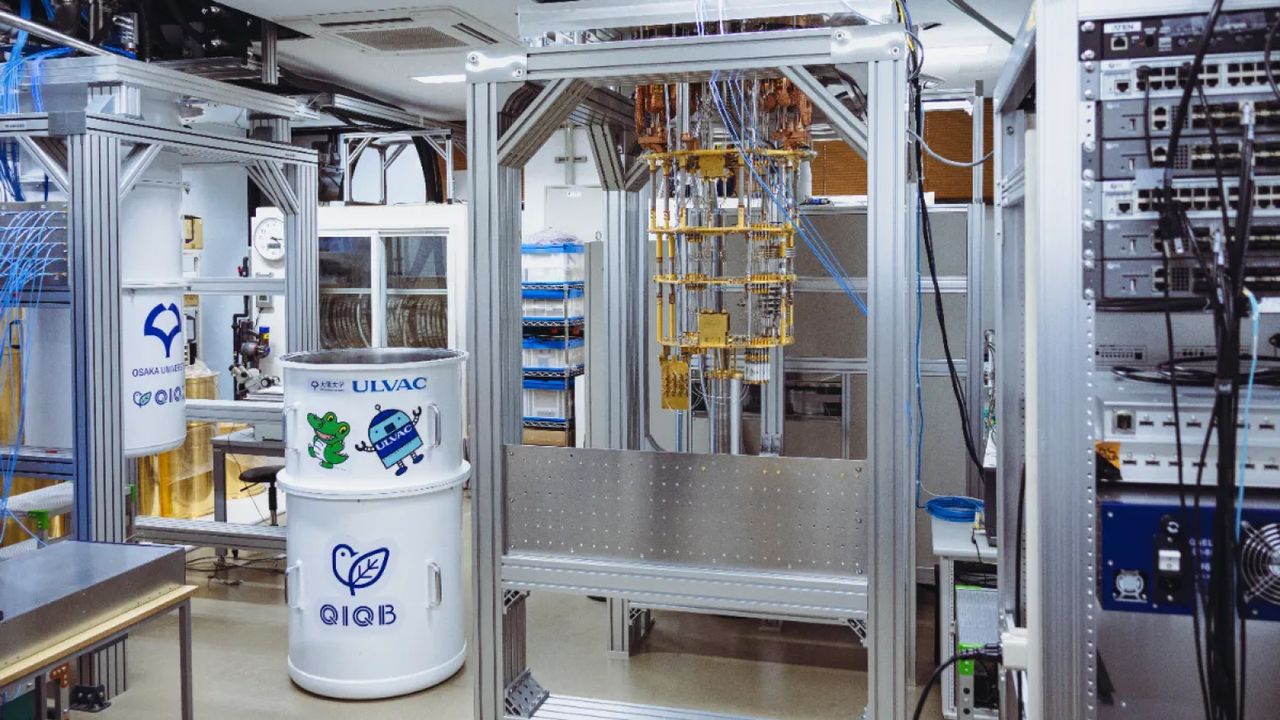
Japan has switched on the first quantum computer that has been designed and built with components from the country. The system is now ready to take on workloads from its base at the University of Osaka’s Center for Quantum Information and Quantum Biology (QIQB).

The new system, which went live on July 28, replaces all previously imported components with homegrown technologies, University of Osaka representatives said in a statement. It will also run on open-source software developed in Japan, called the Open Quantum Toolchain for Operators and Users (OQTOPUS).

The system uses a quantum chip with superconducting qubits — quantum bits derived from metals that exhibit zero electrical resistance when cooled to temperatures close to absolute zero (minus 459.67 degrees Fahrenheit, or minus 273.15 degrees Celsius). The quantum processing unit (QPU) was developed at the Japanese research institute RIKEN.


You may like

Other components that make up the “chandelier” — the main body of the quantum computer — include the chip package, delivered by Seiken, the magnetic shield, infrared filters, bandpass filters, a low-noise amplifier and various cables.

These are all housed in a dilution refrigerator (a specialized cryogenic device that cools the quantum computing components) to allow for those extremely low temperatures. It also comes alongside a pulse tube refrigerator (which again cools various components in use), controllers and a low-noise power source.

OQTOPUS, meanwhile, is a collection of open-source tools that include everything required to run quantum programs. It includes the core engine and cloud module, as well as graphical user interface (GUI) elements, and is designed to be built on top of a QPU and quantum control hardware.

Related: Scientists hit quantum computer error rate of 0.000015% — a world record achievement that could lead to smaller and faster machines

Get the world’s most fascinating discoveries delivered straight to your inbox.

A new frontier of computing

Quantum computing has the potential to outpace the world’s fastest supercomputers and solve problems by making calculations and running simulations far beyond what technology is capable of today. Scientists speculate that quantum computers could be useful in drug discovery, easing traffic flows through a city, and finding the best delivery routes for a logistics company, among plenty of other endeavors.

This is because it can process calculations in parallel, rather than in sequence, by tapping into the weird laws of quantum mechanics. The idea is that the more qubits added to a system, the more powerful the system becomes.

However, there are plenty of barriers to simply adding qubits to quantum computers — in particular, scientists are trying to solve the extremely high error rate that occurs during calculations. For this reason, most research is currently centered on quantum error correction (QEC).

Japan’s first quantum computer was showcased at Expo 2025, held in Osaka from Aug. 14 to Aug. 20..At the exhibition, organizers showcased key components in the quantum computer. Visitors could connect to the system remotely through the cloud and run basic quantum programs. The exhibit also included interactive elements enabling visitors to explore quantum entanglement and other quantum phenomena.

Source link

Share. Facebook Twitter Pinterest LinkedIn Tumblr Email
Previous ArticleHaboob brings zero visibility to Phoenix metro area, disrupts travel
Next Article 2 sickened with Legionnaires’ at Bronx apartment complex, evaluation underway
Editor
  • Website

Related Posts

Lifestyle

Are CAPTCHAs obsolete in the age of AI?

July 7, 2026
Lifestyle

Colorful ‘painting-like’ ripples cover an ancient seafloor structure the Bahamas — Earth from space

July 7, 2026
Lifestyle

First experiment to thicken Arctic ice with seawater shows promise — but there’s a big catch

July 7, 2026
Add A Comment

Comments are closed.

Categories
  • Entertainment
  • Lifestyle
  • News
  • Sports
  • Tech
  • Travel
Recent Posts
  • Are CAPTCHAs obsolete in the age of AI?
  • Colorful ‘painting-like’ ripples cover an ancient seafloor structure the Bahamas — Earth from space
  • First experiment to thicken Arctic ice with seawater shows promise — but there’s a big catch
  • Heart issues tied to ‘microdamage’ in the brain might raise risk of memory loss, study hints
  • Neanderthals and modern humans may have shared culture 59,000 years ago in Turkey, study finds
calendar
July 2026
M T W T F S S
 12345
6789101112
13141516171819
20212223242526
2728293031  
« Jun    
Recent Posts
  • Are CAPTCHAs obsolete in the age of AI?
  • Colorful ‘painting-like’ ripples cover an ancient seafloor structure the Bahamas — Earth from space
  • First experiment to thicken Arctic ice with seawater shows promise — but there’s a big catch
About

Welcome to Baynard Media, your trusted source for a diverse range of news and insights. We are committed to delivering timely, reliable, and thought-provoking content that keeps you informed
and inspired

Categories
  • Entertainment
  • Lifestyle
  • News
  • Sports
  • Tech
  • Travel
Facebook X (Twitter) Pinterest WhatsApp
  • Contact Us
  • About Us
  • Privacy Policy
  • Disclaimer
  • UNSUBSCRIBE
© 2026 copyrights reserved

Type above and press Enter to search. Press Esc to cancel.