Close Menu
  • Home
  • UNSUBSCRIBE
  • News
  • Lifestyle
  • Tech
  • Entertainment
  • Sports
  • Travel
Facebook X (Twitter) WhatsApp
Trending
  • New robotic heart mimics common, mysterious condition to help researchers study it
  • Canon EOS R6 III review: A wildlife wonder
  • Medieval babies and adults buried together in Sweden were not related, archaeologists discover — raising big questions about early Christian burial practices
  • NASA is creating a fifth state of matter on the ISS, thanks to an upgrade to a mini-fridge-sized quantum lab
  • New sodium metal battery design charges in just 4 minutes and retains its capacity for years
  • Quantum computing wielded to create extremely rare material critical to nuclear fusion
  • Scientists build tiny ‘diving suit’ for cockroaches, turning them into search-and-rescue cyborgs
  • Physicists develop the first working model of quantum mechanics using only ‘real’ numbers
Facebook X (Twitter) WhatsApp
Baynard Media
  • Home
  • UNSUBSCRIBE
  • News
  • Lifestyle
  • Tech
  • Entertainment
  • Sports
  • Travel
Baynard Media
Home»Lifestyle»James Webb telescope spots earliest black hole in the known universe, looking ‘as far back as you can practically go’
Lifestyle

James Webb telescope spots earliest black hole in the known universe, looking ‘as far back as you can practically go’

EditorBy EditorAugust 12, 2025No Comments3 Mins Read
Share Facebook Twitter Pinterest LinkedIn Tumblr Reddit Telegram Email
Share
Facebook Twitter LinkedIn Pinterest Email

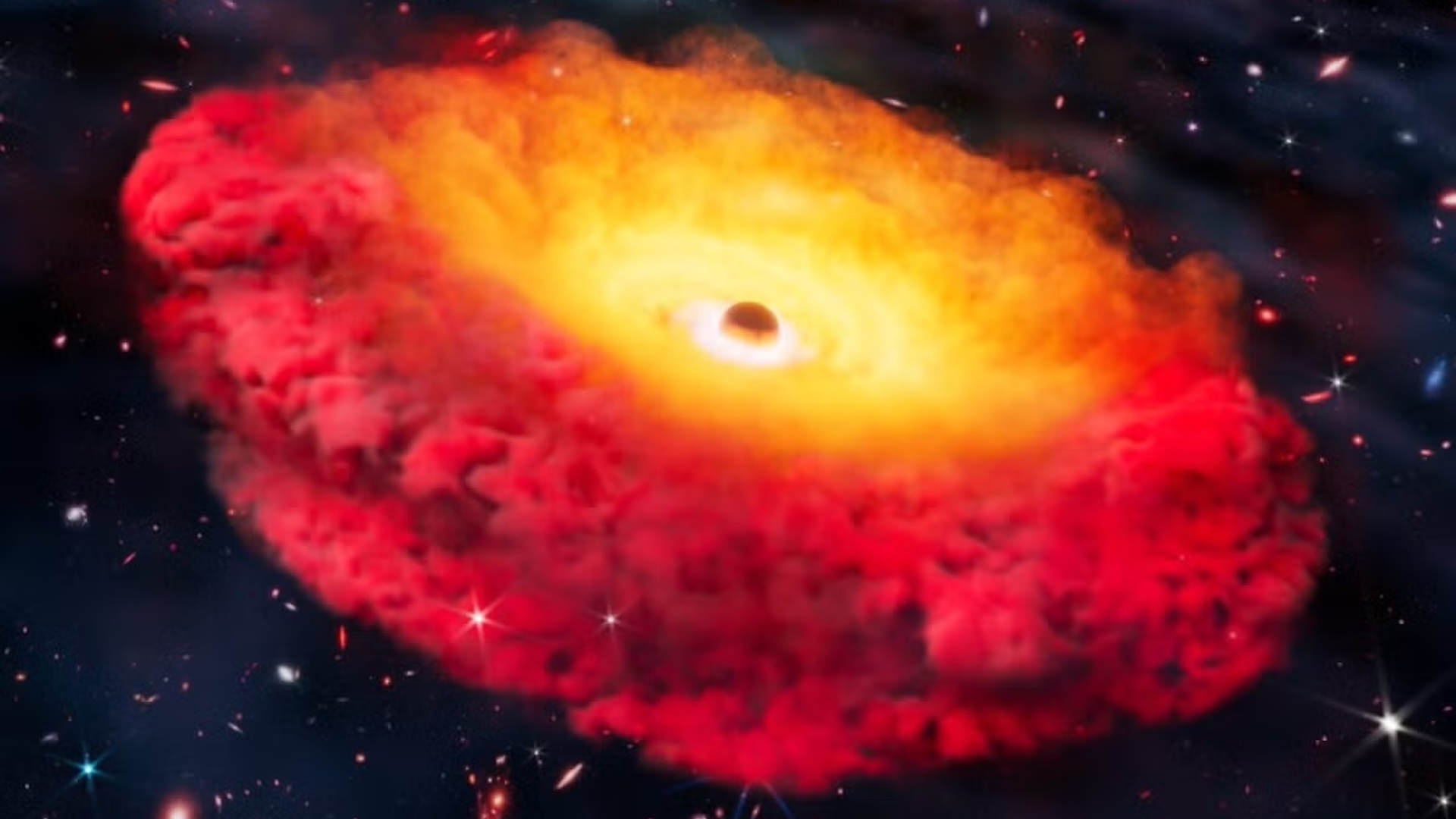
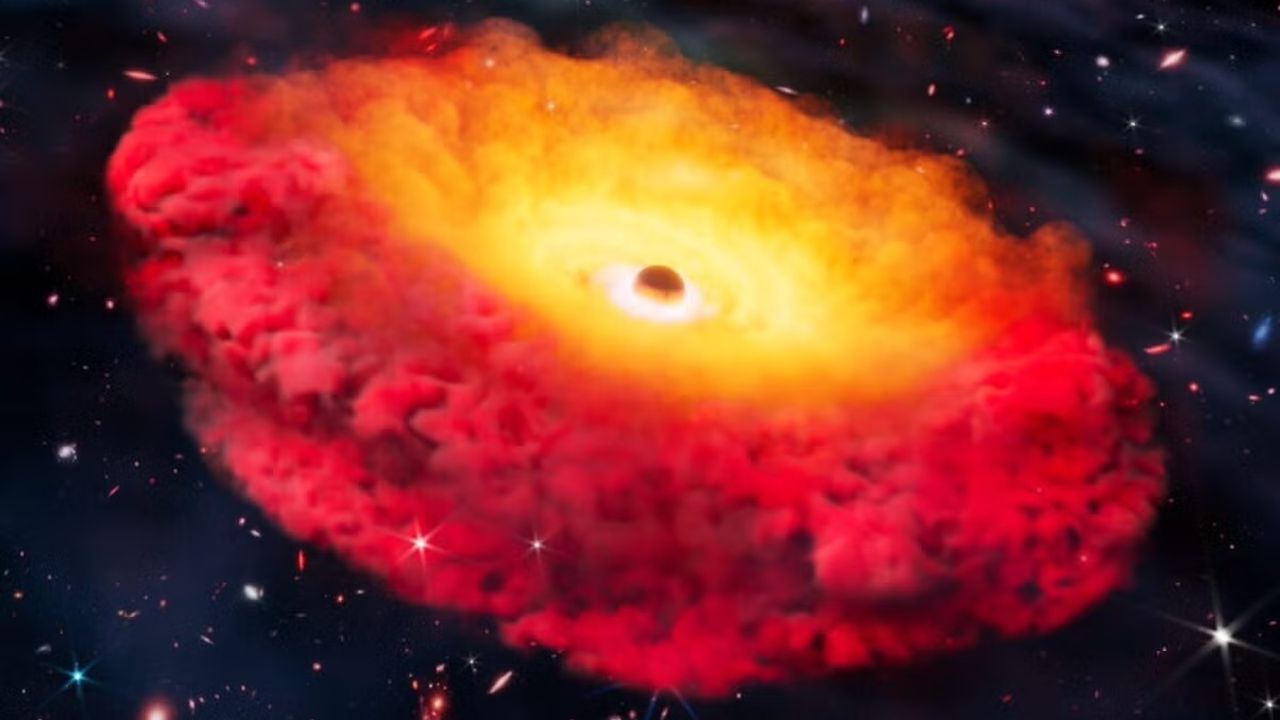
Scientists using the James Webb Space Telescope (JWST) have identified the earliest black hole found thus far, dating back to more than 13 billion years ago.

The black hole and its home galaxy, together dubbed CAPERS-LRD-z9, existed just 500 million years after the Big Bang. Its properties could help researchers understand what the universe was like in that elusive early era, according to a study published August 6 in the Astrophysical Journal Letters.

“When looking for black holes, this is about as far back as you can practically go,” study coauthor Anthony Taylor, an astronomer at the University of Texas, Austin, said in a statement. “We’re really pushing the boundaries of what current technology can detect.”


You may like

CAPERS-LRD-z9 is a type of galaxy called a “Little Red Dot,” so named because they’re small (as galaxies go) and appear to emit red light when observed with JWST’s powerful infrared sensors. Little Red Dots shine brightly, which might suggest they contain a lot of stars — except they formed in the early universe, when an abundance of stars was unlikely, according to current leading theories of cosmology.

“The discovery of Little Red Dots was a major surprise from early JWST data, as they looked nothing like galaxies seen with the Hubble Space Telescope,” study coauthor Steven Finkelstein, an astronomer at UT Austin, said in the statement. “Now, we’re in the process of figuring out what they’re like and how they came to be.”

To better understand the nature of CAPERS-LRD-z9 and Little Red Dots like it, researchers investigated the galaxy with the JWST. The team found a distinct pattern of wavelengths of light created when fast-moving gas falls into a black hole. Though astronomers have found a few objects farther away than CAPERS-LRD-z9 that might be black holes, this pattern makes CAPERS-LRD-z9 the earliest confirmed black hole to date and suggests that black holes might lie at the center of other Little Red Dots.

Related: James Webb telescope captures one of the deepest-ever views of the universe — Space photo of the week

Get the world’s most fascinating discoveries delivered straight to your inbox.

The black hole at the center of CAPERS-LRD-z9 is pretty hefty. It’s some 38 million times more massive than the sun or about 10 times more massive than Sagittarius A*, the supermassive black hole at the center of the Milky Way — though there’s considerable wiggle room in that estimate. The scientists also think that the black hole has as much mass as about 5% of all the stars in its galaxy put together, a ratio far exceeding that of modern galaxies.

“This adds to growing evidence that early black holes grew much faster than we thought possible,” Finkelstein said. “Or they started out far more massive than our models predict.”

CAPERS-LRD-z9 could also help explain why Little Red Dots are red. A dense cloud of gas surrounding the black hole could shift any emitted light into longer, redder wavelengths, the researchers predicted.

Further studies of CAPERS-LRD-z9 could offer even more information about black holes and galaxies in the early universe, the scientists wrote in the study.

“This is a good test object for us,” Taylor said in the statement. “We haven’t been able to study early black hole evolution until recently, and we are excited to see what we can learn from this unique object.”

Source link

Share. Facebook Twitter Pinterest LinkedIn Tumblr Email
Previous ArticleThree-term Democrat ousted by MAGA opponent in 2024 launches comeback for US Senate
Next Article White House reviewing Smithsonian exhibits to make sure they align with Trump’s vision
Editor
  • Website

Related Posts

Lifestyle

New robotic heart mimics common, mysterious condition to help researchers study it

July 11, 2026
Lifestyle

Canon EOS R6 III review: A wildlife wonder

July 10, 2026
Lifestyle

Medieval babies and adults buried together in Sweden were not related, archaeologists discover — raising big questions about early Christian burial practices

July 10, 2026
Add A Comment

Comments are closed.

Categories
  • Entertainment
  • Lifestyle
  • News
  • Sports
  • Tech
  • Travel
Recent Posts
  • New robotic heart mimics common, mysterious condition to help researchers study it
  • Canon EOS R6 III review: A wildlife wonder
  • Medieval babies and adults buried together in Sweden were not related, archaeologists discover — raising big questions about early Christian burial practices
  • NASA is creating a fifth state of matter on the ISS, thanks to an upgrade to a mini-fridge-sized quantum lab
  • New sodium metal battery design charges in just 4 minutes and retains its capacity for years
calendar
July 2026
M T W T F S S
 12345
6789101112
13141516171819
20212223242526
2728293031  
« Jun    
Recent Posts
  • New robotic heart mimics common, mysterious condition to help researchers study it
  • Canon EOS R6 III review: A wildlife wonder
  • Medieval babies and adults buried together in Sweden were not related, archaeologists discover — raising big questions about early Christian burial practices
About

Welcome to Baynard Media, your trusted source for a diverse range of news and insights. We are committed to delivering timely, reliable, and thought-provoking content that keeps you informed
and inspired

Categories
  • Entertainment
  • Lifestyle
  • News
  • Sports
  • Tech
  • Travel
Facebook X (Twitter) Pinterest WhatsApp
  • Contact Us
  • About Us
  • Privacy Policy
  • Disclaimer
  • UNSUBSCRIBE
© 2026 copyrights reserved

Type above and press Enter to search. Press Esc to cancel.