Close Menu
  • Home
  • UNSUBSCRIBE
  • News
  • Lifestyle
  • Tech
  • Entertainment
  • Sports
  • Travel
Facebook X (Twitter) WhatsApp
Trending
  • Arthritis drug shows antiviral effects against RSV, the leading cause of infant hospitalization
  • Daddy longlegs may be capturing and devouring frogs in the tropical forests of South America
  • Google wants to release 64 million bacteria-riddled mosquitoes across California and Florida. Here’s why scientists are enthusiastic.
  • ‘In an unrecoverable state’: NASA confirms MAVEN spacecraft is officially dead after loss of signal behind Mars
  • 2 rivers merged to form the Euphrates 3.6 million years ago, eventually leading to the Fertile Crescent
  • NASA confirms fireball meteor exploded over northeastern US with force of 230 tons of TNT
  • Astronauts could use lightning-like plasma jets to kill germs on the moon and Mars, demo hints
  • First whole-genome sequence of a Greenland shark holds clues to their extreme longevity
Facebook X (Twitter) WhatsApp
Baynard Media
  • Home
  • UNSUBSCRIBE
  • News
  • Lifestyle
  • Tech
  • Entertainment
  • Sports
  • Travel
Baynard Media
Home»Lifestyle»James Webb telescope spies a ‘farting’ dwarf planet with fluorescent gas in the outer solar system
Lifestyle

James Webb telescope spies a ‘farting’ dwarf planet with fluorescent gas in the outer solar system

EditorBy EditorSeptember 30, 2025No Comments5 Mins Read
Share Facebook Twitter Pinterest LinkedIn Tumblr Reddit Telegram Email
Share
Facebook Twitter LinkedIn Pinterest Email

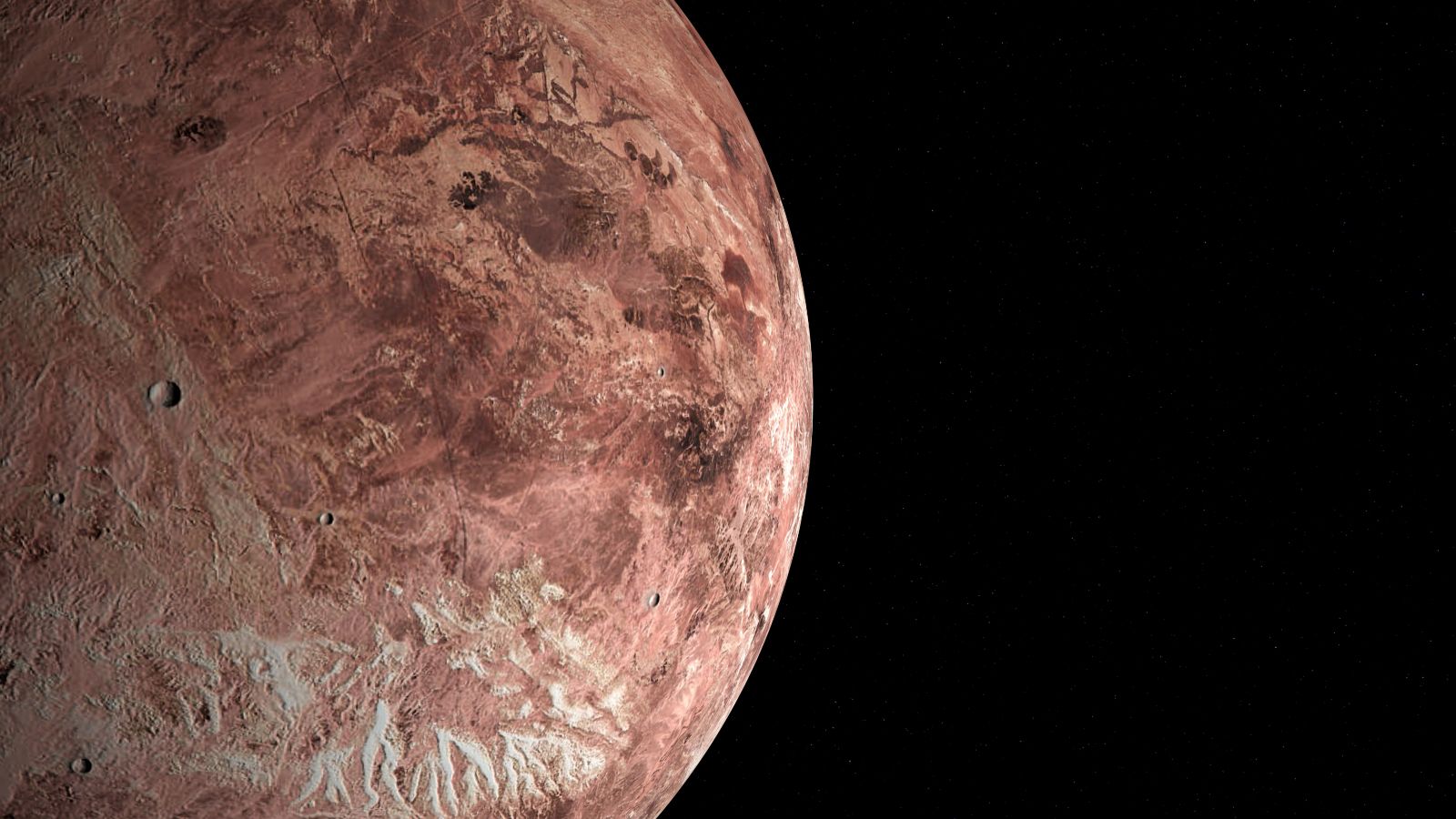
Scientists armed with the immense observing power of the James Webb Space Telescope (JWST) have detected faint traces of fluorescent flatulence leaking out from the dwarf planet Makemake, which lurks in the outer reaches of the solar system. This is only the second time that a gas has been detected on an object this far from Earth, and hints that this wee world is far more active than we once thought.

Makemake is a roughly spherical object measuring around 890 miles (1,430 kilometers) across, which is less than half the diameter of the moon. It is located around 45 times further from the sun than Earth on average, in a region known as the Kuiper Belt — a ring of asteroids, comets and larger icy objects, such as Pluto, beyond the orbit of Neptune. It was discovered in 2005 and has a small moon, dubbed MK2, which is around 110 miles (175 km) across.

Like the dozens of other dwarf planets and dwarf planet candidates within the solar system, Makemake is not considered a true planet because it has not cleared away all the debris from its orbital pathway around the sun. This is the same reason that Pluto lost its full planetary status in 2006.


You may like

Scientists have long known that Makemake’s reddish-brown surface is covered with layers of methane and ethane ice, and some even think that small pellets of these chemicals, measuring around half an inch (1 centimeter) in diameter, may rest on its cold surface, according to NASA.

But in a new study, uploaded Sept. 8 to the preprint server arXiv and accepted for future publication in The Astrophysical Journal Letters, researchers used JWST to take a closer look at Makemake and found that the planetary dwarf also has faint concentrations of methane gas surrounding its icy surface.

A graph showing methane detection overlaid on an image of Makemake

Data collected by JWST clearly shows the presence of methane gas around the surface of Makemake. (Image credit: Courtesy of S. Protopapa, I. Wong/SwRI/STScI/NASA/ESA/CSA)

“The Webb telescope has now revealed that methane is also present in the gas phase above the surface, a finding that makes Makemake even more fascinating,” study lead author Silvia Protopapa, a researcher at the University of Maryland and the Southwest Research Institute in Texas, said in a statement. “It shows that Makemake is not an inactive remnant of the outer solar system, but a dynamic body where methane ice is still evolving.”

Until now, the only other trans-Neptunian object (an object beyond Neptune) known to produce its own gas is Pluto, which has a very thin atmosphere composed mainly of nitrogen, with smaller amounts of methane and carbon monoxide, Live Science’s sister site Space.com reported. The dwarf planet Ceres, which is located in the asteroid belt between Mars and Jupiter, also has a wispy atmosphere made up of water vapor.

Get the world’s most fascinating discoveries delivered straight to your inbox.

JWST spotted the methane thanks to a phenomenon dubbed “solar-excited fluorescence,” which causes the gas to faintly glow as it soaks up solar radiation. Using the telescope’s advanced infrared instruments, the team also measured the temperature of the gas, which is a frigid minus 387 degrees Fahrenheit (minus 233 degrees Celsius).

However, the researchers are still unsure exactly where the methane comes from, or whether it is permanently trapped within Makemake.

One possible explanation is that the methane ice on the dwarf planet’s surface sublimates, or transitions from solid to gas, and is contained within a fragile, superthin atmosphere, like on Pluto and Ceres. But if this is the case, the new data suggests that the pressure in this layer of gas must be more than 1 billion times weaker than Earth’s atmosphere and more than 1 million times weaker than Pluto’s, making it hard to confirm if it exists.

A photo of Makemake as a blurry point of light with arrows pointing to the location of its moon

Images from the Hubble Space Telescope helped to reveal the presence of Makemake’s moon MK2 in 2015. (Image credit: NASA/Hubble Space Telescope)

Another possible explanation is that the gas is being ejected from beneath the object’s icy surface in plumes, like on Saturn’s frozen ocean moon Enceladus. This potential process, known as outgassing, could be happening at various spots across the dwarf planet, with methane shooting outward at up to “a few hundred kilograms per second,” Protopapa said. But it is also very hard to tell if this is the case with the data available.

The researchers hope that follow-up observations by JWST could help solve this puzzle. But regardless of where the methane comes from, the new findings “challenge the traditional view of Makemake as a quiescent, frozen body,” the researchers wrote in the paper.

Earlier in the year, another group of researchers using JWST also revealed that Makemake and another distant dwarf planet, named Eris, could be geologically active, potentially to the point where they might support life. (There are currently no planned missions to study either of the distant dwarf planets up-close.)

Source link

Share. Facebook Twitter Pinterest LinkedIn Tumblr Email
Previous ArticleHalle Berry shows confidence in new string bikini picture post online
Next Article Government close to shutdown as bill fails in Senate
Editor
  • Website

Related Posts

Lifestyle

Arthritis drug shows antiviral effects against RSV, the leading cause of infant hospitalization

June 4, 2026
Lifestyle

Daddy longlegs may be capturing and devouring frogs in the tropical forests of South America

June 3, 2026
Lifestyle

Google wants to release 64 million bacteria-riddled mosquitoes across California and Florida. Here’s why scientists are enthusiastic.

June 3, 2026
Add A Comment

Comments are closed.

Categories
  • Entertainment
  • Lifestyle
  • News
  • Sports
  • Tech
  • Travel
Recent Posts
  • Arthritis drug shows antiviral effects against RSV, the leading cause of infant hospitalization
  • Daddy longlegs may be capturing and devouring frogs in the tropical forests of South America
  • Google wants to release 64 million bacteria-riddled mosquitoes across California and Florida. Here’s why scientists are enthusiastic.
  • ‘In an unrecoverable state’: NASA confirms MAVEN spacecraft is officially dead after loss of signal behind Mars
  • 2 rivers merged to form the Euphrates 3.6 million years ago, eventually leading to the Fertile Crescent
calendar
June 2026
M T W T F S S
1234567
891011121314
15161718192021
22232425262728
2930  
« May    
Recent Posts
  • Arthritis drug shows antiviral effects against RSV, the leading cause of infant hospitalization
  • Daddy longlegs may be capturing and devouring frogs in the tropical forests of South America
  • Google wants to release 64 million bacteria-riddled mosquitoes across California and Florida. Here’s why scientists are enthusiastic.
About

Welcome to Baynard Media, your trusted source for a diverse range of news and insights. We are committed to delivering timely, reliable, and thought-provoking content that keeps you informed
and inspired

Categories
  • Entertainment
  • Lifestyle
  • News
  • Sports
  • Tech
  • Travel
Facebook X (Twitter) Pinterest WhatsApp
  • Contact Us
  • About Us
  • Privacy Policy
  • Disclaimer
  • UNSUBSCRIBE
© 2026 copyrights reserved

Type above and press Enter to search. Press Esc to cancel.