
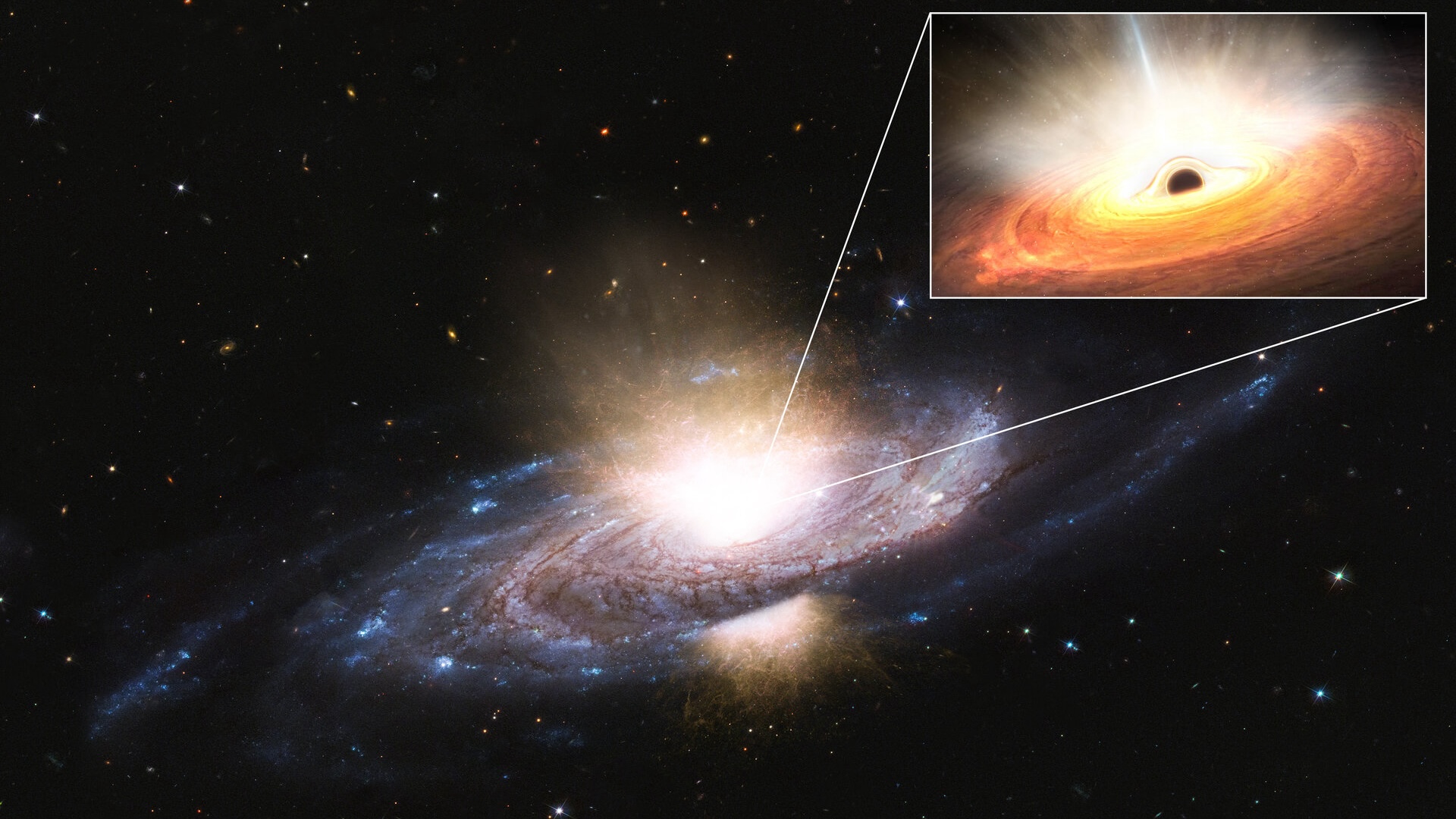
A “fast-feeding” black hole that appeared to defy physics is actually pretty ordinary, observations from the James Webb Space Telescope (JWST) reveal.
In November 2024, astronomers using JWST reported that they’d found a black hole from the early universe that appeared to be gorging on matter 40 times faster than theoretically possible. The black hole, called LID-568, was observed as it existed just 1.5 billion years after the Big Bang — much too early in the history of the universe for it to have gotten that huge.
However, new research suggests that this excessive eating rate may have been an overestimation. After revisiting the JWST observations of the “record-breaking” black hole, astronomers confirmed that it is not extreme after all. In fact, heavy dust obscured the black hole, leading to incorrect calculations, the researchers found.
In an accreting black hole, the infalling material is compressed and heated, causing it to emit high-energy radiation such as X-rays that push material away. The amount of matter a black hole can consume is governed by the Eddington limit, which defines the maximum luminosity at which the outward radiation pressure balances the black hole’s gravitational pull. This limit depends directly on the black hole’s mass — the higher the mass, the higher the Eddington limit.
When the radiation pressure becomes high enough to overpower gravity, the black hole stops accreting matter and thus limits how brightly it shines. However, under certain conditions, a black hole can continue to accrete matter beyond this limit — a process known as super-Eddington accretion.
The observations from last year suggested that LID-568 was undergoing super-Eddington accretion at nearly 40 times greater than expected. LID-568 existed just 1.5 billion years after the Big Bang — which is not enough time for this black hole to have grown this big. As a result, the astronomers speculated that such rapid super-Eddington accretion could provide a convincing explanation for the formation of supermassive black holes with unimaginably high masses in the early universe.
But in the new research, published April 4 in The Astrophysical Journal, astronomers found that LID-568 is feeding at a rate consistent with the Eddington limit — and the mistake was caused by dust.

Left in the dust
The reason for the initial miscalculation about the black hole’s hunger is because dust absorbs and scatters light, which significantly dims the light that reaches us from a black hole.
“For a heavily dust-obscured object like LID-568, it is very important that dust extinction is corrected properly,” said study co-author Myungshin Im, director of the Seoul National University Astronomy Research Center told Live Science in an email. If this effect is not properly accounted for, it can lead to inaccurate calculations of the black hole’s mass, which, in turn, affects the Eddington limit associated with it.
Im explained that, in the team’s study, the researchers measured the black hole’s mass using infrared light from the gas around it. Infrared radiation is much less affected by dust than optical light, which was used in the previous study for black hole mass measurement.
This different approach allowed them to calculate the black hole’s mass to be just under a billion solar masses — about 40 times greater than the previous estimate. Using this revised black hole mass, the Eddington luminosity was recalculated. Overall, the observed luminosity closely matched the Eddington limit. Therefore, the black hole was not in the super-Eddington phase when it was observed, the team concluded. It was just clouded by dust.
Consequently, LID-568’s current feeding habits cannot be attributed to the growth of supermassive black holes, Im said. Astronomers have been aware of this issue in the case of distant galaxies and usually apply corrections for dust extinction in their measurements.
However, for “active galactic nuclei” (AGN) — which contain actively feeding black holes at their centers that dominate the AGN’s brightness and are surrounded by complex dust environments — “dust extinction correction has not been thoroughly applied yet,” Im said. This means the masses of other black holes may have been measured incorrectly, leading to misinterpretations of their properties. The team’s approach could lead to a better understanding of dust-obscured black holes in a new class of galaxies called “little red dots,” which were recently discovered through JWST observations, the team explained in their paper.
