Close Menu
  • Home
  • UNSUBSCRIBE
  • News
  • Lifestyle
  • Tech
  • Entertainment
  • Sports
  • Travel
Facebook X (Twitter) WhatsApp
Trending
  • Global warming is accelerating 5,000 times faster than rice can evolve
  • Scientists discover deadly, highly venomous box jellyfish near Singapore’s ‘Island of Death Behind’
  • Poll: What do you think of PMOS, the new name for PCOS?
  • Celestron Outland X 10×25 roof prism binocular review
  • Withings Body Scan review: Smart scale turned all-in-one health hub
  • World’s first ‘native’ color lidar will let robots and self-driving cars map the world in full color 3D
  • Bright-blue ‘potash ponds’ shine alongside a dark-green river in Utah — Earth from space
  • Deadly Ebola outbreak is a public health emergency of international concern, WHO declares
Facebook X (Twitter) WhatsApp
Baynard Media
  • Home
  • UNSUBSCRIBE
  • News
  • Lifestyle
  • Tech
  • Entertainment
  • Sports
  • Travel
Baynard Media
Home»Lifestyle»James Webb telescope reveals the blazing heart of an iconic galaxy — Space photo of the week
Lifestyle

James Webb telescope reveals the blazing heart of an iconic galaxy — Space photo of the week

EditorBy EditorNovember 2, 2025No Comments3 Mins Read
Share Facebook Twitter Pinterest LinkedIn Tumblr Reddit Telegram Email
Share
Facebook Twitter LinkedIn Pinterest Email

Quick facts

What it is: M82, an edge-on spiral starburst galaxy

Where it is: 12 million light-years away in the constellation Ursa Major

When it was shared: Oct. 23, 2025

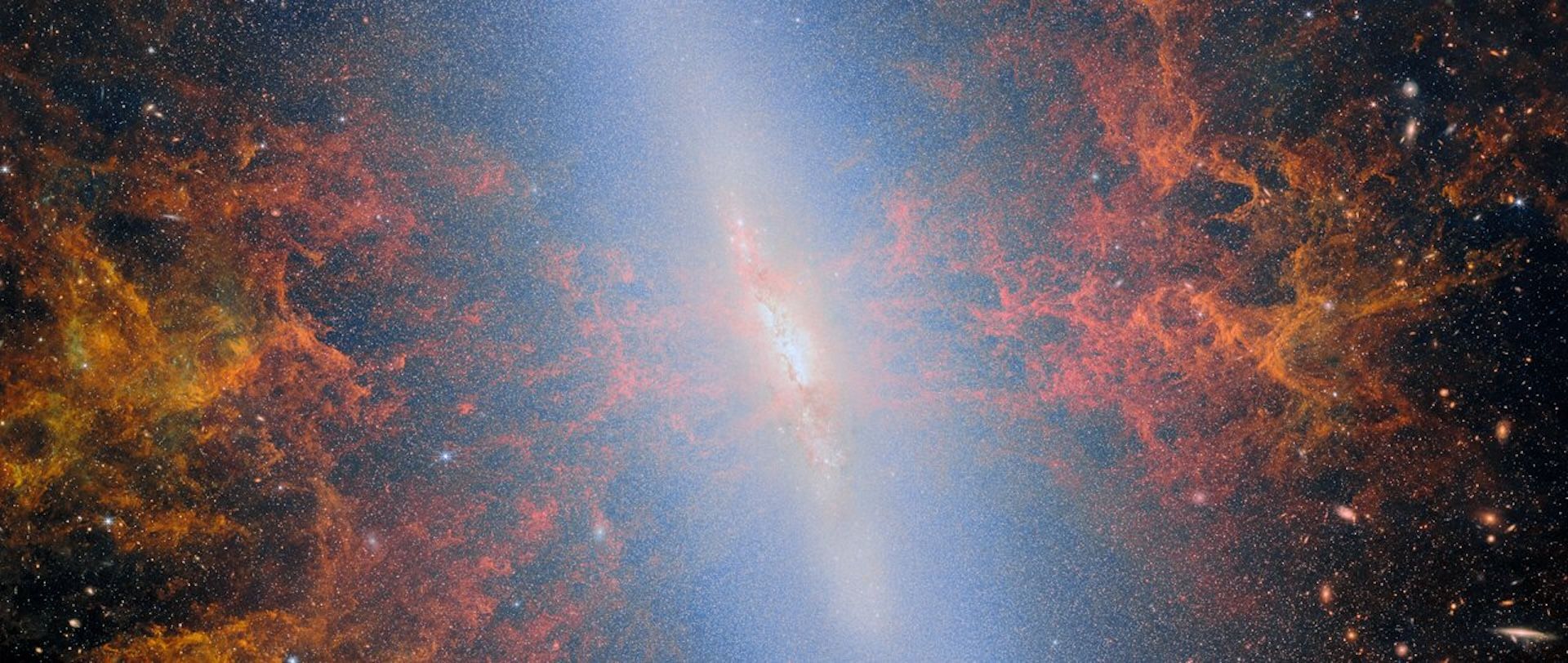
If you own a small backyard telescope, there’s a good chance you’ve seen the Cigar Galaxy (M82) with your own eyes. Not only is it relatively close to the Milky Way and one of the brightest galaxies in the night sky, but it’s visible beside Bode’s Galaxy (M81). A spiral galaxy about four times smaller than the Milky Way, M82 shines five times more brightly and forms stars at 10 times the rate, earning it the title of a starburst galaxy.

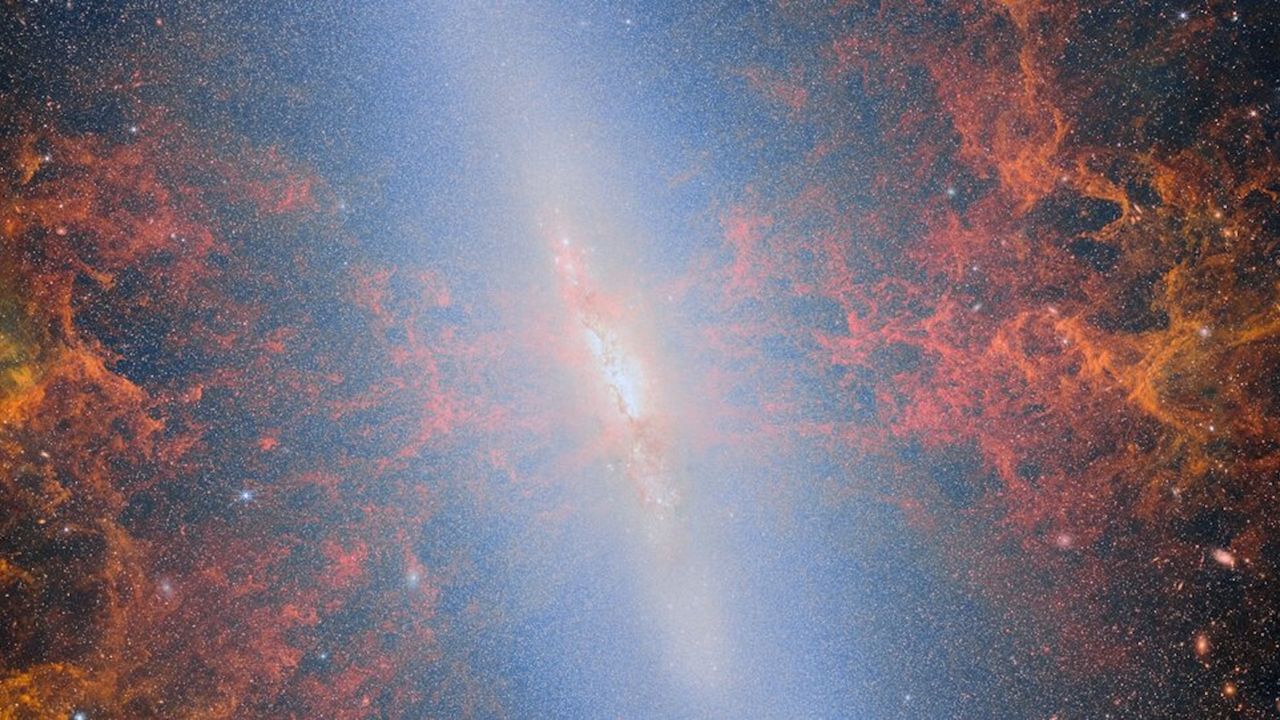
This image from the James Web Space Telescope (JWST) reveals a glowing core teeming with billions of stars. The shot is a follow-up to a close-up image published in 2024. Despite being a side-on view of M82, the photo shows its brilliant core exuding a blue-white glare, with red and orange dust clouds being pushed out above and below. The gas clouds contain cavities and ridges — details that are only possible to spot because of JWST’s Near-InfraRed Camera (NIRCam), which can see straight through them.

M82’s core is a busy place, containing more than 100 super star clusters, some still being born within dense gas clouds. Each super star cluster hosts hundreds of thousands of stars. The reason for M82’s burst of star formation is probably its neighbor, M81, whose gravity it has likely interacted with. As a result, gas from M81 has found its way into M82’s center, spurring an uptick in star formation despite the galaxy’s small size.


You may like

Scientists can also see the glow from plumes of organic molecules in this image. The broad plumes, which are 160 light-years across, are called polycyclic aromatic hydrocarbons (PAHs) and are being pushed away from the galactic disk by powerful outflowing winds produced by M82’s super star clusters.

For stargazers in the Northern Hemisphere, M81 and M82 are a spectacular sight in the northern sky during fall and winter. Both galaxies can be spotted as small, diffuse patches of light northwest of Dubhe — the bright star marking the lip of the Big Dipper’s bowl. Through a small backyard telescope, these two galaxies next door appear together in the same field of view.

For more sublime space images, check out our Space Photo of the Week archives.

Get the world’s most fascinating discoveries delivered straight to your inbox.

Source link

Share. Facebook Twitter Pinterest LinkedIn Tumblr Email
Previous ArticleNicole Scherzinger defends Christianity after Russell Brand controversy
Next Article No evidence mass stabbing on London-bound train was terror attack, police say
Editor
  • Website

Related Posts

Lifestyle

Global warming is accelerating 5,000 times faster than rice can evolve

May 19, 2026
Lifestyle

Scientists discover deadly, highly venomous box jellyfish near Singapore’s ‘Island of Death Behind’

May 19, 2026
Lifestyle

Poll: What do you think of PMOS, the new name for PCOS?

May 19, 2026
Add A Comment

Comments are closed.

Categories
  • Entertainment
  • Lifestyle
  • News
  • Sports
  • Tech
  • Travel
Recent Posts
  • Global warming is accelerating 5,000 times faster than rice can evolve
  • Scientists discover deadly, highly venomous box jellyfish near Singapore’s ‘Island of Death Behind’
  • Poll: What do you think of PMOS, the new name for PCOS?
  • Celestron Outland X 10×25 roof prism binocular review
  • Withings Body Scan review: Smart scale turned all-in-one health hub
calendar
May 2026
M T W T F S S
 123
45678910
11121314151617
18192021222324
25262728293031
« Apr    
Recent Posts
  • Global warming is accelerating 5,000 times faster than rice can evolve
  • Scientists discover deadly, highly venomous box jellyfish near Singapore’s ‘Island of Death Behind’
  • Poll: What do you think of PMOS, the new name for PCOS?
About

Welcome to Baynard Media, your trusted source for a diverse range of news and insights. We are committed to delivering timely, reliable, and thought-provoking content that keeps you informed
and inspired

Categories
  • Entertainment
  • Lifestyle
  • News
  • Sports
  • Tech
  • Travel
Facebook X (Twitter) Pinterest WhatsApp
  • Contact Us
  • About Us
  • Privacy Policy
  • Disclaimer
  • UNSUBSCRIBE
© 2026 copyrights reserved

Type above and press Enter to search. Press Esc to cancel.