Close Menu
  • Home
  • UNSUBSCRIBE
  • News
  • Lifestyle
  • Tech
  • Entertainment
  • Sports
  • Travel
Facebook X (Twitter) WhatsApp
Trending
  • New robotic heart mimics common, mysterious condition to help researchers study it
  • Canon EOS R6 III review: A wildlife wonder
  • Medieval babies and adults buried together in Sweden were not related, archaeologists discover — raising big questions about early Christian burial practices
  • NASA is creating a fifth state of matter on the ISS, thanks to an upgrade to a mini-fridge-sized quantum lab
  • New sodium metal battery design charges in just 4 minutes and retains its capacity for years
  • Quantum computing wielded to create extremely rare material critical to nuclear fusion
  • Scientists build tiny ‘diving suit’ for cockroaches, turning them into search-and-rescue cyborgs
  • Physicists develop the first working model of quantum mechanics using only ‘real’ numbers
Facebook X (Twitter) WhatsApp
Baynard Media
  • Home
  • UNSUBSCRIBE
  • News
  • Lifestyle
  • Tech
  • Entertainment
  • Sports
  • Travel
Baynard Media
Home»Lifestyle»James Webb telescope reveals that asteroids Bennu and Ryugu may be parts of the same gigantic space rock
Lifestyle

James Webb telescope reveals that asteroids Bennu and Ryugu may be parts of the same gigantic space rock

EditorBy EditorAugust 22, 2025No Comments4 Mins Read
Share Facebook Twitter Pinterest LinkedIn Tumblr Reddit Telegram Email
Share
Facebook Twitter LinkedIn Pinterest Email

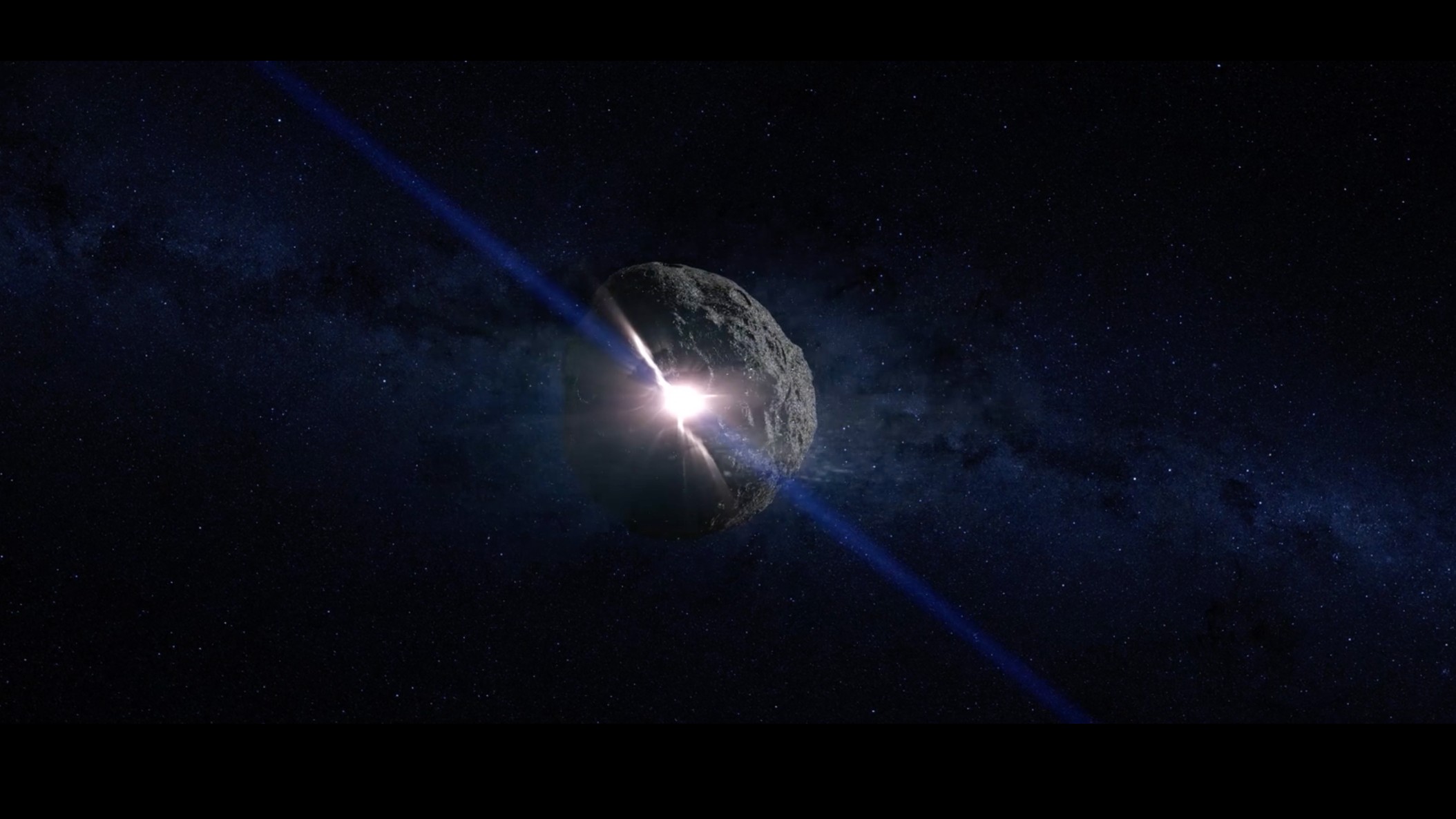
Two of the solar system’s most famous asteroids, Bennu and Ryugu, may be fragments of a single massive “parent” asteroid that was smashed to pieces billions of years ago, new data from the James Webb Space Telescope (JWST) reveals.

If true, the sibling space rocks — which have both recently been visited by spacecraft that successfully returned samples of them to Earth — could shed light on how asteroid families are created and dispersed throughout our cosmic neighborhood.

Bennu is a roughly 1,650-foot-wide (500 meters) asteroid recently visited by NASA’s OSIRIS-REx mission, which touched down on the space rock in 2022 and collected samples that were returned to Earth in September 2023, and have since yielded several promising discoveries. Ryugu, meanwhile, spans around 2,950 feet (900 m) and was visited by Japan’s Hayabusa2 probe in 2019, which delivered samples of the asteroid to our planet in December 2020.


You may like

Both space rocks are shaped like spinning tops and are considered “potentially hazardous asteroids” due to their size and relative proximity to Earth. Neither poses a perceivable threat to our planet for at least the next century — although NASA is keeping a close eye on Bennu, due to the slim chance it could collide with us in 2182.

There are several different ideas about where the two asteroids originate from, but one leading theory is that the pair belongs to the Polana asteroid family, which was created when a massive asteroid broke apart in the early solar system. The largest remaining chunk of this ancient asteroid is 142 Polana, a gigantic space rock spanning more than 34 miles (55 kilometers) wide that is located in the main asteroid belt between Mars and Jupiter.

In a new study, published Aug. 18 in The Planetary Science Journal, researchers compared spectroscopy data of 142 Polana, collected by JWST, with the samples of Bennu and Ryugu brought back to Earth. The researchers found that all three space rocks bear a striking resemblance to one another, suggesting they all originated from the same parent asteroid. However, it is still not 100% certain if this is the case.

Related: ‘City killer’ asteroid 2024 YR4 could shower Earth with ‘bullet-like’ meteors if it hits the moon in 2032

Get the world’s most fascinating discoveries delivered straight to your inbox.

OSIRIS-REx View of Bennu

A recent view of Bennu taken by NASA’s OSIRIS-REx spacecraft (Image credit: NASA/Goddard/University of Arizona)

“Very early in the formation of the solar system, we believe large asteroids collided and broke into pieces to form an ‘asteroid family’ with Polana as the largest remaining body,” study lead author Anicia Arredondo, a planetary scientist at Southwest Research Institute (SwRI) in Texas, said in a statement. The findings “suggest that remnants of that collision not only created Polana, but also Bennu and Ryugu as well,” she added.

All three asteroids share the same core composition of elements and minerals, such as carbon and magnetite, a rare form of iron oxide. However, there are some subtle differences in the concentrations of these substances between 142 Polana and the samples of Bennu and Ryugu, meaning a definite conclusion cannot be reached yet.

The study team believes that these discrepancies are likely caused by the asteroids’ respective outer surfaces, which have each been slightly altered since they broke apart.

“Bennu and Ryugu are now much closer to the sun than Polana, so their surfaces may be more affected by solar radiation and solar particles,” study co-author Tracy Becker, a SwRI planetary scientist, said in the statement. “Likewise, Polana is possibly older than Bennu and Ryugu and thus would have been exposed to micrometeoroid impacts for a longer period,” she added. “That could also change aspects of its surface, including its composition.”

Despite the differences, the researchers say that a shared parent asteroid is the best possible explanation for the space rocks’ origins.

“They are similar enough that we feel confident that all three asteroids could have come from the same parent body, ” Arredondo said.

Source link

Share. Facebook Twitter Pinterest LinkedIn Tumblr Email
Previous ArticleFox News Politics Newsletter: Newsom’s ‘Failures’ Under Fire
Next Article Reports of active shooter at Villanova a ‘cruel hoax’ 
Editor
  • Website

Related Posts

Lifestyle

New robotic heart mimics common, mysterious condition to help researchers study it

July 11, 2026
Lifestyle

Canon EOS R6 III review: A wildlife wonder

July 10, 2026
Lifestyle

Medieval babies and adults buried together in Sweden were not related, archaeologists discover — raising big questions about early Christian burial practices

July 10, 2026
Add A Comment

Comments are closed.

Categories
  • Entertainment
  • Lifestyle
  • News
  • Sports
  • Tech
  • Travel
Recent Posts
  • New robotic heart mimics common, mysterious condition to help researchers study it
  • Canon EOS R6 III review: A wildlife wonder
  • Medieval babies and adults buried together in Sweden were not related, archaeologists discover — raising big questions about early Christian burial practices
  • NASA is creating a fifth state of matter on the ISS, thanks to an upgrade to a mini-fridge-sized quantum lab
  • New sodium metal battery design charges in just 4 minutes and retains its capacity for years
calendar
July 2026
M T W T F S S
 12345
6789101112
13141516171819
20212223242526
2728293031  
« Jun    
Recent Posts
  • New robotic heart mimics common, mysterious condition to help researchers study it
  • Canon EOS R6 III review: A wildlife wonder
  • Medieval babies and adults buried together in Sweden were not related, archaeologists discover — raising big questions about early Christian burial practices
About

Welcome to Baynard Media, your trusted source for a diverse range of news and insights. We are committed to delivering timely, reliable, and thought-provoking content that keeps you informed
and inspired

Categories
  • Entertainment
  • Lifestyle
  • News
  • Sports
  • Tech
  • Travel
Facebook X (Twitter) Pinterest WhatsApp
  • Contact Us
  • About Us
  • Privacy Policy
  • Disclaimer
  • UNSUBSCRIBE
© 2026 copyrights reserved

Type above and press Enter to search. Press Esc to cancel.