Close Menu
  • Home
  • UNSUBSCRIBE
  • News
  • Lifestyle
  • Tech
  • Entertainment
  • Sports
  • Travel
Facebook X (Twitter) WhatsApp
Trending
  • Scientists are fast-tracking 3 Ebola vaccines in hopes of shortening the outbreak — when could they be ready?
  • 2 vanished ‘super Earths’ once orbited near Uranus and Neptune, new study hints
  • Ditch full of 7,000-year-old headless human skeletons discovered in Slovakia, baffling archaeologists
  • Manhattan Project physicist Richard Feynman’s forgotten notes on ‘the restaurant problem’ deciphered after 50 years
  • Doctors need to understand patients’ lived experiences to treat them well—but medical schools may stop requiring that training | Naa Asheley Ashitey
  • Italian teenagers discover 1,800-year-old Roman luxury house underneath their high school gym
  • Roman bath clog: The world’s oldest shower shoes were found at a fort along Hadrian’s Wall
  • Sea ice loss in the Arctic has triggered a critical tipping point that’s destroying the food chain
Facebook X (Twitter) WhatsApp
Baynard Media
  • Home
  • UNSUBSCRIBE
  • News
  • Lifestyle
  • Tech
  • Entertainment
  • Sports
  • Travel
Baynard Media
Home»Lifestyle»James Webb telescope makes first 3D map of an alien planet’s atmosphere — and finds water being ripped apart
Lifestyle

James Webb telescope makes first 3D map of an alien planet’s atmosphere — and finds water being ripped apart

EditorBy EditorNovember 5, 2025No Comments3 Mins Read
Share Facebook Twitter Pinterest LinkedIn Tumblr Reddit Telegram Email
Share
Facebook Twitter LinkedIn Pinterest Email

Scientists have created a three dimensional map of a distant planet’s atmosphere for the first time.

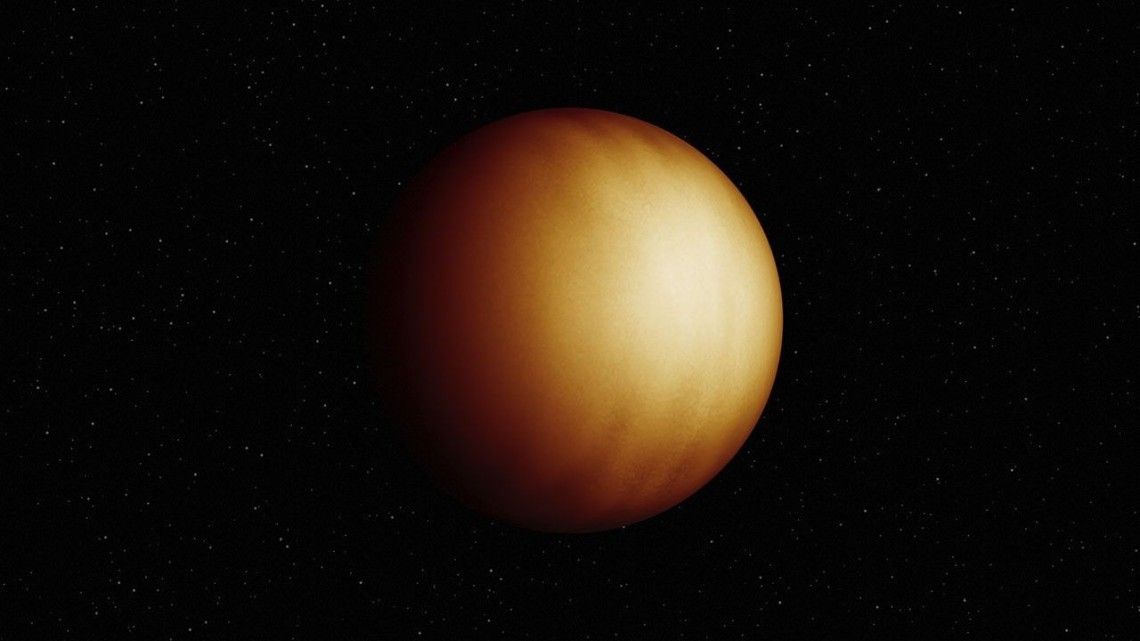
Using data from the James Webb Space Telescope (JWST) and a technique known as eclipse mapping, researchers found different temperature zones in the atmosphere of the exoplanet WASP-18b, a gas giant located about 400 light-years from Earth. The same process could soon help scientists map temperature variations and cloud structures on other faraway planets, according to a study published Oct. 28 in the journal Nature Astronomy.

“Eclipse mapping allows us to image exoplanets that we can’t see directly, because their host stars are too bright,” study co-author Ryan Challener, a researcher studying exoplanets at Cornell University, said in a statement. “With this telescope and this new technique, we can start to understand exoplanets along the same lines as our solar system neighbors.”


You may like

WASP-18b has about 10 times the mass of Jupiter, and its year is just 23 hours long. It’s tidally locked to its star, which means one side of the planet constantly faces the star, while the other side is always dark.

As a planet starts to pass behind its star, the star blocks more and more of the light that the planet reflects, until the planet is fully obscured when viewed from our solar system. Eclipse mapping takes advantage of this progressive change. By measuring how the light from a planet changes as it’s obscured and revealed, scientists can work out the temperature in different regions and altitudes of the planet’s atmosphere.

“You’re looking for changes in tiny portions of the planet as they disappear and reappear into view, so it’s extraordinarily challenging,” Challener said.

In the new study, the scientists built on a previous two-dimensional temperature map of WASP-18b by using different wavelengths of light to create a more detailed, 3D map of the atmosphere. For example, they used data of a wavelength that is absorbed by water to map the exoplanet’s wet upper atmosphere. Wavelengths that water didn’t absorb passed through to lower altitudes, allowing JWST to preferentially look at different levels of the planet’s atmosphere based on the wavelengths it was studying.

Get the world’s most fascinating discoveries delivered straight to your inbox.

A series of light wavelength observations for WASP-18B

By stacking multiple JWST observations of different wavelengths of light, the study authors were able to make a 3D model of WASP-18b’s atmosphere at different depths. (Image credit: Challener et al. / Nature Astronomy)

WASP-18b has two distinct temperature regions on its day side, the team found. It has a circular “hotspot” in the area that directly faces the star and receives the most sunlight. Beyond that is a colder ring that extends to the visible edge of the planet. This suggests that atmospheric winds can’t fully redistribute the heat from the star across the planet.

The scientists also observed less water in the hotspot than the planet’s average. This could mean that temperatures in the hotspot are high enough to rip apart water molecules in the atmosphere, the researchers suggested.

“We think that’s evidence that the planet is so hot in this region that it’s starting to break down the water,” Challener said. “That had been predicted by theory, but it’s really exciting to actually see this with real observations.”

Additional measurements with JWST could boost the resolution of WASP-18b’s atmospheric map and enable scientists to study the atmospheres of other gas giants like it.

“This new technique is going to be applicable to many, many other planets that we can observe with the James Webb Space Telescope,” Challener said. “We can start to understand exoplanets in 3D as a population, which is very exciting.”

Source link

Share. Facebook Twitter Pinterest LinkedIn Tumblr Email
Previous ArticleEx-Knick Charles Oakley owes MSG $642,000 in attorney fees, judge rules
Next Article Philadelphia restaurants hit with fake one-star reviews
Editor
  • Website

Related Posts

Lifestyle

Scientists are fast-tracking 3 Ebola vaccines in hopes of shortening the outbreak — when could they be ready?

June 9, 2026
Lifestyle

2 vanished ‘super Earths’ once orbited near Uranus and Neptune, new study hints

June 9, 2026
Lifestyle

Ditch full of 7,000-year-old headless human skeletons discovered in Slovakia, baffling archaeologists

June 9, 2026
Add A Comment

Comments are closed.

Categories
  • Entertainment
  • Lifestyle
  • News
  • Sports
  • Tech
  • Travel
Recent Posts
  • Scientists are fast-tracking 3 Ebola vaccines in hopes of shortening the outbreak — when could they be ready?
  • 2 vanished ‘super Earths’ once orbited near Uranus and Neptune, new study hints
  • Ditch full of 7,000-year-old headless human skeletons discovered in Slovakia, baffling archaeologists
  • Manhattan Project physicist Richard Feynman’s forgotten notes on ‘the restaurant problem’ deciphered after 50 years
  • Doctors need to understand patients’ lived experiences to treat them well—but medical schools may stop requiring that training | Naa Asheley Ashitey
calendar
June 2026
M T W T F S S
1234567
891011121314
15161718192021
22232425262728
2930  
« May    
Recent Posts
  • Scientists are fast-tracking 3 Ebola vaccines in hopes of shortening the outbreak — when could they be ready?
  • 2 vanished ‘super Earths’ once orbited near Uranus and Neptune, new study hints
  • Ditch full of 7,000-year-old headless human skeletons discovered in Slovakia, baffling archaeologists
About

Welcome to Baynard Media, your trusted source for a diverse range of news and insights. We are committed to delivering timely, reliable, and thought-provoking content that keeps you informed
and inspired

Categories
  • Entertainment
  • Lifestyle
  • News
  • Sports
  • Tech
  • Travel
Facebook X (Twitter) Pinterest WhatsApp
  • Contact Us
  • About Us
  • Privacy Policy
  • Disclaimer
  • UNSUBSCRIBE
© 2026 copyrights reserved

Type above and press Enter to search. Press Esc to cancel.