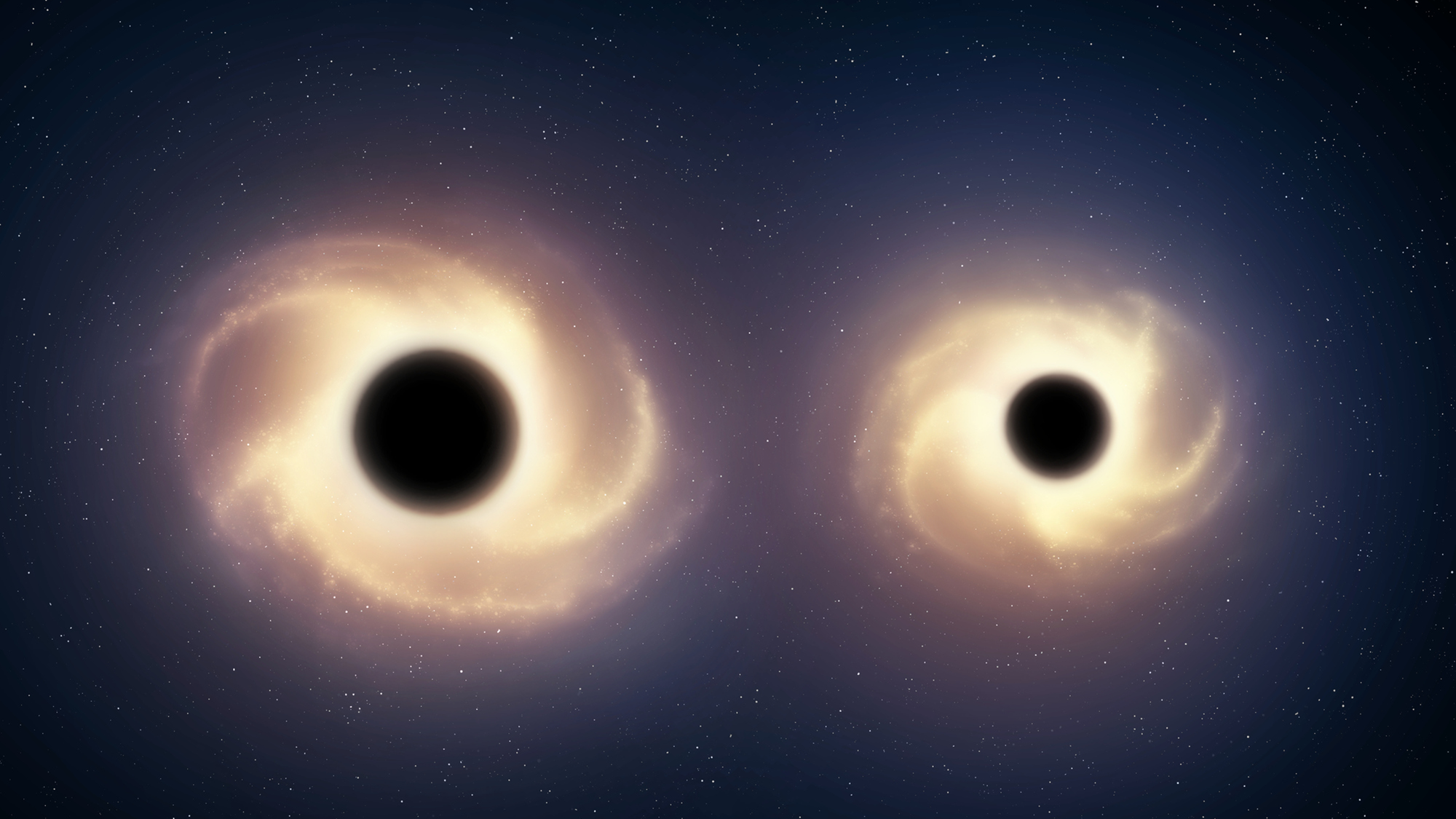
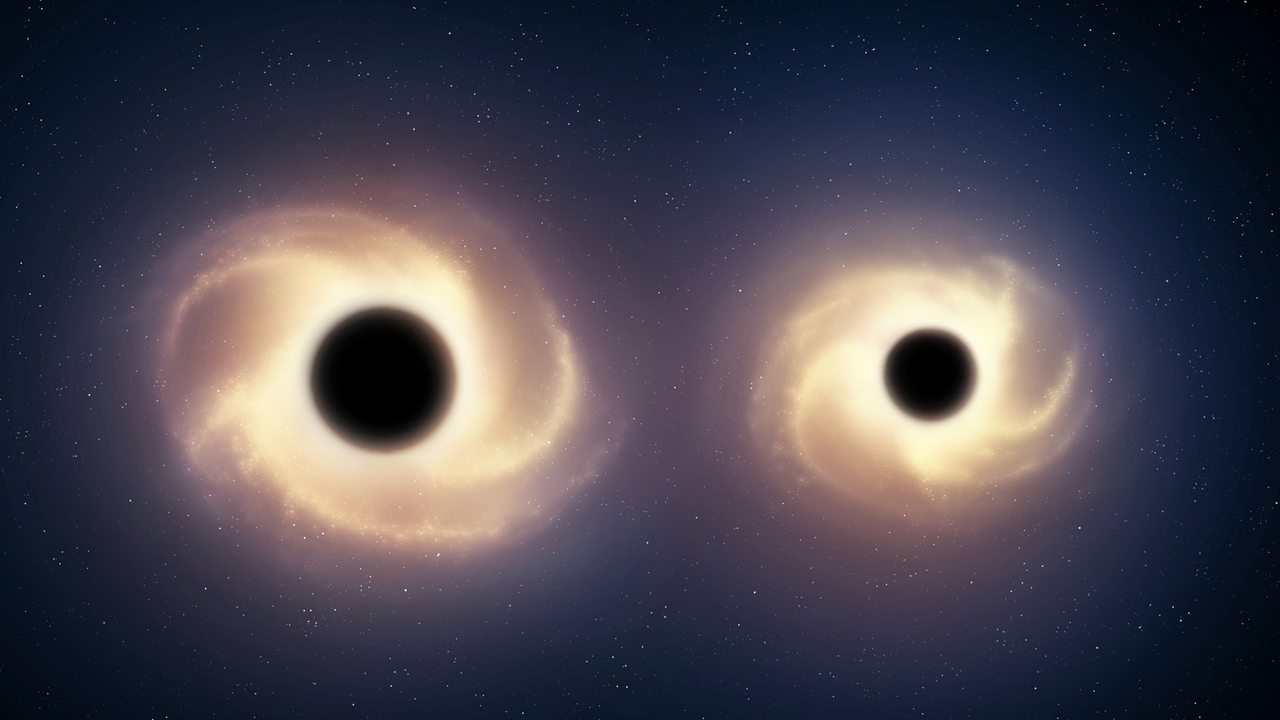
Astronomers have discovered a close pair of actively feeding supermassive black holes, seen when the universe was just 1.3 billion years old. Collectively known as LID-1166, the two monsters are separated by only about 4,900 light-years (1.5 kiloparsecs) inside a merging galaxy, offering the first clear view of a phase that’s critical for understanding the growth of supermassive black holes.
Most large galaxies we can see formed over billions of years by merging with other galaxies. Most galaxies also have central black holes, so a merger between them would produce a system with two black holes. These “dual black hole” systems are thought to be common in the early universe. However, given that they’re buried in dense gas and dust, these black holes are too close to be observed separately.
In a new study uploaded to the arXiv preprint server July 21, Hyewon Suh, an astronomer at the International Gemini Observatory/NSF NOIRLab, and colleagues reported the discovery of the closest-together dual black hole system ever confirmed this early in the universe’s history. The team used the James Webb Space Telescope (JWST) and the Atacama Large Millimeter/submillimeter Array (ALMA), a collection of radio telescopes in Chile, to study this system. The paper has been accepted for publication in the journal Nature Astronomy.
Latest Videos FromLive Science
“What makes that discovery special is that we may be seeing these two black holes growing and interacting in a system that is only about 1.3 billion years after the Big Bang,” Anna Trindade Falcão, an astrophysicist at NASA’s Goddard Space Flight Center who was not involved in the study, told Live Science.
To understand what was producing these strong emissions, the team turned to JWST’s Near-Infrared Spectograph (NIRSpec) instrument, which revealed two compact, glowing sources sitting 4,900 light years apart. Although astronomers have spotted other dual black hole candidates even earlier in the history of the cosmos, those pairs were separated by tens of thousands of light-years or more. LID-1166 is the first confirmed case of two black holes existing this close together.
“This step of the discovery could happen only thanks to the exquisite imaging and spectroscopic capabilities of the JWST, and in particular its instrument NIRSpec,” study co-author Roberto Decarli, an astronomer at the Italian National Institute for Astrophysics in Bologna, told Live Science in an email. “Similar observations from the ground would be extremely challenging due to the poor transparency of the atmosphere at these wavelengths.”
Get the world’s most fascinating discoveries delivered straight to your inbox.
“Meaningful evidence”
Both objects showed spectral signatures of gas swirling at high speeds indicative of actively feeding black holes, also known as active galactic nuclei, powering the merging system. Trindade Falcão said the researchers tested several methods for subtracting the main galaxy’s light, and the signal at the second object’s position stayed there every time, which is “meaningful evidence” that the signal is real
Even so, she says it would be worth double-checking, with a more detailed follow-up analysis, that the data truly shows two separate black holes — rather than one black hole plus some leftover glow being mistaken for a second one.
This step of the discovery could happen only thanks to the exquisite imaging and spectroscopic capabilities of the JWST, and in particular its instrument NIRSpec.
Roberto Decarli, astronomer at the Italian National Institute for Astrophysics in Bologna
Using ALMA data, the team also detected a large pool of cold gas associated with each AGN, which Decarli said “points to the two AGN residing in the center of two galaxies on the verge of merging.”
The presence of the galactic environment around each black hole helped the team rule out other exotic scenarios of how this system formed. For example, if one of the black holes were kicked out of its home galaxy in the process of merging, or flung out through a chaotic three-way gravitational interaction, the black hole would be moving fast, without any gas around it. It would show up as a “naked” black hole stripped of its surroundings. But that’s not what the observations showed.
Monstrous growth
This discovery could also help astronomers understand one of the biggest puzzles in astronomy: how some supermassive black holes grew so quickly in the early universe. Models that explain this rapid growth rely on the same idea that gas rushes in from around the galaxy and gets funneled down to the center, feeding the black hole, Decarli explained.
“Cannibalizing other galaxies is part of this process,” he said. “But what if these galaxies also host a massive black hole at their center?” Studying systems like LID-1166 “will help us shed light on how the growth of these galaxies and black holes will take place,” he added.
The basic idea that early galaxies merge and drag their black holes together isn’t surprising on its own, as it’s something theory has predicted for years, Trindade Falcão noted. “What is striking here is resolving this process in an obscured pair that is only 1.5 kiloparsecs apart,” she said, and this is the first step toward uncovering a hidden population of black holes that, in theory, we know should exist.
See how much you know about black holes with our black hole quiz!