Close Menu
  • Home
  • UNSUBSCRIBE
  • News
  • Lifestyle
  • Tech
  • Entertainment
  • Sports
  • Travel
Facebook X (Twitter) WhatsApp
Trending
  • New blood test aims to spot liver scarring when it’s still reversible and before it paves the way to cancer
  • ‘We’re the best servants anyone could dream of!’: AI superintelligence has no need to enslave humans because we’re already bowing to it
  • Glowing ring of plankton surrounding New Zealand islands linked to deadly underwater plateau — Earth from space
  • Omar files new financial form in response to Trump, GOP critics
  • New study confirms lobsters feel pain, driving scientists to call for a ban on boiling them alive
  • Ex-CENTCOM commanderwarns against ‘risky’ US ground op to seize Iran uranium
  • Santa Ana’s Upcoming Report on Police Firing on ICE Protesters Lacks Details
  • Stephen Hawking’s black hole information paradox could be solved — if the universe has 7 dimensions
Facebook X (Twitter) WhatsApp
Baynard Media
  • Home
  • UNSUBSCRIBE
  • News
  • Lifestyle
  • Tech
  • Entertainment
  • Sports
  • Travel
Baynard Media
Home»Lifestyle»James Webb telescope captures auroras on Neptune for first time ever
Lifestyle

James Webb telescope captures auroras on Neptune for first time ever

EditorBy EditorMarch 27, 2025No Comments3 Mins Read
Share Facebook Twitter Pinterest LinkedIn Tumblr Reddit Telegram Email
Share
Facebook Twitter LinkedIn Pinterest Email

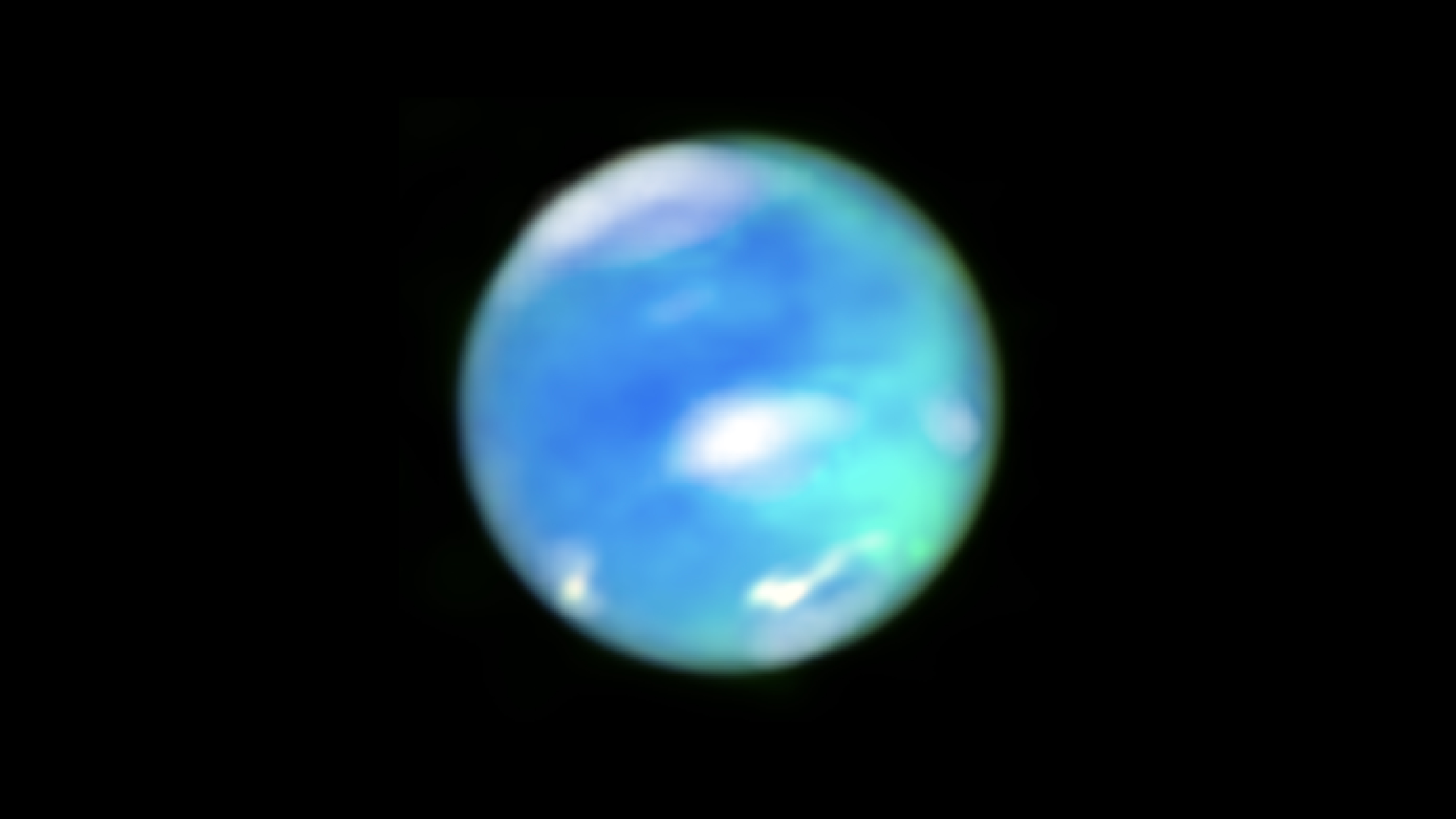
New James Webb Space Telescope (JWST) images have captured auroras on Neptune for the first time.

The telescope spotted infrared auroras that create exotic molecules known as trihydrogen cations, according to a study published March 26 in Nature. Scientists identified auroras on Jupiter, Saturn, and Uranus more than 30 years ago, but Neptune’s auroras staunchly evaded detection until now.

Auroras form when energetic, charged particles from the sun get caught up in a planet’s magnetic field. The field funnels the particles toward the planet’s magnetic poles, where they collide with — and ionize — atmospheric molecules along the way, causing them to glow.

Unlike auroras on Earth, which occur at extreme northern and southern latitudes near our planet’s North and South Pole, Neptune’s auroras appear near the planet’s mid-latitudes. That’s because Neptune’s magnetic field is tilted 47 degrees off its rotational axis, so the planet’s magnetic poles lie between the geographic poles and the equator — around where South America would be located on Earth.

And unlike the Northern Lights, Neptune’s auroras aren’t visible to the naked eye.

“Turns out, actually imaging the auroral activity on Neptune was only possible with Webb’s near-infrared sensitivity,” Henrik Melin, a planetary scientist at Northumbria University in the U.K., said in a statement. “It was so stunning to not just see the auroras, but the detail and clarity of the signature really shocked me.”

Finishing Voyager’s work

In June 2023, researchers used JWST’s Near-Infrared Spectrograph to look for the trihydrogen cation (H3+), a hallmark of auroral activity in the hydrogen-rich atmospheres of the solar system’s gas giants. NASA’s Voyager 2 probe flew by Neptune in 1989, but it didn’t have the right equipment to detect the cation. Since then, scientists at ground-based facilities, such as Hawaii’s Keck telescope and NASA Infrared Telescope Facility, have looked for this molecule in Neptune’s atmosphere without success, despite predictions that it should be present.

Get the world’s most fascinating discoveries delivered straight to your inbox.

Related: ‘Hidden’ rings of Uranus revealed in dazzling new James Webb telescope images

This time, JWST detected H3+, but researchers also noted unexpected changes in Neptune’s atmosphere. “I was astonished — Neptune’s upper atmosphere has cooled by several hundreds of degrees [since the Voyager flyby],” Melin said in the statement. “In fact, the temperature in 2023 was just over half of that in 1989.”

These cold temperatures could be why scientists haven’t detected H3+ on Neptune until now. The auroras appear much fainter at cold temperatures, and light reflecting off Neptune’s clouds may have drowned them out, the researchers said.

“As we look ahead and dream of future missions to Uranus and Neptune, we now know how important it will be to have instruments tuned to the wavelengths of infrared light to continue to study the auroras,” study coauthor Leigh Fletcher, a planetary scientist at Leicester University in the U.K., said in the statement. “This observatory has finally opened the window onto this last, previously hidden ionosphere of the giant planets.”

Source link

Share. Facebook Twitter Pinterest LinkedIn Tumblr Email
Previous ArticleOil executives bluntly criticize Trump tariffs and ‘drill, baby, drill’ in anonymous survey
Next Article At Columbia University, Trump’s crackdown chills a fervent campus
Editor
  • Website

Related Posts

Lifestyle

New blood test aims to spot liver scarring when it’s still reversible and before it paves the way to cancer

April 21, 2026
Lifestyle

‘We’re the best servants anyone could dream of!’: AI superintelligence has no need to enslave humans because we’re already bowing to it

April 21, 2026
Lifestyle

Glowing ring of plankton surrounding New Zealand islands linked to deadly underwater plateau — Earth from space

April 21, 2026
Add A Comment

Comments are closed.

Categories
  • Entertainment
  • Lifestyle
  • News
  • Sports
  • Tech
  • Travel
Recent Posts
  • New blood test aims to spot liver scarring when it’s still reversible and before it paves the way to cancer
  • ‘We’re the best servants anyone could dream of!’: AI superintelligence has no need to enslave humans because we’re already bowing to it
  • Glowing ring of plankton surrounding New Zealand islands linked to deadly underwater plateau — Earth from space
  • Omar files new financial form in response to Trump, GOP critics
  • New study confirms lobsters feel pain, driving scientists to call for a ban on boiling them alive
calendar
April 2026
M T W T F S S
 12345
6789101112
13141516171819
20212223242526
27282930  
« Mar    
Recent Posts
  • New blood test aims to spot liver scarring when it’s still reversible and before it paves the way to cancer
  • ‘We’re the best servants anyone could dream of!’: AI superintelligence has no need to enslave humans because we’re already bowing to it
  • Glowing ring of plankton surrounding New Zealand islands linked to deadly underwater plateau — Earth from space
About

Welcome to Baynard Media, your trusted source for a diverse range of news and insights. We are committed to delivering timely, reliable, and thought-provoking content that keeps you informed
and inspired

Categories
  • Entertainment
  • Lifestyle
  • News
  • Sports
  • Tech
  • Travel
Facebook X (Twitter) Pinterest WhatsApp
  • Contact Us
  • About Us
  • Privacy Policy
  • Disclaimer
  • UNSUBSCRIBE
© 2026 copyrights reserved

Type above and press Enter to search. Press Esc to cancel.