Close Menu
  • Home
  • UNSUBSCRIBE
  • News
  • Lifestyle
  • Tech
  • Entertainment
  • Sports
  • Travel
Facebook X (Twitter) WhatsApp
Trending
  • Deadly Ebola outbreak is a public health emergency of international concern, WHO declares
  • 1,200-year-old giant ‘death jar’ in Laos contains generations of human skeletons
  • Doctor’s kit found on Mount Vesuvius victim in Pompeii
  • 950-year-old burial of a pet dingo is first clear archaeological evidence of humans ritually ‘feeding’ a grave anywhere in the world
  • Daunian kyathos: A 2,700-year-old ceramic cup from Italy decorated with an exuberant-looking, bug-eyed fellow
  • ‘Truly significant’: James Webb telescope reveals largest-ever map of the universe’s hidden megastructures
  • Webb and Hubble sink deep into the dazzling Whirlpool Galaxy — Space photo of the week
  • ‘Last titan’ of Thailand discovered, and it’s the longest-necked dinosaur on record from Southeast Asia
Facebook X (Twitter) WhatsApp
Baynard Media
  • Home
  • UNSUBSCRIBE
  • News
  • Lifestyle
  • Tech
  • Entertainment
  • Sports
  • Travel
Baynard Media
Home»Lifestyle»James Webb Space Telescope uncovers 300 mysteriously luminous objects. Are they galaxies or something else?
Lifestyle

James Webb Space Telescope uncovers 300 mysteriously luminous objects. Are they galaxies or something else?

EditorBy EditorAugust 25, 2025No Comments2 Mins Read
Share Facebook Twitter Pinterest LinkedIn Tumblr Reddit Telegram Email
Share
Facebook Twitter LinkedIn Pinterest Email

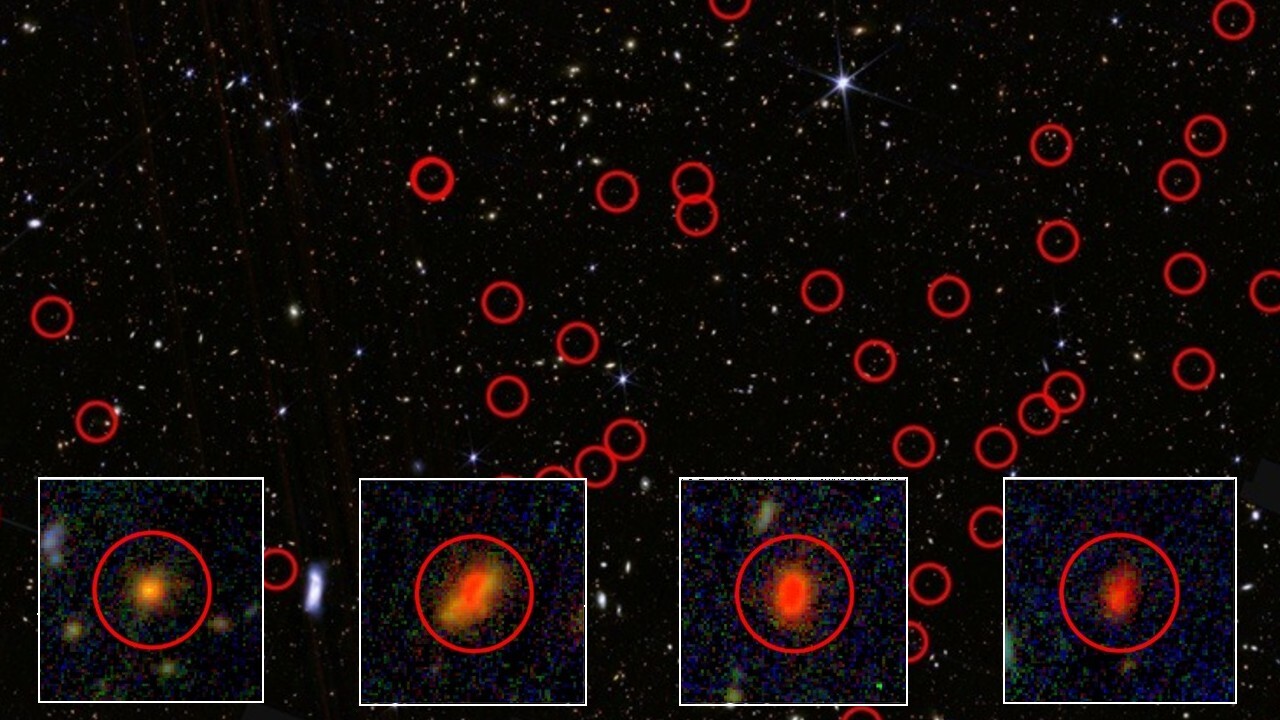
Hundreds of unexpectedly energetic objects have been discovered throughout the distant universe, possibly hinting that the cosmos was far more active during its infancy than astronomers once believed.

Using deep-field images from NASA’s James Webb Space Telescope (JWST), researchers at the University of Missouri identified 300 unusually bright objects in the early universe. While they could be galaxies, astronomers aren’t yet sure what they are for certain. Galaxies forming so soon after the Big Bang should be faint, limited by the pace at which they could form stars. Yet these candidates shine far brighter than current models of early galaxy formation predict.

“If even a few of these objects turn out to be what we think they are, our discovery could challenge current ideas about how galaxies formed in the early universe — the period when the first stars and galaxies began to take shape,” Haojing Yan, co-author of the study, said in a statement from the university.


You may like

To discover these objects, the team applied a method called the “dropout” technique, which detects objects that appear in redder wavelengths but vanish in bluer, shorter-wavelength images. This indicates the objects are extremely distant, showing the universe as it was more than 13 billion years ago.

To estimate distances, the team analyzed the objects’ brightnesses across multiple wavelengths to infer redshift, age and mass. JWST’s powerful Near-Infrared Camera and Mid-Infrared Instrument are designed to detect light from the farthest reaches of space, making them ideal for studying the early universe.

“As the light from these early galaxies travels through space, it stretches into longer wavelengths — shifting from visible light into infrared,” Yan said in the statement. “This stretching, called redshift, helps us determine how far away these galaxies are. The higher the redshift, the closer the galaxy is to the beginning of the universe.”

Next, the researchers hope to use targeted spectroscopic observations, focusing on the brightest sources. Confirming the newly found objects as genuine early galaxies would refine our current understanding of how quickly the first cosmic structures formed and evolved — and add to the growing list of transformative discoveries made by the JWST since it began observing the cosmos in 2022.

Get the world’s most fascinating discoveries delivered straight to your inbox.

The findings were published June 27 in The Astrophysical Journal.

Source link

Share. Facebook Twitter Pinterest LinkedIn Tumblr Email
Previous ArticleGrassley defies Trump demand to scrap Senate ‘blue slips’ for judicial picks
Next Article U.S. could take stakes in more companies, Trump adviser says
Editor
  • Website

Related Posts

Lifestyle

Deadly Ebola outbreak is a public health emergency of international concern, WHO declares

May 19, 2026
Lifestyle

1,200-year-old giant ‘death jar’ in Laos contains generations of human skeletons

May 19, 2026
Lifestyle

Doctor’s kit found on Mount Vesuvius victim in Pompeii

May 18, 2026
Add A Comment

Comments are closed.

Categories
  • Entertainment
  • Lifestyle
  • News
  • Sports
  • Tech
  • Travel
Recent Posts
  • Deadly Ebola outbreak is a public health emergency of international concern, WHO declares
  • 1,200-year-old giant ‘death jar’ in Laos contains generations of human skeletons
  • Doctor’s kit found on Mount Vesuvius victim in Pompeii
  • 950-year-old burial of a pet dingo is first clear archaeological evidence of humans ritually ‘feeding’ a grave anywhere in the world
  • Daunian kyathos: A 2,700-year-old ceramic cup from Italy decorated with an exuberant-looking, bug-eyed fellow
calendar
May 2026
M T W T F S S
 123
45678910
11121314151617
18192021222324
25262728293031
« Apr    
Recent Posts
  • Deadly Ebola outbreak is a public health emergency of international concern, WHO declares
  • 1,200-year-old giant ‘death jar’ in Laos contains generations of human skeletons
  • Doctor’s kit found on Mount Vesuvius victim in Pompeii
About

Welcome to Baynard Media, your trusted source for a diverse range of news and insights. We are committed to delivering timely, reliable, and thought-provoking content that keeps you informed
and inspired

Categories
  • Entertainment
  • Lifestyle
  • News
  • Sports
  • Tech
  • Travel
Facebook X (Twitter) Pinterest WhatsApp
  • Contact Us
  • About Us
  • Privacy Policy
  • Disclaimer
  • UNSUBSCRIBE
© 2026 copyrights reserved

Type above and press Enter to search. Press Esc to cancel.