Close Menu
  • Home
  • UNSUBSCRIBE
  • News
  • Lifestyle
  • Tech
  • Entertainment
  • Sports
  • Travel
Facebook X (Twitter) WhatsApp
Trending
  • Very low and very high heart rates linked to increased risk of stroke in huge study
  • Icy object beyond Pluto has an atmosphere that shouldn’t exist, study suggests
  • Researcher discovers shortcut to Mars that could cut travel time in half — if we build the right spacecraft
  • Canadian ’emoji’ lake vanishes after dramatic, landslide-like collapse — Earth from space
  • The universe may end trillions of years sooner than we thought
  • ‘They weren’t burned by accident’: Mysterious green rocks discovered high in Pyrenees reveal ancient copper-smelting camp
  • Full moon helps paint vibrant, muddy ‘brushstrokes’ in Indonesian river — Earth from space
  • Estrogen in both the male and female brain shapes responses to trauma, study suggests
Facebook X (Twitter) WhatsApp
Baynard Media
  • Home
  • UNSUBSCRIBE
  • News
  • Lifestyle
  • Tech
  • Entertainment
  • Sports
  • Travel
Baynard Media
Home»Lifestyle»James Webb Space Telescope reveals thick cosmic dust of Sagittarius B2, the most most enormous star-forming cloud in the Milky Way — Space photo of the week
Lifestyle

James Webb Space Telescope reveals thick cosmic dust of Sagittarius B2, the most most enormous star-forming cloud in the Milky Way — Space photo of the week

EditorBy EditorSeptember 28, 2025No Comments3 Mins Read
Share Facebook Twitter Pinterest LinkedIn Tumblr Reddit Telegram Email
Share
Facebook Twitter LinkedIn Pinterest Email

Quick facts

What it is: Sagittarius B2 (Sgr B2) molecular cloud

Where it is: 25,000 light-years from Earth in the constellation Sagittarius

When it was shared: Sept. 24, 2025

Why it’s so special: Stars in the Milky Way galaxy are born in huge molecular clouds. The most massive is Sagittarius B2, which is just a few hundred light-years from our the galaxy’s central black hole (called Sagittarius A*). This black hole is much more bountiful than you might first think — it has 10% of the galactic center’s gas, but accounts for about half of the region’s ongoing star formation. Why star formation is so disproportionate within the galactic center region is a conundrum for scientists.

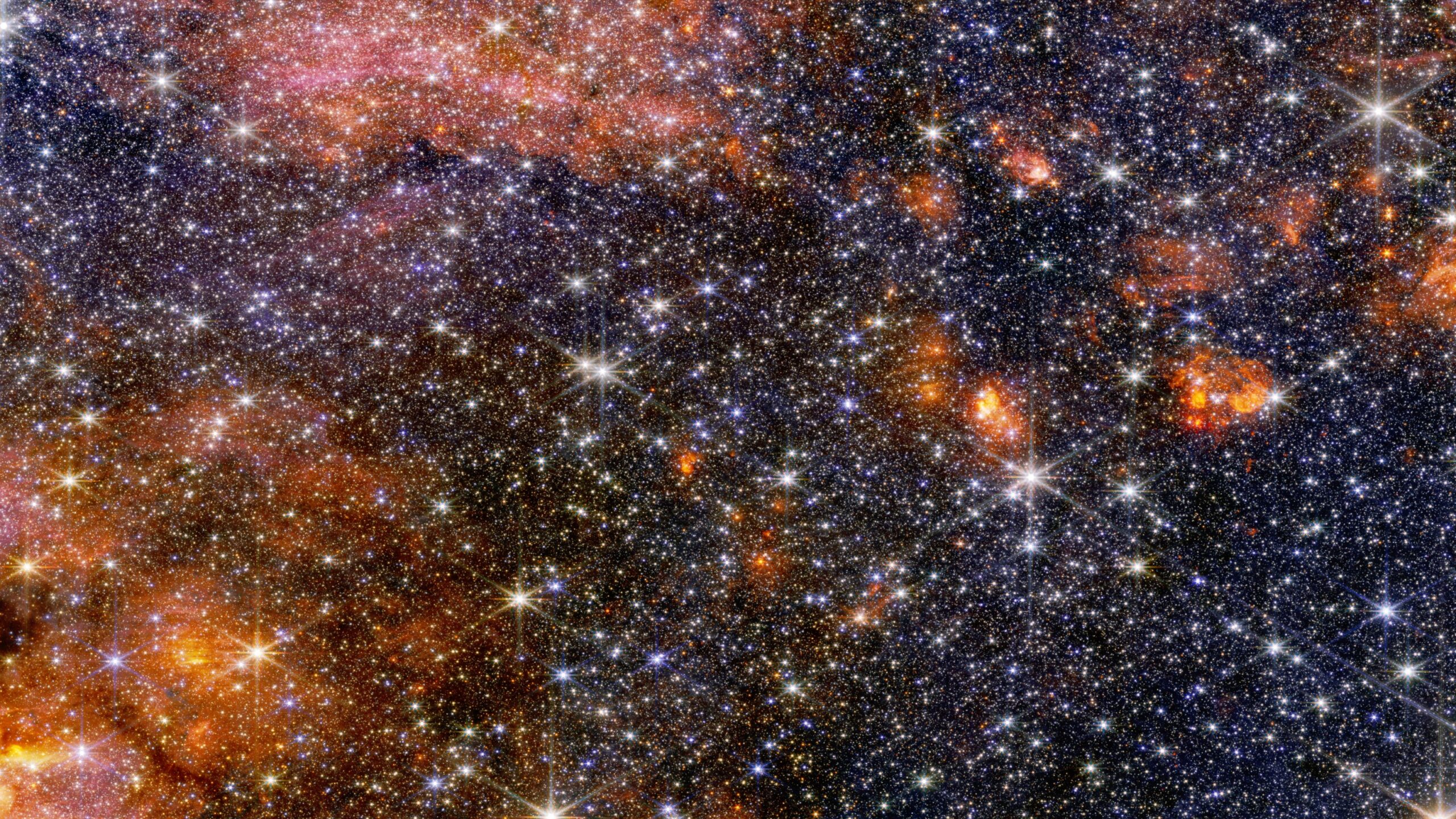
Cue the James Webb Space Telescope (JWST), which recently observed Sagittarius B2 in two wavelengths of light to help astronomers find out why. This breathtaking new image (above) of the molecular cloud comes from the JWST’s Near-Infrared Camera (NIRCam). In it, we see stars shine brightly between orange clouds of gas and dust shining in near-infrared light.

However, even within the infrared spectrum, the difference in what can be seen is considerable, as proven by another image of the cloud by the JWST’s Mid-Infrared Instrument (MIRI).


You may like

A stunning starscape captured by the James Webb Space Telescope

JWST’s full-size image of the Sagittarius B2 star-forming cloud (Image credit: NASA, ESA, CSA, STScI, Adam Ginsburg (University of Florida), Nazar Budaiev (University of Florida), Taehwa Yoo (University of Florida); Image Processing: Alyssa Pagan (STScI))

The MIRI image is entirely different, revealing the region’s dust clouds illuminated by its stars. It shows pink and purple clouds surrounded by very dark regions studded with stars. The JWST cannot see everything:. Even its infrared vision can’t penetrate the densest clouds, which remain dark and opaque in the MIRI image. Within those regions, hidden from view, are the raw ingredients for stars.

A pink, purple and splotchy picture of clouds in outer space

Webb’s MIRI (Mid-Infrared Instrument) shows the Sagittarius B2 (Sgr B2) region in mid-infrared light, with warm dust glowing brightly. (Image credit: NASA, ESA, CSA, STScI, A. Ginsburg (University of Florida), N. Budaiev (University of Florida), T. Yoo (University of Florida). Image processing: A. Pagan (STScI))

Why Sagittarius B2 is so much more productive than the rest of the galactic center remains puzzling, but there are clues. On the right-hand side of the MIRI image is a very bright, red region known to be rich in molecular material. It could hold the key to why the cloud outpaces the star production of the entire galactic center, potentially reshaping theories of how galaxies grow and evolve. Scientists plan to use Webb’s new data on Sagittarius B2 to figure out how long it has been forming stars and whether a specific event triggered its prolific activity.

For more sublime space images, check out our Space Photo of the Week archives.

Get the world’s most fascinating discoveries delivered straight to your inbox.

Source link

Share. Facebook Twitter Pinterest LinkedIn Tumblr Email
Previous ArticlePrince Philip’s swearing habits revealed by King Charles’ former butler
Next Article Mexican Navy ship reopens after Brooklyn Bridge accident
Editor
  • Website

Related Posts

Lifestyle

Very low and very high heart rates linked to increased risk of stroke in huge study

May 6, 2026
Lifestyle

Icy object beyond Pluto has an atmosphere that shouldn’t exist, study suggests

May 5, 2026
Lifestyle

Researcher discovers shortcut to Mars that could cut travel time in half — if we build the right spacecraft

May 5, 2026
Add A Comment

Comments are closed.

Categories
  • Entertainment
  • Lifestyle
  • News
  • Sports
  • Tech
  • Travel
Recent Posts
  • Very low and very high heart rates linked to increased risk of stroke in huge study
  • Icy object beyond Pluto has an atmosphere that shouldn’t exist, study suggests
  • Researcher discovers shortcut to Mars that could cut travel time in half — if we build the right spacecraft
  • Canadian ’emoji’ lake vanishes after dramatic, landslide-like collapse — Earth from space
  • The universe may end trillions of years sooner than we thought
calendar
May 2026
M T W T F S S
 123
45678910
11121314151617
18192021222324
25262728293031
« Apr    
Recent Posts
  • Very low and very high heart rates linked to increased risk of stroke in huge study
  • Icy object beyond Pluto has an atmosphere that shouldn’t exist, study suggests
  • Researcher discovers shortcut to Mars that could cut travel time in half — if we build the right spacecraft
About

Welcome to Baynard Media, your trusted source for a diverse range of news and insights. We are committed to delivering timely, reliable, and thought-provoking content that keeps you informed
and inspired

Categories
  • Entertainment
  • Lifestyle
  • News
  • Sports
  • Tech
  • Travel
Facebook X (Twitter) Pinterest WhatsApp
  • Contact Us
  • About Us
  • Privacy Policy
  • Disclaimer
  • UNSUBSCRIBE
© 2026 copyrights reserved

Type above and press Enter to search. Press Esc to cancel.